 AnatomyCompass
Supraspinatus
M. supraspinatus · Horse · Muscular system · Thoracic limb
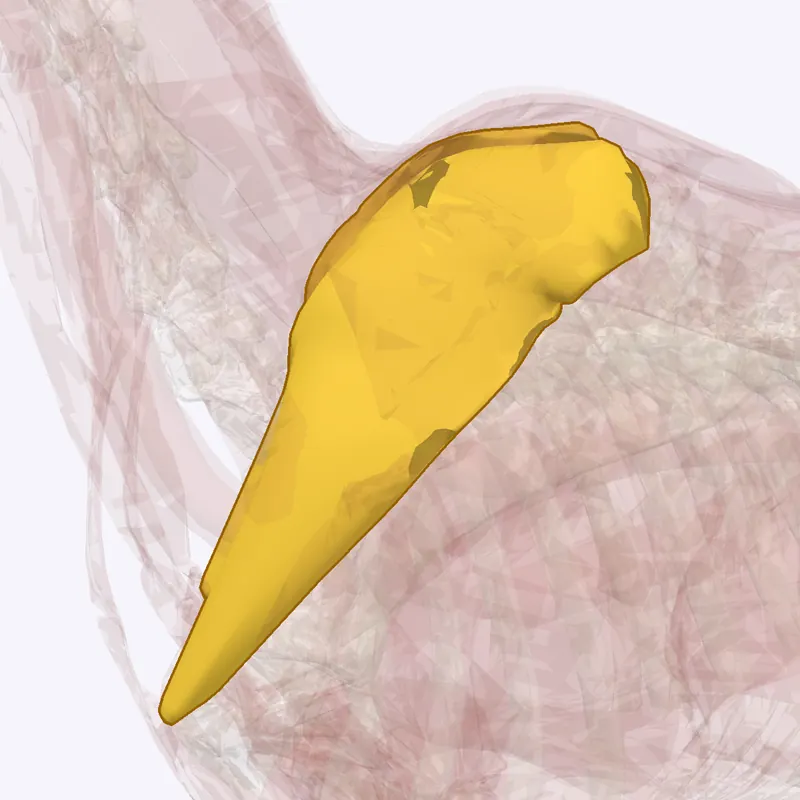
Fills the supraspinous fossa of the scapula and extends and stabilises the shoulder.
Key points
- It arises from the supraspinous fossa, the spine and the scapular cartilage.
- It ends on the greater and lesser tubercles, on either side of the biceps tendon.
- With the infraspinatus and subscapularis it acts as a contractile ligament of the shoulder.
- It is supplied by the suprascapular nerve.
- In sweeny it wastes and the scapular spine stands out.
Overview
Thick muscle that fills the supraspinous fossa and bulges beyond the cranial border of the scapula.
The horse has no true collateral ligaments at the shoulder. The supraspinatus and infraspinatus, together with the subscapularis, act as contractile ligaments that stabilise the joint.
It ends in two branches, on either side of the biceps brachii tendon.
Origin
Supraspinous fossa (fossa supraspinata), spine and cartilage of the scapula.
Insertion
Cranial parts of the greater tubercle (tuberculum majus) and lesser tubercle (tuberculum minus) of the humerus.
Action
Extends and stabilises the shoulder.
Innervation
Suprascapular nerve (n. suprascapularis).
Clinical relevance
In sweeny, the suprascapular nerve is injured where it winds around the cranial border of the scapula. It is caused by collisions or, in draught horses, by the collar.
The supraspinatus and infraspinatus waste and the scapular spine stands out. Without these stabilisers, the shoulder shifts laterally when the limb bears weight.
Related structures
See it in 3D on your iPhone
Peel the layers, spin the model, quiz yourself on it and stand it on your desk in AR. AnatomyCompass is coming to iPhone, iPad and Mac: get one email when it’s out.
More of the Horse: Muscular system
- Biceps brachii
- Brachialis
- Brachiocephalicus
- Accessory ligaments of the digital flexors (check ligaments)
- Deltoideus
- Extensor carpi radialis
- Common digital extensor
- Flexor carpi ulnaris
- Deep digital flexor (thoracic limb)
- Superficial digital flexor (thoracic limb)
- Infraspinatus
- Interosseus medius (suspensory ligament)
- Latissimus dorsi
- Omotransversarius
- Pectoral muscles
- Trapezius
- Triceps brachii
Text adapted from Vet Atlas (CC BY-SA 4.0). 3D model: Vet Atlas procedural musculature (CC BY-SA 4.0). Sources and licences. This veterinary text has not yet been reviewed by a veterinarian.