 AnatomyCompass
Accessory ligaments of the digital flexors (check ligaments)
Ligg. accessoria mm. flexorum digitorum · Horse · Muscular system · Thoracic limb
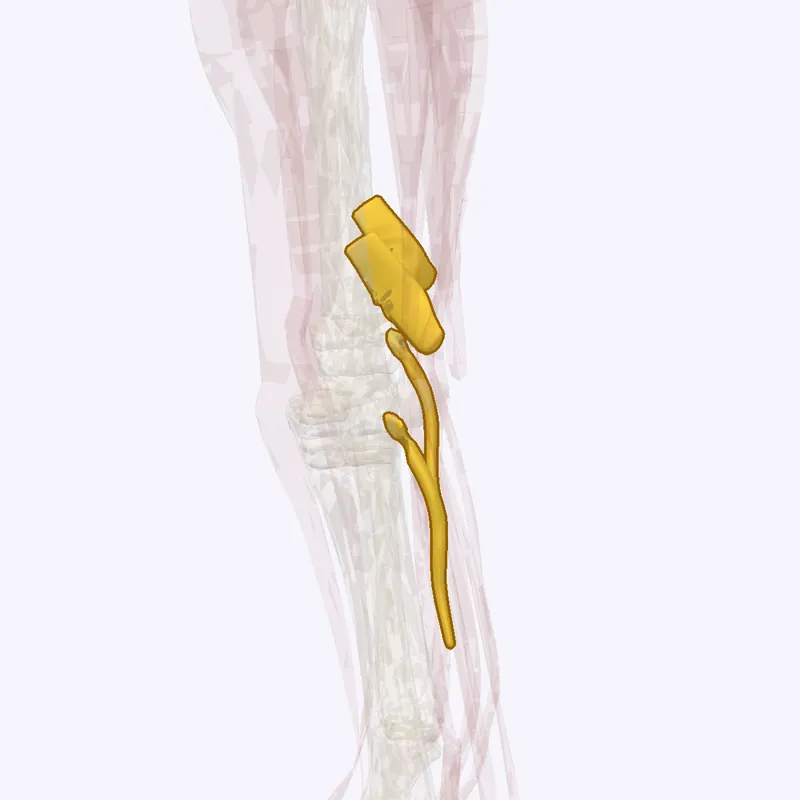
Two ligaments that anchor the forelimb flexor tendons to the skeleton; they let the horse support the fetlock without muscular effort and are part of the stay apparatus.
Key points
- The radial check ligament arises from the distal radius and joins the superficial flexor above the carpus.
- The carpal check ligament continues the palmar carpal ligament to the deep digital flexor.
- They are part of the stay apparatus, which lets the horse stand for hours with little effort.
- Carpal check desmitis is more common in ponies and older horses.
- Desmotomy of the carpal check ligament treats club foot in foals.
Overview
They are two fibrous bands that tie the digital flexor tendons to the skeleton of the thoracic limb.
They fix the tendon below the muscle belly. The horse's weight then tenses the tendon without the muscle having to contract.
- Accessory ligament of the superficial digital flexor. Also called the radial or superior check ligament.
- Accessory ligament of the deep digital flexor. Also called the carpal or inferior check ligament. It continues the palmar carpal ligament.
In the pelvic limb the superficial digital flexor has no accessory ligament, and that of the deep flexor is thin or absent.
Origin
- Radial check ligament: caudomedial surface of the distal radius.
- Carpal check ligament: palmar carpal ligament.
Insertion
- Radial check ligament: superficial digital flexor tendon, proximal to the carpus.
- Carpal check ligament: deep digital flexor tendon, at about mid-metacarpus.
Action
They passively transfer the load on the fetlock to the radius and carpus, and limit stretching of the muscle bellies.
Innervation
They have no motor innervation, as they are ligaments.
Clinical relevance
- Stay apparatus. With the digital flexors and the interosseus medius they form the stay apparatus of the thoracic limb. It lets the horse stand for hours with little muscular effort.
- Desmitis of the accessory ligament of the deep digital flexor. It causes swelling at the back of the proximal third of the cannon. It is more common in ponies and older horses. It is diagnosed by ultrasonography.
- Desmotomy. Desmotomy of either ligament is used to treat flexural deformities in foals. The distal one for club foot; the proximal one for some fetlock deformities.
Related structures
See it in 3D on your iPhone
Peel the layers, spin the model, quiz yourself on it and stand it on your desk in AR. AnatomyCompass is coming to iPhone, iPad and Mac: get one email when it’s out.
More of the Horse: Muscular system
- Biceps brachii
- Brachialis
- Brachiocephalicus
- Deltoideus
- Extensor carpi radialis
- Common digital extensor
- Flexor carpi ulnaris
- Deep digital flexor (thoracic limb)
- Superficial digital flexor (thoracic limb)
- Infraspinatus
- Interosseus medius (suspensory ligament)
- Latissimus dorsi
- Omotransversarius
- Pectoral muscles
- Supraspinatus
- Trapezius
- Triceps brachii
Text adapted from Vet Atlas (CC BY-SA 4.0). 3D model: Vet Atlas procedural musculature (CC BY-SA 4.0). Sources and licences. This veterinary text has not yet been reviewed by a veterinarian.