 AnatomyCompass
Brachialis
M. brachialis · Horse · Muscular system · Thoracic limb
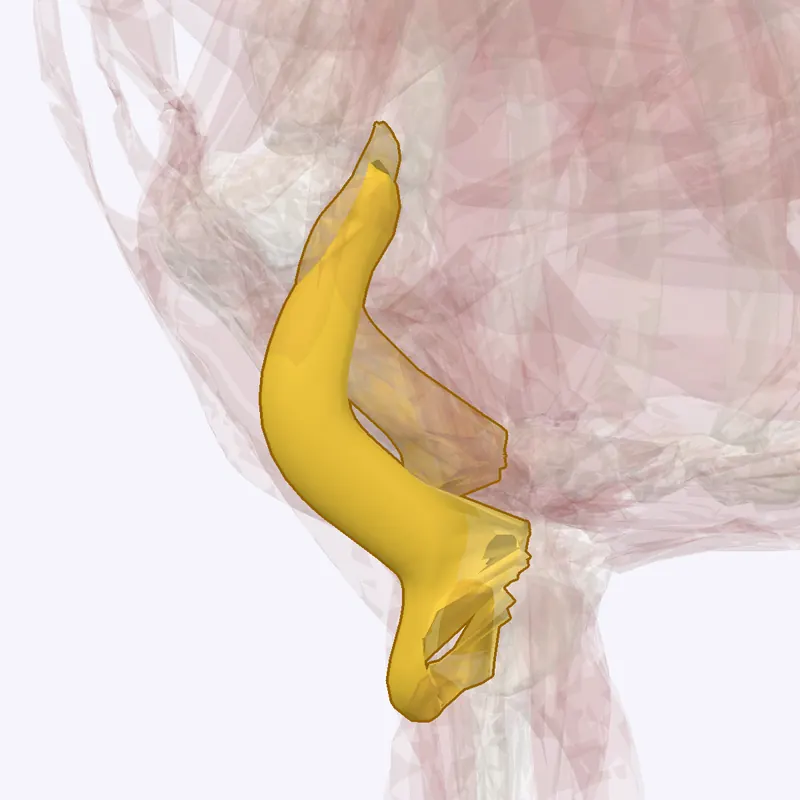
Elbow flexor that spirals down the lateral surface of the humerus.
Key points
- It runs in the brachial groove alongside the radial nerve.
- It is supplied by the musculocutaneous nerve, not the radial.
- The radial nerve is injured in humeral fractures or by lateral recumbency under anaesthesia.
- Radial paralysis gives a dropped elbow and poor weight bearing on the hoof.
Overview
It arises on the caudal surface of the proximal humerus and spirals down the brachial groove (sulcus musculi brachialis) to the cranial side of the elbow.
There it passes under the biceps tendon and ends on the medial surface of the radius.
Origin
Caudal surface of the proximal humerus, distal to the head.
Insertion
Proximal end of the radius, on its medial surface.
Action
Flexes the elbow.
Innervation
Musculocutaneous nerve (n. musculocutaneus).
Clinical relevance
The radial nerve accompanies this muscle in the brachial groove and crosses the lateral surface of the arm.
It can be injured in two settings:
- fractures of the humeral shaft
- compression during general anaesthesia in lateral recumbency
The horse shows a dropped elbow. It cannot extend the elbow, carpus or fetlock and bears weight poorly on the hoof.
Related structures
See it in 3D on your iPhone
Peel the layers, spin the model, quiz yourself on it and stand it on your desk in AR. AnatomyCompass is coming to iPhone, iPad and Mac: get one email when it’s out.
More of the Horse: Muscular system
- Biceps brachii
- Brachiocephalicus
- Accessory ligaments of the digital flexors (check ligaments)
- Deltoideus
- Extensor carpi radialis
- Common digital extensor
- Flexor carpi ulnaris
- Deep digital flexor (thoracic limb)
- Superficial digital flexor (thoracic limb)
- Infraspinatus
- Interosseus medius (suspensory ligament)
- Latissimus dorsi
- Omotransversarius
- Pectoral muscles
- Supraspinatus
- Trapezius
- Triceps brachii
Text adapted from Vet Atlas (CC BY-SA 4.0). 3D model: Vet Atlas procedural musculature (CC BY-SA 4.0). Sources and licences. This veterinary text has not yet been reviewed by a veterinarian.