 AnatomyCompass
Superficial digital flexor (thoracic limb)
M. flexor digitorum superficialis (membri thoracici) · Horse · Muscular system · Thoracic limb
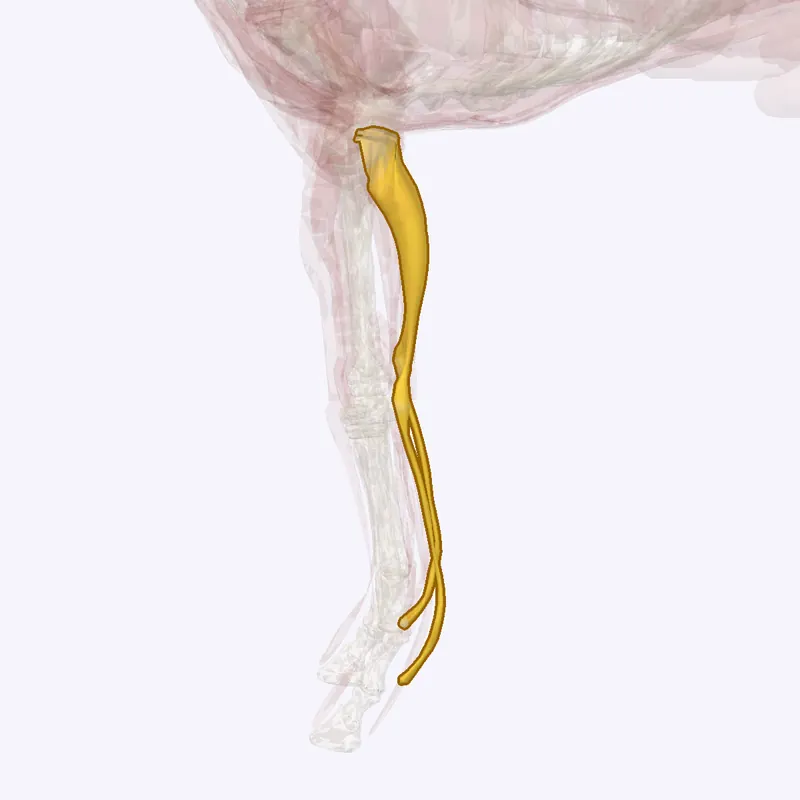
Digital flexor of the forelimb whose long tendon runs down the palmar cannon; with its accessory ligament it is part of the stay apparatus and it is the most commonly injured tendon in the sport horse.
Key points
- Its accessory ligament, the superior check ligament, arises from the caudomedial radius.
- The tendon passes through the carpal canal inside the carpal sheath.
- At the fetlock it forms the manica flexoria for the deep digital flexor tendon.
- It inserts on the first and second phalanges and is supplied by the ulnar nerve.
- Tendinopathy bulges the middle third of the cannon and is diagnosed by ultrasonography.
Overview
Its belly lies on the caudal forearm, between the flexor carpi ulnaris and the deep digital flexor. It contains much tendinous tissue.
Above the carpus it receives its accessory ligament (lig. accessorium), also called the radial or "superior" check ligament. It arises from the caudomedial radius.
Course of the tendon
- It passes through the carpal canal inside the carpal sheath.
- It runs down the palmar cannon as the most superficial tendon.
- At the fetlock it forms a ring, the manica flexoria, through which the deep digital flexor tendon passes. Both run inside the digital sheath.
- Distal to the fetlock it splits into two branches, one on each side, that end on the first and second phalanges.
Origin
Medial epicondyle of the humerus and, through the accessory ligament, the caudomedial surface of the radius.
Insertion
Distal end of the first phalanx and proximal end of the second phalanx, on both sides.
Action
Flexes the digit and the carpus. With the limb planted, it supports the fetlock and prevents its hyperextension.
Innervation
Ulnar nerve (n. ulnaris).
Clinical relevance
- Stay apparatus. The accessory ligament anchors the tendon to the radius, so it supports the fetlock without muscle contraction. It is part of the stay apparatus of the thoracic limb, together with the deep digital flexor and the interosseus medius.
- Superficial digital flexor tendinopathy ("bowed tendon"). One of the most common injuries of racehorses and sport horses. It mostly affects the middle third of the cannon, which bulges behind. It is diagnosed by ultrasonography. Rehabilitation takes many months and re-injury is common.
- Desmotomy of the accessory ligament. It has been used in the treatment of tendinopathy and of some flexural deformities of the fetlock.
- Distension of the carpal sheath. It shows proximal to the carpus. It may be due to lesions of this tendon or to an osteochondroma of the distal radius rubbing on it.
Diseases
- Superficial digital flexor tendinopathyOverstrain injury of the superficial digital flexor tendon, almost always in the mid-metacarpal region of the…
Related structures
See it in 3D on your iPhone
Peel the layers, spin the model, quiz yourself on it and stand it on your desk in AR. AnatomyCompass is coming to iPhone, iPad and Mac: get one email when it’s out.
More of the Horse: Muscular system
- Biceps brachii
- Brachialis
- Brachiocephalicus
- Accessory ligaments of the digital flexors (check ligaments)
- Deltoideus
- Extensor carpi radialis
- Common digital extensor
- Flexor carpi ulnaris
- Deep digital flexor (thoracic limb)
- Infraspinatus
- Interosseus medius (suspensory ligament)
- Latissimus dorsi
- Omotransversarius
- Pectoral muscles
- Supraspinatus
- Trapezius
- Triceps brachii
Text adapted from Vet Atlas (CC BY-SA 4.0). 3D model: Vet Atlas procedural musculature (CC BY-SA 4.0). Sources and licences. This veterinary text has not yet been reviewed by a veterinarian.