 AnatomyCompass
Deltoideus
M. deltoideus · Horse · Muscular system · Thoracic limb
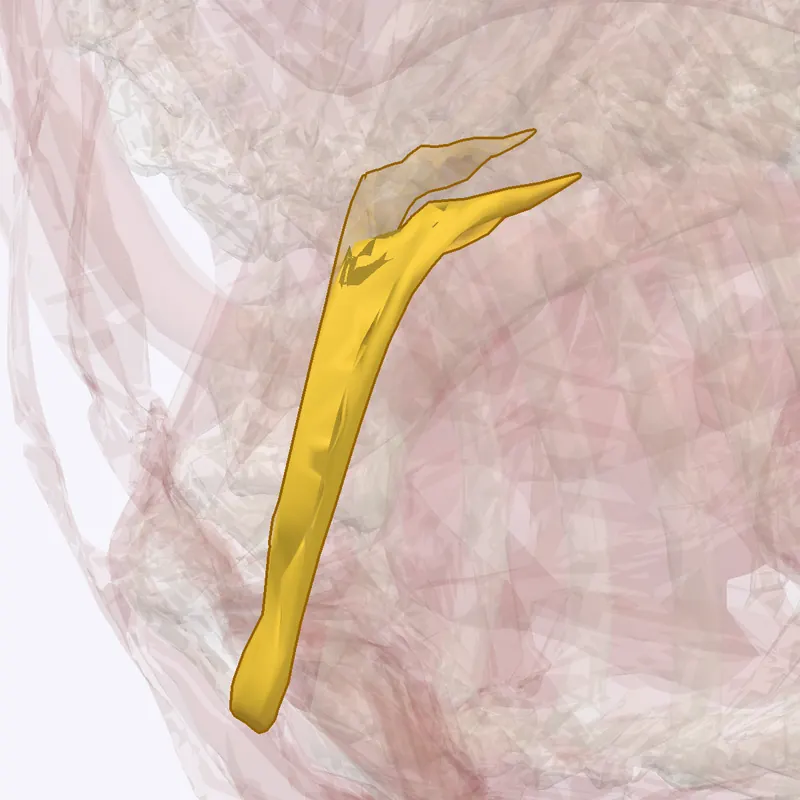
Muscle on the lateral surface of the shoulder; flexes the shoulder and abducts the arm.
Key points
- The horse has no acromion, so the deltoideus lacks an acromial part.
- It arises from an aponeurosis attached to the spine and caudal border of the scapula.
- It inserts on the deltoid tuberosity of the humerus, very prominent in the horse.
- It is supplied by the axillary nerve.
Overview
It lies on the lateral surface of the scapula and shoulder, caudal to the spine. It covers part of the infraspinatus.
The horse has no acromion: the scapular spine ends distally without that prominence. The deltoideus therefore has no separate acromial part as in cattle. It arises almost entirely from an aponeurosis attached to the spine and the caudal border of the scapula.
Origin
Spine of the scapula, through an aponeurosis, and caudal border of the scapula.
Insertion
Deltoid tuberosity (tuberositas deltoidea) of the humerus, very prominent in the horse.
Action
Flexes the shoulder and abducts the arm.
Innervation
Axillary nerve (n. axillaris).
Related structures
See it in 3D on your iPhone
Peel the layers, spin the model, quiz yourself on it and stand it on your desk in AR. AnatomyCompass is coming to iPhone, iPad and Mac: get one email when it’s out.
More of the Horse: Muscular system
- Biceps brachii
- Brachialis
- Brachiocephalicus
- Accessory ligaments of the digital flexors (check ligaments)
- Extensor carpi radialis
- Common digital extensor
- Flexor carpi ulnaris
- Deep digital flexor (thoracic limb)
- Superficial digital flexor (thoracic limb)
- Infraspinatus
- Interosseus medius (suspensory ligament)
- Latissimus dorsi
- Omotransversarius
- Pectoral muscles
- Supraspinatus
- Trapezius
- Triceps brachii
Text adapted from Vet Atlas (CC BY-SA 4.0). 3D model: Vet Atlas procedural musculature (CC BY-SA 4.0). Sources and licences. This veterinary text has not yet been reviewed by a veterinarian.