 AnatomyCompass
Scapula
Scapula · Horse · Skeletal system · Thoracic limb
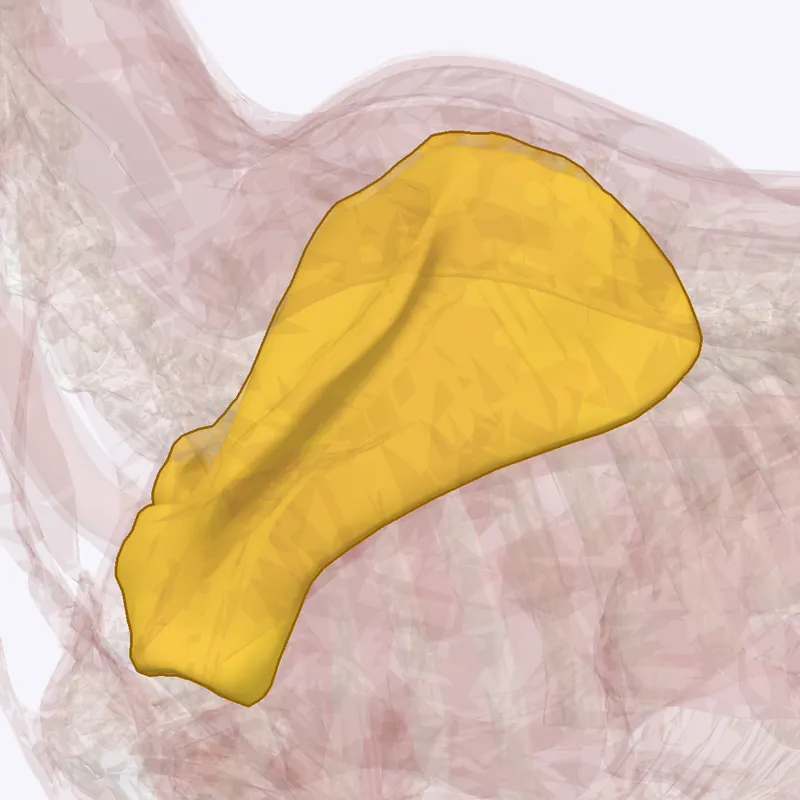
Flat, elongated bone of the shoulder. In the horse it lacks an acromion and has a low spine with a palpable tuberosity and a large scapular cartilage along its dorsal border.
Key points
- It is attached to the trunk by muscles only, a synsarcosis, mainly the serratus ventralis.
- The shoulder joint has no collateral ligaments; the surrounding muscles take over that role.
- The supraglenoid tubercle gives origin to the biceps brachii, and its fractures are intra-articular.
- Injury to the suprascapular nerve wastes the supraspinatus and infraspinatus.
- Shoulder osteochondrosis affects the glenoid cavity and the head of the humerus.
Overview
The scapula is a flat, triangular and elongated bone lying against the lateral wall of the thorax.
It has no bony joint with the trunk. The thoracic limb is attached to it by muscles only, a synsarcosis. The main one is the serratus ventralis, which suspends the thorax between the two limbs.
In the horse it slopes obliquely from the withers to the point of the shoulder. Its dorsal border is extended by a broad scapular cartilage (cartilago scapulae).
Key features
- Scapular spine (spina scapulae). Divides the lateral surface into the supraspinous and infraspinous fossae, filled by the muscles of the same names. In the horse it is low and flattens distally without forming an acromion.
- Tuberosity of the spine (tuber spinae scapulae). A thickening in the middle third of the spine, easily palpated under the skin.
- Costal surface. It carries the subscapular fossa and the serrated face, where the serratus ventralis attaches.
- Glenoid cavity (cavitas glenoidalis). Shallow. It articulates with the head of the humerus at the shoulder joint, which has no collateral ligaments: the surrounding muscles take over that role.
- Supraglenoid tubercle (tuberculum supraglenoidale). Large and prominent, cranial to the glenoid cavity. Origin of the biceps brachii.
- Coracoid process. On the medial side of the supraglenoid tubercle. Origin of the coracobrachialis.
Clinical relevance
- Fractures of the supraglenoid tubercle. From falls or collisions of the shoulder with fixed objects. Being intra-articular, they affect the athletic prognosis.
- Atrophy of the supraspinatus and infraspinatus ("sweeney"). From injury to the suprascapular nerve, which wraps around the neck of the scapula and is vulnerable to blows on the point of the shoulder. The spine stands out under the skin and the shoulder may swing outwards when the limb bears weight.
- Osteochondrosis of the shoulder. In young horses it affects the glenoid cavity and the head of the humerus. It causes lameness and a poor athletic prognosis.
Related structures
See it in 3D on your iPhone
Peel the layers, spin the model, quiz yourself on it and stand it on your desk in AR. AnatomyCompass is coming to iPhone, iPad and Mac: get one email when it’s out.
More of the Horse: Skeletal system
Text adapted from Vet Atlas (CC BY-SA 4.0). 3D model: "Horse Skeleton" by Diego Luján García (diegoluga on Sketchfab) (CC BY 4.0). Sources and licences. This veterinary text has not yet been reviewed by a veterinarian.