 AnatomyCompass
Caudal vertebrae
Vertebrae caudales · Cat · Skeletal system · Axial skeleton
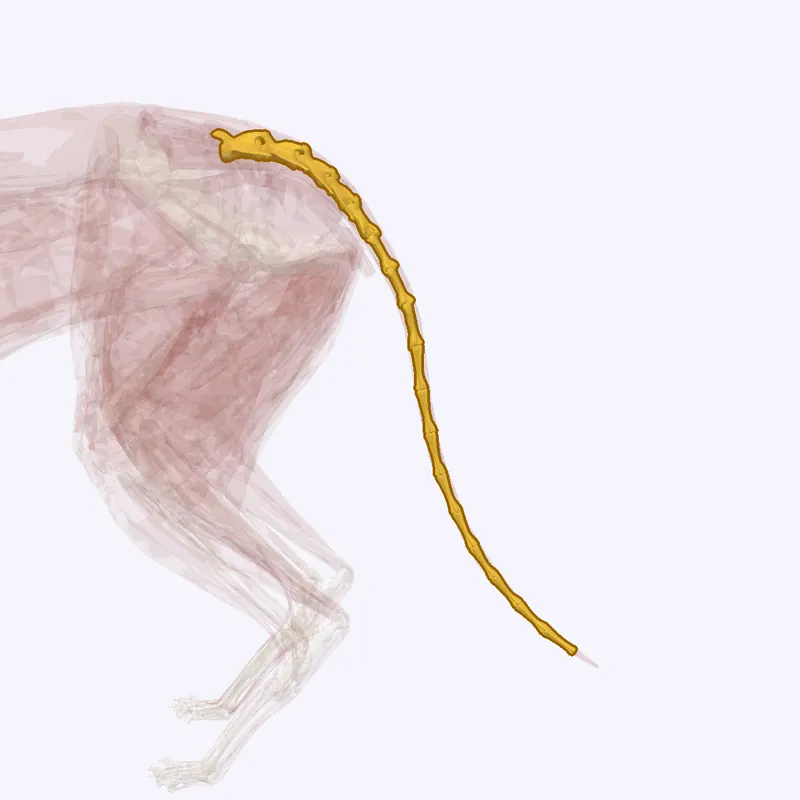
The vertebrae of the tail, about twenty in the cat. The first ones keep a vertebral arch and processes; towards the tip they become simple cylindrical bodies.
Key points
- The vertebral canal of the first caudals holds only the last nerve roots, not spinal cord.
- The haemal arches protect the median caudal artery.
- Sacrocaudal luxation causes a flaccid tail and urinary or faecal incontinence.
- A stiff tail is an early sign of Scottish Fold osteochondrodysplasia.
- Vaccines go in the distal tail so that amputation with wide margins is possible.
Overview
The number of caudal vertebrae varies between cats. It is usually about twenty.
They articulate with the apex of the sacrum and with each other through intervertebral discs, which makes the tail very mobile.
The tail helps with balance during jumping and walking on narrow surfaces. It is also a means of communication.
Features
- First caudal vertebrae. They have a complete vertebral arch, short spinous processes, well-developed transverse processes and cranial and caudal articular processes. Their vertebral canal contains only the last nerve roots, not spinal cord.
- Middle and distal vertebrae. The arch disappears and the processes are reduced to small tubercles. What remains is a cylindrical body, longest in the middle of the tail and progressively shorter towards the tip.
- Haemal arches (arcus haemales). Small V-shaped bones on the ventral side of the first caudal vertebrae. They protect the median caudal artery, which runs along the ventral surface of the tail.
Clinical relevance
- Sacrocaudal luxation and fractures. They follow tail pull or road accidents. Injury to the caudal, pudendal and pelvic nerves causes a flaccid tail and urinary or faecal incontinence.
- Scottish Fold osteochondrodysplasia. The same cartilage defect that folds the ears shortens and thickens the caudal vertebrae. A stiff, inflexible tail is an early sign.
- Manx cats. Taillessness caused by a dominant mutation is associated with sacrocaudal malformations and spina bifida, the Manx syndrome.
- Tail vaccination. The distal tail is used as a vaccine injection site. If an injection-site sarcoma develops, it allows amputation with wide margins.
This model has 17 caudal vertebrae, a number set by the skeletal reconstruction.
Diseases
- Sacrocaudal luxationFracture or luxation between the sacrum and the first caudal vertebrae from traction on the tail ("tail-pull…
- Scottish fold osteochondrodysplasiaInherited cartilage disorder caused by the same genetic variant that folds the Scottish fold's ears. It…
Related structures
See it in 3D on your iPhone
Peel the layers, spin the model, quiz yourself on it and stand it on your desk in AR. AnatomyCompass is coming to iPhone, iPad and Mac: get one email when it’s out.
More of the Cat: Skeletal system
Text adapted from Vet Atlas (CC BY-SA 4.0). 3D model: "Feline Skeleton Dec" by westerly (Sketchfab) (CC BY 4.0). Sources and licences. This veterinary text has not yet been reviewed by a veterinarian.