 AnatomyCompass
Atlas
Atlas · Cat · Skeletal system · Axial skeleton
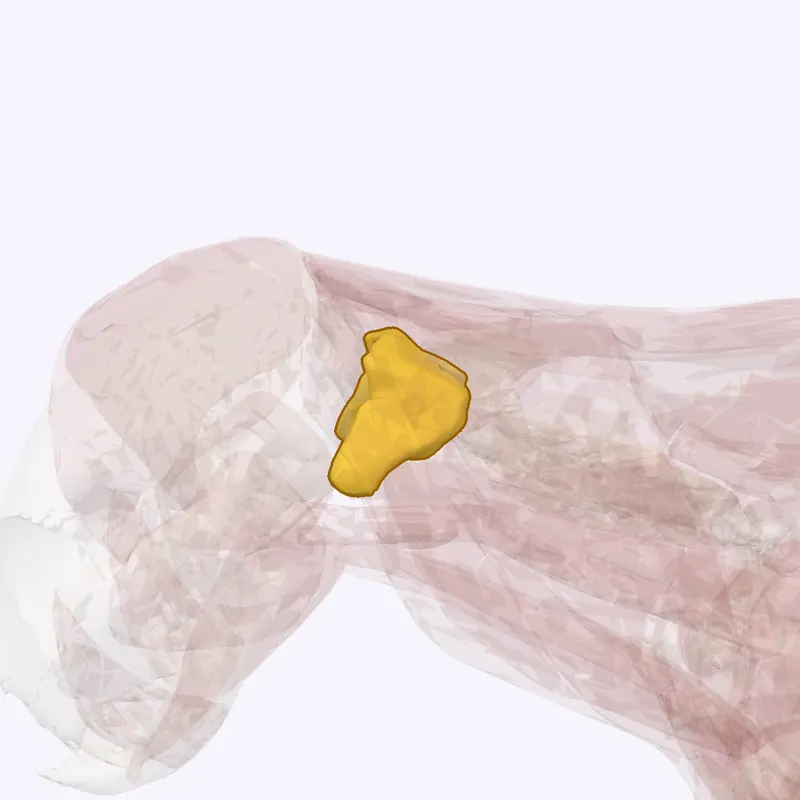
First cervical vertebra (C1). A bony ring without a body, with wide wings, that carries the skull and allows the nodding movement.
Key points
- The atlanto-occipital joint flexes and extends the head, the "yes" movement.
- The atlantoaxial joint rotates the head, the "no" movement.
- The wings are palpable on each side of the neck, just caudal to the skull.
- The cerebellomedullary cistern is punctured between the occipital bone and the dorsal arch, with the head flexed.
- Cats show atlantoaxial instability much less often than toy-breed dogs.
Overview
The atlas is the first cervical vertebra. Unlike the others, it has no vertebral body and no spinous process.
It is a ring made of a dorsal arch and a ventral arch, joined laterally by two masses from which the wings (alae atlantis) project. It articulates cranially with the occipital condyles and caudally with the axis.
Key features
- Cranial articular foveae. Two deep cavities that receive the occipital condyles. The atlanto-occipital joint allows flexion and extension of the head, the "yes" movement.
- Caudal articular foveae. Flatter surfaces for the axis. The atlantoaxial joint allows rotation of the head, the "no" movement.
- Fovea of the dens (fovea dentis). On the dorsal surface of the ventral arch, where the dens of the axis rests.
- Dorsal and ventral tubercles. Small midline prominences on each arch.
- Wings of the atlas. Wide horizontal plates, easily palpable on each side of the neck just caudal to the skull.
- Foramina. The lateral vertebral foramen transmits the first cervical nerve. The transverse foramen, at the base of the wing, transmits the vertebral artery.
Clinical relevance
- Cerebellomedullary cistern puncture. Cerebrospinal fluid is collected between the occipital bone and the dorsal arch of the atlas, with the head flexed. The wings and the external occipital protuberance are the landmarks.
- Atlantoaxial instability. Much less common than in toy-breed dogs. In cats it is described after trauma and, rarely, with malformations of the dens of the axis.
- Fractures. Uncommon, and associated with road accidents and falls.
Related structures
See it in 3D on your iPhone
Peel the layers, spin the model, quiz yourself on it and stand it on your desk in AR. AnatomyCompass is coming to iPhone, iPad and Mac: get one email when it’s out.
More of the Cat: Skeletal system
Text adapted from Vet Atlas (CC BY-SA 4.0). 3D model: "Feline Skeleton Dec" by westerly (Sketchfab) (CC BY 4.0). Sources and licences. This veterinary text has not yet been reviewed by a veterinarian.