 AnatomyCompass
Hyoid apparatus
Apparatus hyoideus · Cat · Skeletal system · Axial skeleton
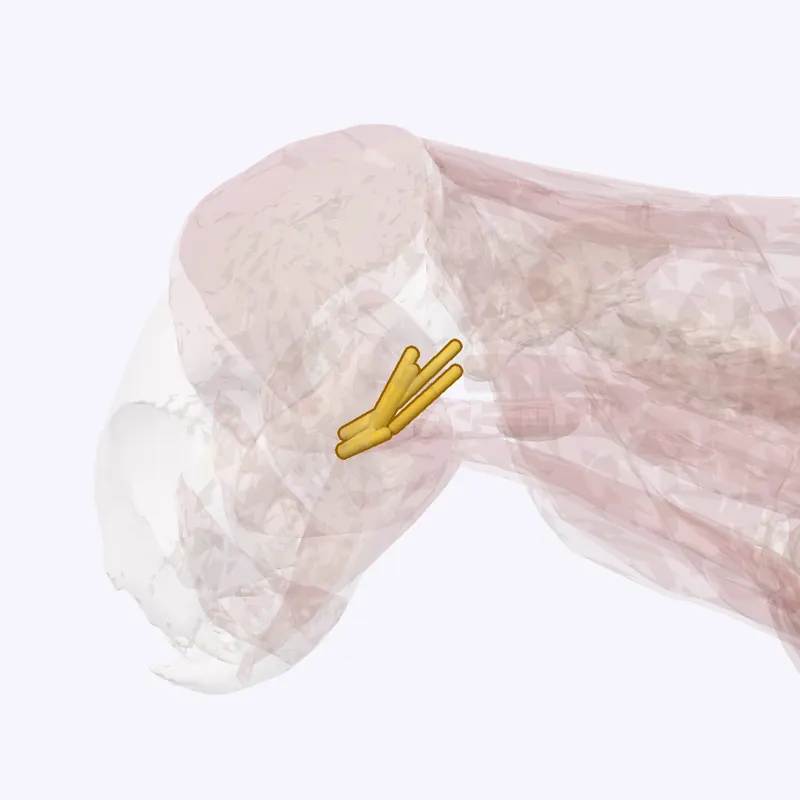
Chain of small bones that suspends the tongue and larynx from the skull. In the domestic cat it is fully ossified.
Key points
- It hangs from the tympanic region of the skull and does not articulate with the mandible.
- The basihyoid, unpaired and transverse, is the body of the apparatus at the root of the tongue.
- The thyrohyoids articulate with the thyroid cartilage of the larynx.
- Purring comes from rhythmic contraction of the intrinsic muscles of the larynx.
- In every vomiting cat, lift the tongue to look for a linear foreign body.
Overview
The hyoid apparatus (apparatus hyoideus) is a set of small articulated bones that hangs from the tympanic region of the skull. It supports the root of the tongue, the pharynx and the larynx.
It lies between the rami of the mandible and does not articulate with it.
Components
- Tympanohyoid cartilage. Attaches the chain to the mastoid region of the temporal bone.
- Stylohyoid, epihyoid and ceratohyoid. On each side they form the suspensory chain, which runs rostroventrally from the skull to the body of the hyoid.
- Basihyoid. Unpaired transverse bone at the root of the tongue. It is the body of the apparatus.
- Thyrohyoids. They run caudally from the basihyoid and articulate with the thyroid cartilage of the larynx.
Domestic cat and big cats
In the domestic cat every element of the suspensory chain is ossified. In the big cats that roar (Panthera), by contrast, the epihyoid is replaced by an elastic ligament.
This difference has classically been linked to the ability to roar or to purr. Purring, however, is produced in the larynx, by the rhythmic contraction of its intrinsic muscles.
Functions
- It supports and moves the tongue. Many lingual muscles, such as the hyoglossus and geniohyoideus, anchor on it.
- It positions the larynx during swallowing.
- It receives neck muscles such as the sternohyoideus and thyrohyoideus.
Clinical relevance
- Linear foreign bodies. Thread and string often loop around the base of the tongue. Look for them by lifting the tongue in every vomiting cat.
- Radiography. The hyoid bones show on lateral views of the head and neck and must not be mistaken for foreign bodies.
- Trauma. Fractures are rare. They follow strangulation or blows to the neck and can cause dysphagia.
In this model the hyoid apparatus is illustrative geometry; its shape and position are approximate.
Related structures
See it in 3D on your iPhone
Peel the layers, spin the model, quiz yourself on it and stand it on your desk in AR. AnatomyCompass is coming to iPhone, iPad and Mac: get one email when it’s out.
More of the Cat: Skeletal system
Text adapted from Vet Atlas (CC BY-SA 4.0). 3D model: Vet Atlas placeholder geometry (CC BY-SA 4.0). Sources and licences. This veterinary text has not yet been reviewed by a veterinarian.