 AnatomyCompass
Lumbar vertebrae
Vertebrae lumbales · Cat · Skeletal system · Axial skeleton
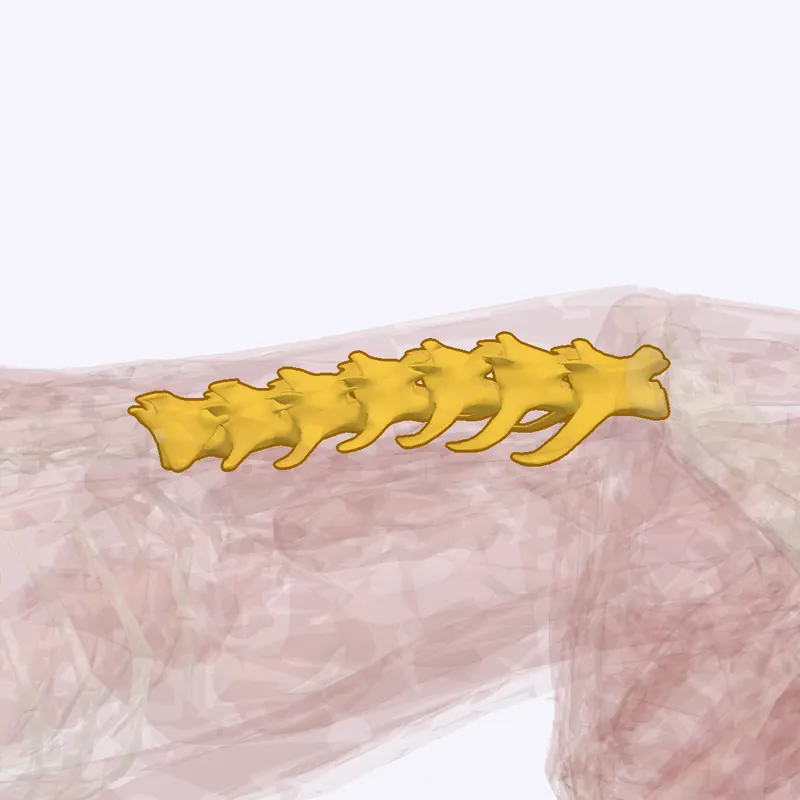
The seven vertebrae of the loin, between the thorax and the sacrum. Long bodies and long cranioventrally directed transverse processes give the cat a very mobile lumbar spine.
Key points
- They are the largest vertebrae of the column.
- The transverse processes anchor the psoas, quadratus lumborum and abdominal aponeurosis.
- In the cat the spinal cord ends at about L7, further caudally than in the dog.
- At lumbosacral epidural, accidental intrathecal injection is more likely than in the dog.
- Lumbosacral stenosis causes reluctance to jump and pelvic limb deficits.
Overview
The cat has seven lumbar vertebrae (L1–L7).
They are the largest vertebrae of the column. Their bodies lengthen caudally up to the mid-lumbar region.
The region is very flexible. Flexion and extension of the lumbar spine lengthen the stride at the gallop and power the jump.
Features
- Bodies. Long and slightly flattened dorsoventrally.
- Transverse processes. Long, flat and directed cranioventrally. They give attachment to the hypaxial muscles, such as the psoas and quadratus lumborum, and to the aponeurosis of the abdominal muscles.
- Spinous processes. Lower and wider than the thoracic ones, sloping cranially.
- Mammillary and accessory processes. The mammillary processes sit on the cranial articular processes. The accessory processes project caudally from the pedicle and overlap the next vertebra. Both anchor bundles of the epaxial muscles.
- L7. Shorter, with a wide caudal end that articulates with the sacrum at the lumbosacral joint.
- Spinal cord. In the cat it ends further caudally than in the dog, at about L7. The dural sac can continue into the sacrum.
Clinical relevance
- Epidural anaesthesia. The needle is placed in the lumbosacral space. Because the spinal cord and dural sac reach further back than in the dog, accidental intrathecal injection is more likely in the cat.
- Disc disease and lumbosacral stenosis. Less common than in the dog but described in older cats. They cause lumbar pain, reluctance to jump and pelvic limb deficits.
- Spinal lymphoma and trauma. Other causes of lumbar spinal cord injury. Trauma is usually a road accident.
Related structures
See it in 3D on your iPhone
Peel the layers, spin the model, quiz yourself on it and stand it on your desk in AR. AnatomyCompass is coming to iPhone, iPad and Mac: get one email when it’s out.
More of the Cat: Skeletal system
Text adapted from Vet Atlas (CC BY-SA 4.0). 3D model: "Feline Skeleton Dec" by westerly (Sketchfab) (CC BY 4.0). Sources and licences. This veterinary text has not yet been reviewed by a veterinarian.