 AnatomyCompass
Hip bone
Os coxae · Cat · Skeletal system · Pelvic limb
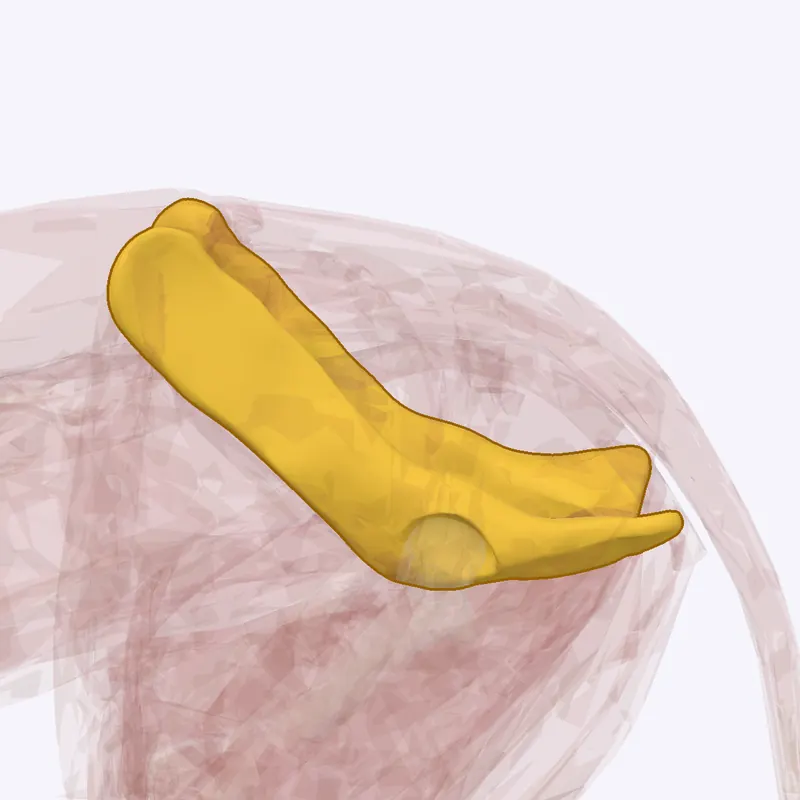
Bone of the hip, formed by the fusion of the ilium, ischium and pubis. The two hip bones and the sacrum form the pelvis, which is long and narrow in the cat.
Key points
- The ilium, ischium and pubis meet at the acetabulum.
- The ischiatic tuberosity is palpable on each side of the tail base.
- Pelvic fractures break the ring in at least two places, often with sacroiliac luxation.
- Malunion narrows the pelvic canal and can cause megacolon.
- Feline hip dysplasia is mainly a shallow acetabulum; the Maine Coon is predisposed.
Overview
The hip bone (os coxae) results from the fusion of three bones, the ilium, ischium and pubis, which meet at the acetabulum.
- Ventrally, the two hip bones meet at the pelvic symphysis.
- Dorsally, they articulate with the sacrum at the sacroiliac joints.
In the cat the pelvis is long and narrow, with its axis almost parallel to the spine.
Key features
- Ilium. The cranial part. Its wing is narrow and elongated, with the palpable iliac crest and the auricular surface, which articulates with the sacrum. The gluteal muscles arise from its lateral surface.
- Ischium. The caudal part. It carries the ischiatic tuberosity, palpable on each side of the tail base, where the hamstring muscles arise: biceps femoris, semitendinosus and semimembranosus. The ischiatic arch lies between the two ischia.
- Pubis. The ventral and medial part. It forms the cranial edge of the obturator foramen and the cranial part of the symphysis.
- Acetabulum. Deep socket that receives the femoral head. Its articular surface is crescent-shaped (facies lunata) and opens ventrally at the acetabular notch. It surrounds the acetabular fossa, where the ligament of the femoral head attaches.
- Obturator foramen. Large opening between the pubis and ischium, closed in life by a membrane and the obturator muscles.
Clinical relevance
Pelvic fractures
They are among the most common fractures of the cat, nearly always from road accidents.
- They are usually multiple: the pelvic ring breaks in at least two places.
- They often come with sacroiliac luxation.
- Displaced fractures of the acetabulum or ilium usually need surgery.
Malunion reduces the diameter of the pelvic canal and can cause chronic constipation and megacolon.
In pelvic trauma the urethra, bladder and the sciatic and obturator nerves must be assessed.
Hip dysplasia
In the cat it shows mainly as a shallow acetabulum with remodelling of its craniodorsal rim. The Maine Coon is predisposed.
Clinical signs are usually mild.
Diseases
- Hip dysplasiaAbnormal development of the coxofemoral joint with joint laxity that ends in osteoarthritis. A common…
Related structures
See it in 3D on your iPhone
Peel the layers, spin the model, quiz yourself on it and stand it on your desk in AR. AnatomyCompass is coming to iPhone, iPad and Mac: get one email when it’s out.
More of the Cat: Skeletal system
Text adapted from Vet Atlas (CC BY-SA 4.0). 3D model: "Feline Skeleton Dec" by westerly (Sketchfab) (CC BY 4.0). Sources and licences. This veterinary text has not yet been reviewed by a veterinarian.