 AnatomyCompass
Scottish fold osteochondrodysplasia
Congenital · Cat
Inherited cartilage disorder caused by the same genetic variant that folds the Scottish fold's ears. It produces deformities of the distal limbs and tail and progressive, painful osteoarthritis.
Key points
- The same TRPV4 variant folds the ear and causes the disease.
- Every fold-eared Scottish fold is affected to some degree.
- Homozygous cats, bred from two fold-eared parents, have severe, early lesions.
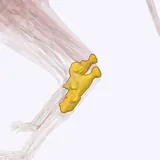
- The tarsus is worst affected, with a plantar exostosis caudal to the calcaneus in advanced cases.
- Only the genetic test rules out the variant, because some carriers end up straight-eared.
What it is
Scottish fold osteochondrodysplasia is a developmental disorder of cartilage and bone.
It is caused by a dominant variant of the TRPV4 gene, which encodes a calcium-permeable ion channel. The same variant makes the ear cartilage weak so that it folds forward, the trait that defines the breed. This is why the folded ear and the disease are inseparable.
Articular and growth cartilage develop abnormally. Over time, bony deformities, exostoses around the distal joints and progressive osteoarthritis appear.
Inheritance
Inheritance is incompletely dominant:
- homozygous cats, born from mating two fold-eared cats, have severe, early lesions
- heterozygous cats, born from mating a Scottish fold with a straight-eared cat, also develop lesions, usually milder and later
There is no fold-eared Scottish fold free of the disease. On welfare grounds, some cat registries do not recognise the breed and breeding fold-eared cats is restricted in some countries.
Who it affects
Fold-eared Scottish fold cats and crosses carrying the variant, such as some cats of related breeds.
Radiographic changes can be seen in kittens only a few weeks old, and lameness from 4–6 months. In heterozygous cats the age of onset and severity vary widely, from a few months to several years.
Most straight-eared cats of the breed do not carry the variant. But some heterozygous kittens are born with folded ears that straighten as they grow, so only the genetic test rules it out.
Anatomy involved
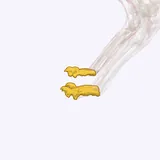
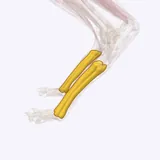
In the distal pelvic limbs, the tarsus, metatarsus and phalanges are most severely affected. The bones are short and misshapen. In advanced cases a large plantar exostosis forms caudal to the calcaneus and around the tarsometatarsal region.
The distal thoracic limbs show similar lesions in the carpus, metacarpus and digits.
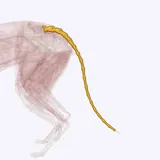
The caudal vertebrae are short, wide and irregularly shaped. The tail is thick, short and stiff, and the cat cannot flex it normally.
In the ears, the auricular cartilage is folded.
Clinical signs
- lameness
- a stiff or stilted gait
- reluctance to jump and move
- a short, thick, inflexible tail
In advanced cases hard swellings can be felt on the plantar aspect of the tarsi, and the distal limbs are short and misshapen.
Cats hide pain well. Chronic pain may show only as reduced activity and play, and an apparently calm temperament may actually reflect pain.
Diagnosis
- Breed and folded ears, with compatible signs.
- On examination, tail stiffness, assessed by flexing the tail gently without forcing it, and pain and thickening of the distal joints.
- Radiographs of the feet, tarsi, carpi and tail. They show short, misshapen bones, narrowed joint spaces, progressive new bone formation around the distal joints and, in advanced cases, a plantar exostosis caudal to the calcaneus.
- Genetic test for the TRPV4 variant.
Treatment
There is no cure, and no single treatment works for every cat. Treatment is palliative and aims to control chronic pain:
- analgesics; a pain relief trial can show whether the cat becomes more active
- subcutaneous pentosan polysulfate or oral glycosaminoglycan preparations, which have helped some cats
In selected cases palliative radiotherapy of the exostoses, excision of the exostoses and pantarsal arthrodesis have been used.
The environment is adapted with ramps, cat walks and cat trees so the cat can still reach high places.
The most important measure is prevention: not breeding fold-eared cats.
Key studies
- Gandolfi et al. (2016). Genome-wide association study of 44 Scottish folds and 54 controls. It identified the TRPV4 p.V342F (c.1024G>T) variant, associated with both the folded ear and the osteochondrodysplasia; it was absent from 648 unaffected cats. In cells, the mutant channel showed altered activity.
- Rorden et al. (2021). Radiographic survey of 22 genotyped Scottish folds, assessed by four reviewers blinded to ear shape. All 10 fold-eared cats were heterozygous and none of the 12 straight-eared cats carried the variant. Fold-eared cats scored worse on average, but their changes were much milder than in earlier reports. The sample is small.
- Velie et al. (2023). VetCompass records of 1131 Scottish Fold and 117 Scottish Shorthair cats in Australia (1992–2018). Only 12 Scottish folds had a clinical diagnosis of osteochondrodysplasia and another 69 cats were suspected cases; diagnosed cats were usually under 30 months old. It measures diagnoses recorded in first-opinion practice, not radiographic lesions.
- Matsumoto et al. (2026). 114 cats genotyped and photographed as they grew. Seven heterozygous cats had folded ears as kittens that straightened as they matured (12.7% of heterozygotes); their pinnae were smaller than those of straight-eared cats without the variant. Ear shape alone is not enough to identify carriers.
- Ukawa et al. (2026). Genotyping of 8610 cats of 14 breeds in Japan. As genetic testing was adopted, homozygous Scottish folds fell from 14.2% in 2017 to 1.9% in 2024, while the proportion of heterozygotes held steady. The variant was also found in the American Curl, Norwegian Forest Cat, Munchkin and Minuet.
Structures affected
References
- Malik R, Allan GS, Howlett CR, et al. Osteochondrodysplasia in Scottish Fold cats. Aust Vet J 77:85-92 (1999)
- Takanosu M, Takanosu T, Suzuki H, Suzuki K. Incomplete dominant osteochondrodysplasia in heterozygous Scottish Fold cats. J Small Anim Pract 49:197-199 (2008)
- Gandolfi B, Alamri S, Darby WG, et al. A dominant TRPV4 variant underlies osteochondrodysplasia in Scottish fold cats. Osteoarthritis Cartilage 24:1441-1450 (2016)
- Rorden C, Griswold MC, Moses N, et al. Radiographical Survey of Osteochondrodysplasia in Scottish Fold Cats caused by the TRPV4 gene variant. Hum Genet 140:1525-1534 (2021)
- Velie BD, Milden T, Miller H, et al. An estimation of osteochondrodysplasia prevalence in Australian Scottish Fold cats: a retrospective study using VetCompass Data. BMC Vet Res 19:252 (2023)
- Matsumoto Y, Ishii R, Ukawa H, et al. Straightened Small Pinnae in TRPV4 c.1024G>T Heterozygous Cats. Anim Genet 57:e70114 (2026)
- Ukawa H, Akashi A, Hayashi H, et al. Genetic Evidence of a Recent Decline and Crossbreed Distribution of TRPV4 c.1024G>T Variant in Domestic Cats. Anim Genet 57:e70118 (2026)
- Hubler M, Volkert M, Kaser-Hotz B, Arnold S. Palliative irradiation of Scottish Fold osteochondrodysplasia. Vet Radiol Ultrasound 45:582-585 (2004)
- Nakajo T, Fujita Y, Ichinohe T, Maruo T. Combined surgical, radiation, and medical therapies for osteochondrodysplasia in a Scottish Fold cat. J Am Anim Hosp Assoc 56:175 (2020)
- Mathews KG, Koblik PD, Knoeckel MJ, et al. Resolution of lameness associated with Scottish fold osteodystrophy following bilateral ostectomies and pantarsal arthrodeses: a case report. J Am Anim Hosp Assoc 31:280-288 (1995)
- Cats Protection: Cats with folded ears
- FECAVA: Belgium bans breeding and trading of cats with folded ears
See it in 3D on your iPhone
Peel the layers, spin the model, quiz yourself on it and stand it on your desk in AR. AnatomyCompass is coming to iPhone, iPad and Mac: get one email when it’s out.
Text adapted from Vet Atlas (CC BY-SA 4.0). Sources and licences. This veterinary text has not yet been reviewed by a veterinarian.