 AnatomyCompass
Phalanges of the thoracic limb
Ossa digitorum manus · Cat · Skeletal system · Thoracic limb
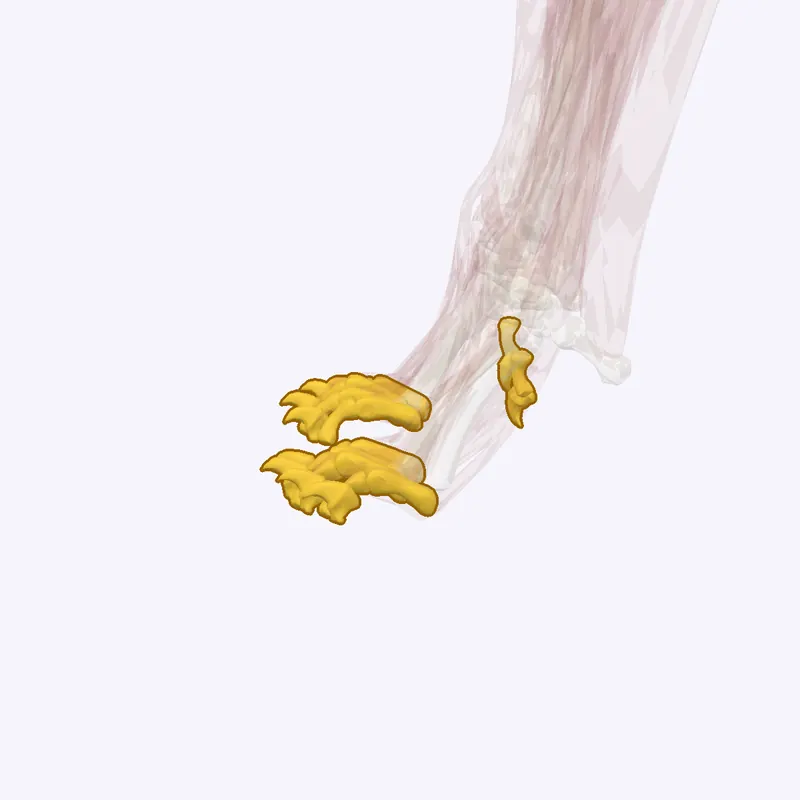
Bones of the five digits of the forepaw. The distal phalanx carries the claw and, at rest, is held retracted over the middle phalanx by dorsal elastic ligaments.
Key points
- Digit I, the dewclaw, does not touch the ground and has only two phalanges.
- The dorsal elastic ligaments hold the claw retracted with no muscular effort.
- Contraction of the deep digital flexor rotates the distal phalanx and brings the claw out.
- Onychectomy is not a nail trim but amputation of the distal phalanx.
- In lung-digit syndrome, lung carcinoma metastasises to the distal phalanges.
Overview
The cat's forepaw has five digits.
- Digit I, the dewclaw, is short, does not touch the ground and has two phalanges.
- Digits II to V have three phalanges: proximal, middle and distal.
The cat bears weight on digits II to V through the digital pads.
Key features
- Proximal phalanx (phalanx proximalis). The longest. It articulates with the head of the metacarpal and with the proximal sesamoid bones.
- Middle phalanx (phalanx media). Shorter and asymmetrical. At rest, the distal phalanx folds dorsally alongside it.
- Distal phalanx (phalanx distalis). Carries the claw.
- Sesamoid bones. Proximal, two per digit at the metacarpophalangeal joint, and dorsal.
Distal phalanx
- Ungual process (processus unguicularis). Curved and laterally compressed. It fits inside the horny sheath of the claw.
- Ungual crest (crista unguicularis). A bony fold that wraps the base of the claw like a sheath. The germinal tissue that produces the claw lies beneath it.
- Flexor tubercle. On the palmar surface. The deep digital flexor tendon inserts on it.
Claw retraction
The dorsal elastic ligaments run from the middle phalanx to the ungual crest of the distal phalanx. They hold the claw retracted with no muscular effort.
When the deep digital flexor contracts, the distal phalanx rotates palmarly, the ligaments stretch and the claw comes out. This is protraction.
Clinical relevance
- Onychectomy, or declawing. It is not a nail trim but the amputation of the distal phalanx of each digit. If germinal tissue of the ungual crest is left behind, the claw can regrow abnormally. It causes pain, lameness and retained bone fragments. It is banned in many countries and discouraged by the main veterinary associations.
- High-rise syndrome. The distal limbs are among the regions injured, together with the face and thorax.
- Lung-digit syndrome. Primary lung carcinoma of the cat can metastasise to the distal phalanges, with swelling and bone lysis in one or several digits.
- Polydactyly. Inherited extra digits, with a higher risk of ingrown claws.
Diseases
- High-rise syndromeThe set of injuries of cats that fall from windows or balconies of tall buildings. Most cats survive with…
Related structures
See it in 3D on your iPhone
Peel the layers, spin the model, quiz yourself on it and stand it on your desk in AR. AnatomyCompass is coming to iPhone, iPad and Mac: get one email when it’s out.
More of the Cat: Skeletal system
Text adapted from Vet Atlas (CC BY-SA 4.0). 3D model: "Feline Skeleton Dec" by westerly (Sketchfab) (CC BY 4.0). Sources and licences. This veterinary text has not yet been reviewed by a veterinarian.