 AnatomyCompass
Claws
Unguicula · Cat · Integumentary system · Thoracic limb
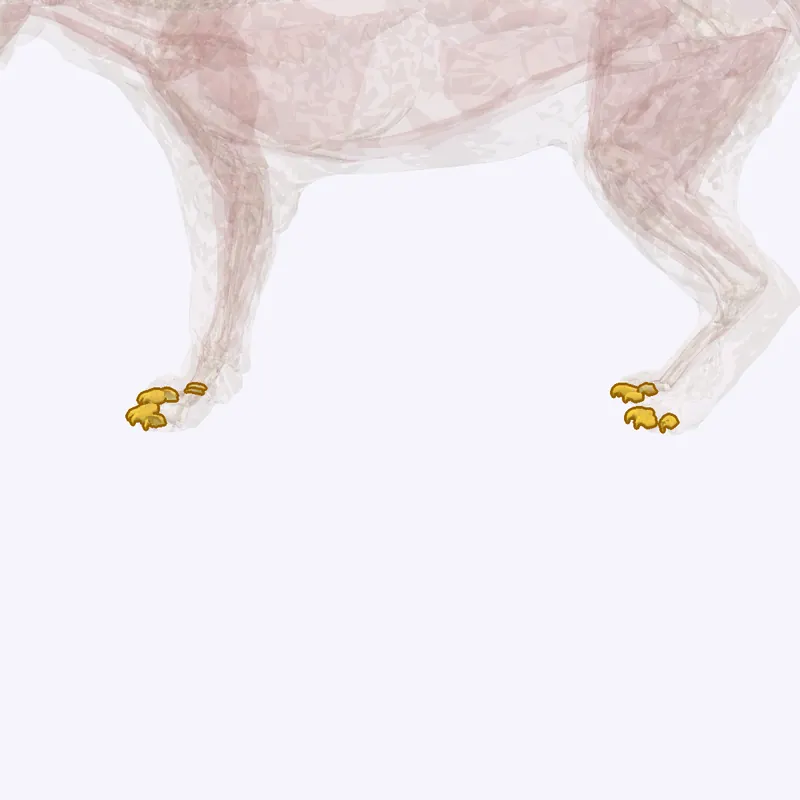
Curved, sharp horny sheaths covering the ungual process of the distal phalanx. They are retractile; at rest they stay hidden in the fur and come out when the deep digital flexor contracts.
Key points
- At rest the dorsal elastic ligaments keep the distal phalanx folded and the claw hidden.
- The pink dermis is the living part; trimming cuts only the tip, distal to it.
- Onychectomy requires amputation of the distal phalanx and is banned in many countries.
- Paronychia with caseous exudate in several digits suggests pemphigus foliaceus.
- In lung-digit syndrome a primary lung carcinoma metastasises to the digits.
Overview
The cat's claw (unguicula) is a modified skin structure: a sheath of hard keratin wrapping the ungual process of the distal phalanx.
At its base the ungual crest of the phalanx forms a bony fold that covers the proximal edge of the claw.
Cat claws are retractile. At rest the dorsal elastic ligaments hold the distal phalanx folded beside the middle phalanx. The claw stays hidden in the fur and does not wear down as the cat walks.
When the cat contracts the deep digital flexor, the distal phalanx rotates and the claw comes out.
The thoracic limb has five claws, including that of the dewclaw (digit I), which does not touch the ground. The pelvic limb normally has four.
Structure
- Wall. Forms the dorsal and side surfaces. It is curved and strongly compressed laterally, which makes it sharp.
- Sole. Palmar or plantar surface, of softer keratin.
- Claw dermis. Highly vascular, innervated connective tissue between the phalanx and the keratin. It is the living part and, in unpigmented claws, shows as a pink zone.
- Growth in layers. The claw grows continuously from its base. When the cat scratches, the old outer layers come off as sheaths and leave a new, sharp claw underneath.
Function
Holding prey, climbing, defence and marking.
By scratching surfaces the cat leaves visible marks and scent from the glands of the pads.
Clinical relevance
- Ingrown claws. In older or inactive cats the claws are sharpened less, overgrow and can pierce the pad. This is common in the dewclaw and in polydactyl cats.
- Nail trimming. Pressing the pad extends the claw, so only the tip is cut, distal to the pink dermis.
- Onychectomy. Removing the claws requires amputation of the distal phalanx. It is banned in many countries. The alternatives are regular trimming, scratching posts and nail caps.
- Paronychia. Infection or inflammation of the claw fold. With caseous exudate in several digits it suggests pemphigus foliaceus.
- Lung-digit syndrome. Digital metastases of a primary lung carcinoma present as swelling and deformity of the claw and digit.
Related structures
See it in 3D on your iPhone
Peel the layers, spin the model, quiz yourself on it and stand it on your desk in AR. AnatomyCompass is coming to iPhone, iPad and Mac: get one email when it’s out.
Text adapted from Vet Atlas (CC BY-SA 4.0). 3D model: "Cat Model" by Lova Dahn (Sketchfab) (CC BY 4.0). Sources and licences. This veterinary text has not yet been reviewed by a veterinarian.