 AnatomyCompass
High-rise syndrome
Traumatic · Cat
The set of injuries of cats that fall from windows or balconies of tall buildings. Most cats survive with treatment.
Key points
- The classic triad is thoracic trauma, facial trauma and limb fractures.
- Thoracic trauma is the most common, with pneumothorax and pulmonary contusion.
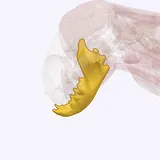
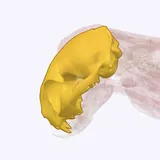
- A midline hard palate fracture and mandibular symphyseal separation are typical.
- An untreated palatal fracture can leave an oronasal fistula.
- It is prevented with sturdy nets or screens on windows and balconies.
What it is
High-rise syndrome is the characteristic pattern of injuries in cats that fall from a height of at least two storeys.
During the fall, the cat uses its righting reflex to rotate its body and point its feet toward the ground. On impact the extended limbs absorb part of the energy. The rest is transmitted to the thorax and head, which strike the ground.
Hence the typical combination of injuries:
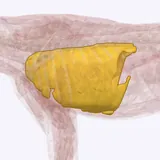
- thoracic trauma, the most common: pneumothorax and pulmonary contusion, sometimes rib fractures or diaphragmatic hernia
- facial trauma: epistaxis, midline fracture of the hard palate, mandibular symphyseal separation, dental fractures and facial abrasions
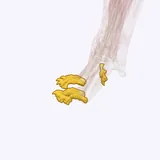
- limb injuries: fractures of the thoracic and pelvic limbs, luxations and injuries of the tarsus and digits
Some studies found that injury severity peaks at intermediate heights and falls at greater heights. This curvilinear pattern is debated: the largest series found that severity rose steadily with fall height.
Who it affects
Young cats in urban settings with access to unprotected windows, balconies or terraces. There are more cases in warm months, when windows are open.
Falls usually happen while the cat chases insects or birds, or slips from a railing.
Anatomy involved
Lungs and pleural space
Pulmonary contusion and pneumothorax.
Skull and mandible
The hard palate splits along the median suture and the mandibular symphysis separates in the midline. Fractures of the mandible and of the teeth also occur.
Thoracic limbs
Fractures and luxations, less often than in the pelvic limbs.
Pelvic limbs
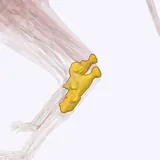
Fractures of the tibia and femur, and tarsal injuries: fractures and luxations.
Clinical signs
- dyspnoea and tachypnoea
- shock
- epistaxis and blood in the mouth
- malocclusion or inability to close the mouth
- lameness or limb deformity
Diagnosis
- First, stabilisation and primary survey: airway, breathing and circulation. Point-of-care thoracic ultrasound detects pneumothorax.
- Thoracic radiographs once the cat tolerates them, to look for pneumothorax, contusion, rib fractures or diaphragmatic hernia.
- Oral examination, often under sedation, and CT of the head for palatal and mandibular fractures.
- Limb radiographs and abdominal ultrasound to rule out bladder and other organ injuries.
Treatment
Stabilisation comes first: oxygen, thoracocentesis for pneumothorax, analgesia and treatment of shock.
Fractures are repaired once the cat is stable:
- mandibular symphyseal separation, with cerclage wire around the rostral mandible
- hard palate fracture, with suturing or flaps when needed, because untreated it can leave an oronasal fistula
- limb fractures, with internal or external fixation depending on the bone and fracture configuration
Most cats that reach the clinic alive survive with treatment.
Prevention is simple: sturdy nets or screens on windows and balconies.
Key studies
- Whitney and Mehlhaff (1987). 132 cats seen in New York over 5 months. 90% had some thoracic trauma; among them, 68% had pulmonary contusion and 63% pneumothorax. Facial trauma was present in 57%, limb fractures in 39% and hard palate fracture in 17%. 37% needed emergency treatment, and 90% of the treated cats survived.
- Vnuk et al. (2004). 119 cats in Zagreb. 59.6% were under one year old, the average fall was four storeys and 96.5% survived. 46.2% had limb fractures, more often of the pelvic limbs (61.5%), and the tibia was the bone most often fractured; thoracic trauma was found in 33.6%. Falls from the seventh storey or higher were associated with more severe injuries.
- Bonner et al. (2012). 84 cats in Philadelphia, with a mean fall of 2.65 storeys. 66% had some orofacial injury: epistaxis, hard palate fracture, mandibular fracture or symphyseal separation, and dental and tongue injuries. Survival was 94%; one untreated palatal fracture ended in an oronasal fistula.
- Candela Andrade et al. (2025). The largest series, published in two parts: 1125 cats treated in Berlin between 2004 and 2013. Mean age was 2.3 years; 77% of falls happened in summer, 62.1% at night and 74.2% onto hard surfaces. Thoracic trauma was found in 58.3%, orofacial injuries in 51.1%, limb fractures in 47.2% and shock in 48.6%, and 87% survived. Injury severity correlated with age, landing surface and fall height. It is retrospective and from a single centre.
Structures affected
References
- Whitney WO, Mehlhaff CJ. High-rise syndrome in cats. J Am Vet Med Assoc 191:1399-1403 (1987)
- Vnuk D, Pirkić B, Maticić D, et al. Feline high-rise syndrome: 119 cases (1998-2001). J Feline Med Surg 6:305-312 (2004)
- Bonner SE, Reiter AM, Lewis JR. Orofacial manifestations of high-rise syndrome in cats: a retrospective study of 84 cases. J Vet Dent 29:10-18 (2012)
- Candela Andrade M, Slunsky P, Nerlich A, et al. High-rise syndrome in cats (part 1): epidemiology and risk factors. J Feline Med Surg 27:1098612X251334091 (2025)
- Candela Andrade M, Slunsky P, Nerlich A, et al. High-rise syndrome in cats (part 2): injury patterns and survival rate. J Feline Med Surg 27:1098612X251334096 (2025)
- Merck Veterinary Manual: Trauma in Emergency Medicine in Small Animals
- Merck Veterinary Manual: Dentofacial Trauma in Small Animals
See it in 3D on your iPhone
Peel the layers, spin the model, quiz yourself on it and stand it on your desk in AR. AnatomyCompass is coming to iPhone, iPad and Mac: get one email when it’s out.
Text adapted from Vet Atlas (CC BY-SA 4.0). Sources and licences. This veterinary text has not yet been reviewed by a veterinarian.