 AnatomyCompass
Radius
Radius · Cat · Skeletal system · Thoracic limb
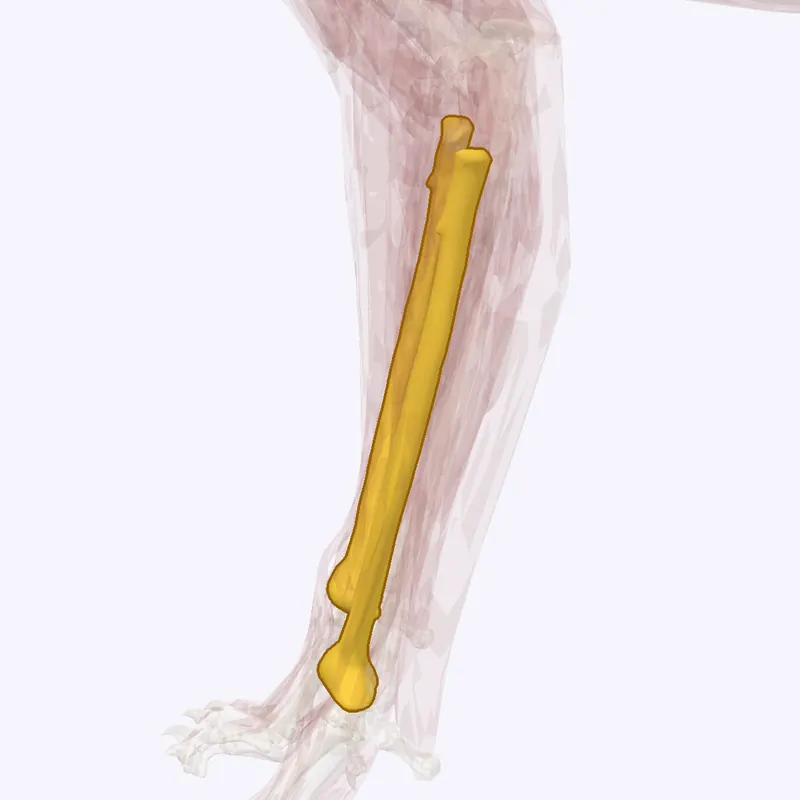
Bone of the forearm lying cranial to the ulna. In the cat it rotates widely around the ulna, letting the paw turn to catch prey and to groom.
Key points
- It is the main weight-bearing bone of the forearm, from elbow to carpus.
- Its range of pronation and supination is much greater than in the dog.
- The radial tuberosity receives the insertion of the biceps brachii.
- Intramedullary pins are not suitable for repairing the radius.
- Loss of forearm rotation suggests joint injury or fracture.
Overview
The radius is, with the ulna, one of the two bones of the forearm. It is the main weight-bearing bone: it receives the load of the humerus at the elbow and passes it to the carpus.
In the cat, the radius and ulna are joined by an interosseous membrane and loose ligaments. The radius can rotate around the ulna with a range of pronation and supination much greater than in the dog.
Key features
- Head of the radius (caput radii). The proximal end. It has a concave fovea that articulates with the capitulum of the humerus and an articular circumference that turns in the radial notch of the ulna.
- Radial tuberosity. On the medial surface, distal to the neck. The biceps brachii inserts on it.
- Body. Slightly curved cranially. The extensor muscles of the carpus and digits cover it cranially.
- Trochlea of the radius. Distal articular surface for the radial carpal bone.
- Styloid process (processus styloideus radii). Medial distal projection, palpable.
- Ulnar notch. On the lateral edge of the distal end. It articulates with the head of the ulna.
Clinical relevance
- Radius and ulna fractures. Common after road accidents and falls. They are repaired with plates or external fixators. Intramedullary pins are not suitable for the radius.
- Osteosarcoma. Can affect the radius, although in the cat it is less common than in the pelvic limb.
- Examination. Forearm rotation is assessed by holding the elbow and turning the paw. Its loss suggests joint injury or fracture.
Diseases
- OsteosarcomaThe most common malignant bone tumour of the dog. It affects the metaphysis of long bones in large and giant…
Related structures
See it in 3D on your iPhone
Peel the layers, spin the model, quiz yourself on it and stand it on your desk in AR. AnatomyCompass is coming to iPhone, iPad and Mac: get one email when it’s out.
More of the Cat: Skeletal system
Text adapted from Vet Atlas (CC BY-SA 4.0). 3D model: "Feline Skeleton Dec" by westerly (Sketchfab) (CC BY 4.0). Sources and licences. This veterinary text has not yet been reviewed by a veterinarian.