 AnatomyCompass
Scapula
Scapula · Cat · Skeletal system · Thoracic limb
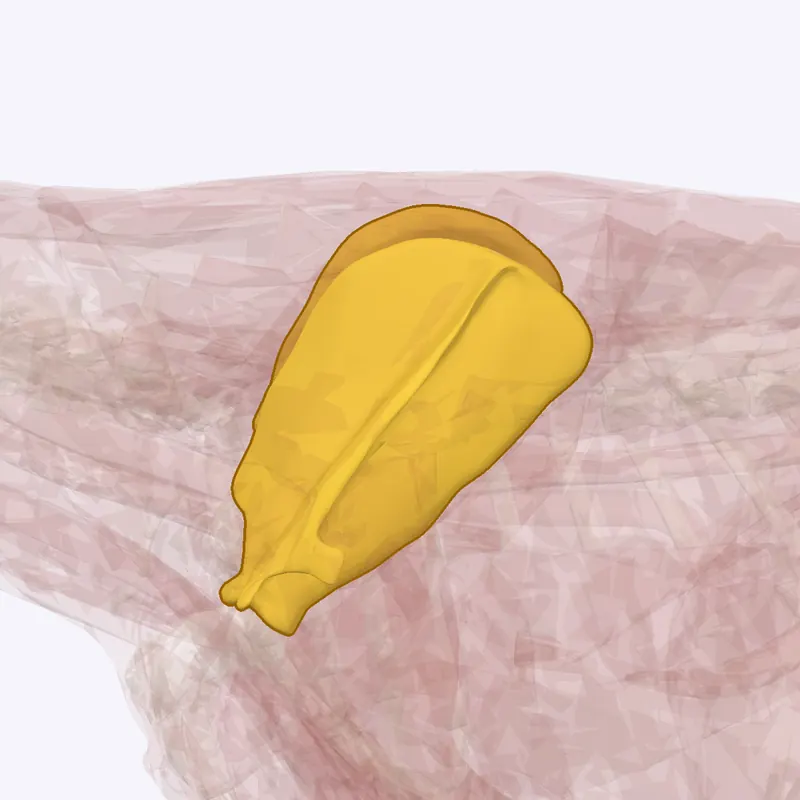
Flat bone of the shoulder, joined to the trunk only by muscles. In the cat its acromion has two projections, the hamate and suprahamate processes.
Key points
- It has no bony joint with the trunk; the shoulder girdle muscles hold it.
- The spine divides the lateral surface into the supraspinous and infraspinous fossae.
- The suprahamate process of the acromion is directed caudally.
- The supraglenoid tubercle is the origin of the biceps brachii.
- In dorsal luxation the dorsal border rises above the back when the limb bears weight.
Overview
The scapula is a flat, triangular bone lying against the lateral wall of the cranial thorax.
It has no bony joint with the trunk. The muscles of the shoulder girdle hold it in place: serratus ventralis, rhomboideus, trapezius and others. This lets it glide widely during walking and jumping.
Distally it articulates with the humerus at the shoulder joint.
Key features
- Spine of the scapula (spina scapulae). A ridge on the lateral surface that divides it into the supraspinous fossa, cranial, and the infraspinous fossa, caudal. The muscles of the same names fill them.
- Acromion. The distal end of the spine. In the cat it carries a hamate process (processus hamatus), directed ventrally, and a suprahamate process (processus suprahamatus), directed caudally. The acromial part of the deltoideus and the omotransversarius attach to them.
- Medial or costal surface. It has the subscapular fossa, for the subscapularis, and the serrated face, where the serratus ventralis inserts.
- Dorsal border. Extended by the scapular cartilage.
- Glenoid cavity (cavitas glenoidalis). Shallow articular surface for the head of the humerus.
- Supraglenoid tubercle. Origin of the biceps brachii. Medial to it, the small coracoid process gives origin to the coracobrachialis.
Clinical relevance
- Fractures. Uncommon, because the scapula is protected by a thick layer of muscle. They occur in high-energy trauma.
- Dorsal scapular luxation. Described in cats after falls or trauma. Rupture of the serratus ventralis and the other muscles that fix the scapula to the trunk makes the dorsal border rise above the line of the back when the limb bears weight.
- Radiography. On lateral thoracic views, the scapula overlaps the spine and the first ribs.
Related structures
See it in 3D on your iPhone
Peel the layers, spin the model, quiz yourself on it and stand it on your desk in AR. AnatomyCompass is coming to iPhone, iPad and Mac: get one email when it’s out.
More of the Cat: Skeletal system
Text adapted from Vet Atlas (CC BY-SA 4.0). 3D model: "Feline Skeleton Dec" by westerly (Sketchfab) (CC BY 4.0). Sources and licences. This veterinary text has not yet been reviewed by a veterinarian.