 AnatomyCompass
Mandible
Mandibula · Horse · Skeletal system · Axial skeleton
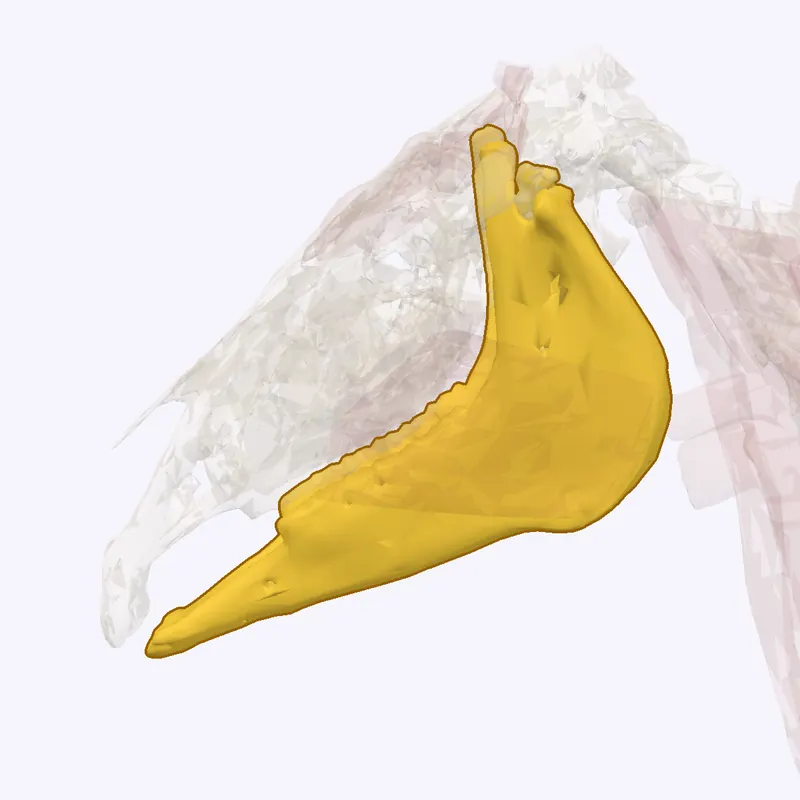
The bone of the lower jaw, formed by two halves fused at the symphysis. In the horse it has a wide interdental space where the bit rests and a vascular notch where the pulse is taken.
Key points
- The mandibular symphysis fuses during the first months of life.
- The ramus is tall and the angle very wide, for the attachment of the masseter.
- The temporomandibular joint has a disc and allows wide side-to-side movements.
- The mental nerve leaves through the mental foramen and is blocked for dental procedures.
- Eruption bumps in young horses normally resolve on their own.
Overview
The mandible (mandibula) is the only movable bone of the skull. Its two halves fuse at the mandibular symphysis during the first months of life. In the adult it is a single bone.
Each half has:
- an incisive part, which holds the incisors and the canine
- a body, carrying the cheek teeth
- a vertical ramus, which articulates with the skull
In the horse the ramus is tall and the mandibular angle very wide, for the attachment of the powerful masseter.
Key features
- Interalveolar margin (margo interalveolaris). The interdental space, or "bars", between the canine or incisors and the first cheek tooth. It is covered only by gum. The bit rests here.
- Notch for the facial vessels (incisura vasorum facialium). On the ventral border, rostral to the angle. The facial artery and vein and the parotid duct cross it onto the face. The horse's pulse is taken here.
- Mental foramen (foramen mentale). On the lateral surface of the incisive part. The mental nerve exits through it.
- Mandibular foramen (foramen mandibulae). On the medial surface of the ramus. The inferior alveolar nerve enters the mandibular canal through it.
- Coronoid process. Tall and narrow. It rises into the temporal fossa and receives the temporalis.
- Condylar process. Articulates with the temporal bone at the temporomandibular joint. The joint has an articular disc and allows the wide side-to-side movements of chewing.
Clinical relevance
- Injuries to the bars. A poorly fitted bit or rough use of the reins can injure the gum and the bone of the interdental space.
- Fractures of the incisive part. Common when the horse bites a fixed object and pulls back. They usually have a good prognosis with wire fixation.
- Eruption bumps. Firm swellings on the ventral border in young horses, below the erupting premolars. They normally resolve on their own.
- Nerve blocks. The mental and inferior alveolar nerves are anaesthetised for dental procedures.
Diseases
- StranglesHighly contagious infection by Streptococcus equi subsp. equi that causes fever and abscesses in the lymph…
Related structures
See it in 3D on your iPhone
Peel the layers, spin the model, quiz yourself on it and stand it on your desk in AR. AnatomyCompass is coming to iPhone, iPad and Mac: get one email when it’s out.
More of the Horse: Skeletal system
Text adapted from Vet Atlas (CC BY-SA 4.0). 3D model: "Horse (Equus ferus caballus)" by The University of Edinburgh Open.Ed, Royal (Dick) School of Veterinary Studies (Sketchfab) (CC BY 4.0). Sources and licences. This veterinary text has not yet been reviewed by a veterinarian.