 AnatomyCompass
Sacrum
Os sacrum · Horse · Skeletal system · Axial skeleton
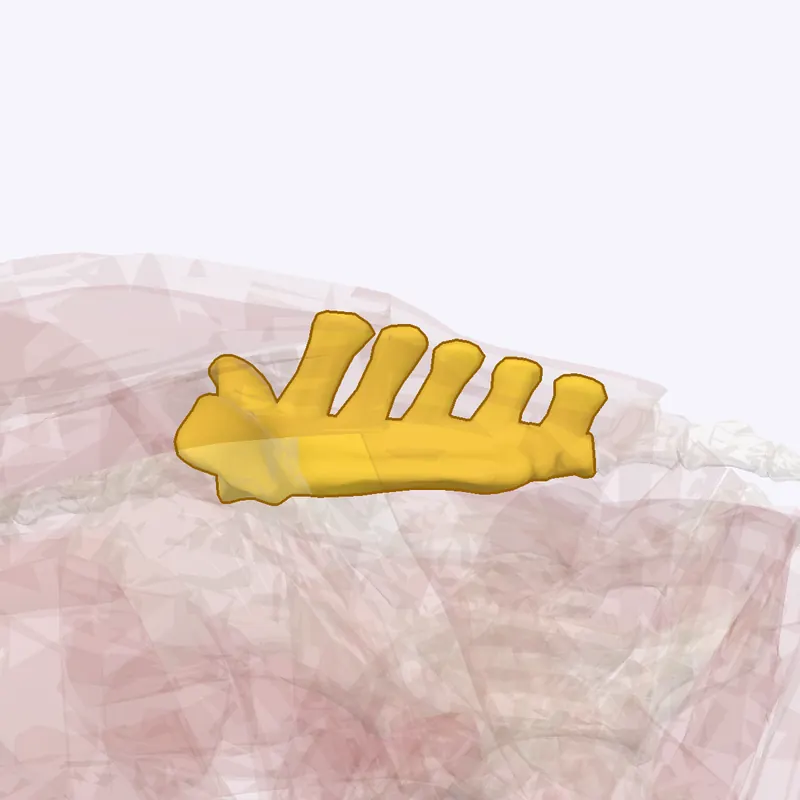
Bone formed by the fusion of five sacral vertebrae. It joins the spine to the pelvis at the sacroiliac joints; in the horse its spinous processes remain separate at their tips.
Key points
- In the horse the wings also articulate with the transverse processes of L6.
- The promontory projects ventrally at the pelvic inlet.
- The tubera sacralia of the ilium lie level with the tips of the spinous processes.
- Sacroiliac joint disease causes croup pain and poor performance in sport horses.
- A sacral fracture can cause tail paralysis and incontinence.
Overview
The sacrum (os sacrum) results from the fusion of five sacral vertebrae and forms the roof of the pelvic cavity.
- Its base articulates cranially with the last lumbar vertebra.
- Its wings articulate with the ilium at the sacroiliac joints. Through them the thrust of the pelvic limbs is transmitted to the spine.
- In the horse the wings also articulate with the transverse processes of L6, at the intertransverse joint.
Key features
- Base and promontory. The base is the cranial surface of the body of S1. The promontory projects ventrally at the pelvic inlet.
- Wings (alae ossis sacri). Broad and triangular, with the auricular surface for the ilium on their dorsolateral side.
- Spinous processes. Joined at their base but free at the tips, unlike the continuous sacral crest of cattle.
- Tubera sacralia. They belong to the ilium and rise beside the spinous processes. In the horse they lie level with their tips or slightly above them.
- Dorsal and ventral sacral foramina. Transmit the branches of the sacral nerves.
- Ligaments. The dorsal and ventral sacroiliac ligaments join the sacrum to the ilium. The broad sacrotuberous ligament closes the pelvic cavity laterally.
Clinical relevance
- Sacroiliac joint disease. A recognised cause of croup pain and poor performance in sport horses. Diagnosis is difficult because the joint is deeply covered by muscle.
- Asymmetry of the tubera sacralia ("hunter's bump"). Prominence of one or both tubera sacralia. It can point to an old injury of the sacroiliac ligaments, although it is also seen in horses without signs.
- Sacral fractures. Seen in horses that fall over backwards or onto the croup. They can injure the sacral and caudal nerves, causing tail paralysis, urinary and faecal incontinence and loss of perineal sensation.
Related structures
See it in 3D on your iPhone
Peel the layers, spin the model, quiz yourself on it and stand it on your desk in AR. AnatomyCompass is coming to iPhone, iPad and Mac: get one email when it’s out.
More of the Horse: Skeletal system
Text adapted from Vet Atlas (CC BY-SA 4.0). 3D model: "Horse Skeleton" by Diego Luján García (diegoluga on Sketchfab) (CC BY 4.0). Sources and licences. This veterinary text has not yet been reviewed by a veterinarian.