 AnatomyCompass
Strangles
Infectious · Horse
Highly contagious infection by Streptococcus equi subsp. equi that causes fever and abscesses in the lymph nodes of the head. Some recovered horses keep carrying the bacterium in the guttural pouches without signs and are the source of new outbreaks.
Key points
- Outbreaks usually start after the arrival of a new horse, often a healthy carrier.
- Around 10% of recovered horses remain carriers.
- Carriers are detected by guttural pouch endoscopy with lavage and PCR.
- Uncomplicated cases get supportive care, without antibiotics.
- Horses with high SeM titres are not vaccinated because of the risk of purpura haemorrhagica.
What it is
Strangles (equine distemper) is an infection of the upper airways and their lymph nodes. It is caused by Streptococcus equi* subsp. *equi, a bacterium adapted to equids.
It enters through the mouth or nose and attaches to the lymphoid tissue of the pharynx. Within a few hours it reaches the mandibular and retropharyngeal lymph nodes, where it forms abscesses.
- Mandibular abscesses usually rupture to the outside under the jaw.
- Retropharyngeal abscesses often drain into the guttural pouches. There pus can accumulate (empyema) and thicken into concretions (chondroids).
Around 10% of horses that recover remain carriers. They harbour the bacterium in the guttural pouches without signs for months or years and shed it intermittently. They are the main reason the disease persists and reaches clean premises.
The complications are:
- bastard strangles, with abscesses in other lymph nodes, such as the mesenteric or mediastinal nodes, or in organs
- purpura haemorrhagica, an immune-complex vasculitis with oedema and haemorrhages
- myopathies
- airway obstruction by enlarged lymph nodes, which gives the disease its English name
Who it affects
Horses, donkeys and mules of all ages, with more cases in young animals.
Outbreaks usually start after the arrival of a new horse, often a healthy carrier. It spreads by direct contact and through water troughs, feeders, equipment, clothing and hands.
Anatomy involved
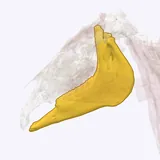
Mandible
Between its two rami, in the intermandibular space, lie the mandibular lymph nodes. They are palpably enlarged, hot and painful, and most abscesses form and open there.
Behind the rami, under the base of the skull, lie the retropharyngeal lymph nodes and the guttural pouches.
Guttural pouches
They are extensions of the auditory tube found only in equids. The medial retropharyngeal lymph nodes are in contact with their floor, so their abscesses rupture into them.
They are the site of persistence of the bacterium in carriers and where samples are taken to detect them.
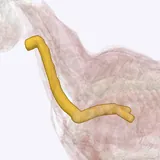
Trachea
Retropharyngeal abscesses compress the pharynx and larynx and can obstruct airflow. In such cases an emergency tracheotomy may be needed.
Clinical signs
- High fever, depression and inappetence, often one or two days before the horse starts shedding the bacterium.
- Mucopurulent nasal discharge.
- Enlarged, painful mandibular lymph nodes that eventually abscess and drain thick pus.
- Dysphagia, extended head and respiratory noise.
- Breathing difficulty, if the retropharyngeal nodes are very enlarged.
Horses with partial immunity can have mild forms, with little fever and barely enlarged nodes.
Diagnosis
- In acute cases, quantitative PCR and culture of pus from an abscess, a nasopharyngeal swab or a nasopharyngeal wash.
- ELISAs against antigens A and C detect exposed horses, for example before they enter a premises.
- Titres against the SeM protein help assess purpura haemorrhagica or metastatic abscesses.
- Ultrasonography of the lymph nodes and, in bastard strangles, abdominal or thoracic ultrasonography.
Carriers are detected by guttural pouch endoscopy with lavage and PCR. It is much more sensitive than a nasal swab.
PCR is more sensitive than culture, but it also detects dead bacteria. Horses that were PCR-positive but culture-negative have transmitted the infection, so combined culture and PCR is recommended.
Treatment and prevention
Uncomplicated cases
Treatment relies mainly on supportive care, without antibiotics:
- rest and palatable feed
- non-steroidal anti-inflammatory drugs
- hot packing to bring abscesses to maturity
- drainage and flushing of mature abscesses
Antibiotics
Mainly penicillin is used, in these cases:
- in the febrile phase, before abscesses form
- in horses with breathing difficulty or severe dysphagia
- in complications
Giving them once abscesses have formed can delay maturation. Recommendations rest mostly on expert opinion.
Carriers
Treatment is guttural pouch lavage, endoscopic removal of chondroids and topical and systemic penicillin, until results are negative.
Outbreak control
- isolate sick horses
- separate exposed from unexposed horses
- take temperatures daily to detect new cases early
- quarantine and test incoming horses
- keep restrictions in place until carriers have been ruled out
Vaccines
There are live attenuated vaccines and a recombinant subunit vaccine that allows vaccinated horses to be distinguished from infected ones (DIVA). They reduce the number and severity of cases but do not always prevent infection.
Vaccinating horses with high SeM titres is not recommended because of the risk of purpura haemorrhagica.
Regulations
Drug use in horses is subject to each country's regulations and to withdrawal periods. In the EU the horse is a food-producing species. Its identification document (passport) states whether it is excluded from slaughter for human consumption, which determines which drugs may be given.
Key studies
- ACVIM consensus (Boyle et al., 2018). Updates the 2005 guideline on signs, pathogenesis, epidemiology, treatment, complications and control. It highlights the role of carriers, redefines the reference standard for detecting infection with PCR and serology, stresses prudent antibiotic use and links vaccination to control programmes. It is expert opinion.
- Houben et al. (2023). Systematic review and meta-analysis of 10 outbreaks (8 published). The estimated basic reproduction number was 2.2 (95% CI 1.9–2.5), and 2.7 (95% CI 2.1–3.3) when outbreaks in which every horse fell ill were included. It helps calculate the vaccine coverage needed. Most estimates rely only on final outbreak size and may underestimate contagiousness.
- Boyle et al. (2017). Diagnostic study in 44 convalescent horses sampled at the same time in the nasopharynx and the guttural pouches. Isothermal DNA amplification (LAMP) was positive in 1 of 41 nasopharyngeal swabs, 6 of 38 nasopharyngeal washes and 24 of 44 guttural pouch lavages, where detection was 51 times more likely (OR 51.0). In the pouch lavages, real-time PCR was positive in 18 of 44 and culture in only 4 of 44. It is a single group of horses.
- Robinson et al. (2020). Four experimental challenge studies in ponies with the recombinant vaccine Strangvac versus an adjuvant-only placebo. All 36 control ponies became ill. With the vaccine, 5 of 16 were protected 2 weeks after the second dose, 7 of 12 at 2 months, and 15 of 16 (94%) 2 weeks after a third dose. The response did not interfere with the exposure ELISA (DIVA). It is an experimental infection in ponies, and the study was funded by the manufacturer, with authors linked to it.
- Mitchell et al. (2021). Genomic analysis of 670 S. equi isolates from 19 countries. It showed many transmissions between regions and countries linked to horse movements, driven by carriers that look healthy and are rarely detected at pre-purchase or transit examinations. It is a population genetics study, not a clinical one, and one of the authors works for a vaccine manufacturer.
Structures affected
References
- Sellon DC, Long MT. Equine Infectious Diseases, 2nd ed. Elsevier (2014)
- Boyle AG, Timoney JF, Newton JR, et al. Streptococcus equi Infections in Horses: Guidelines for Treatment, Control, and Prevention of Strangles-Revised Consensus Statement. J Vet Intern Med 32:633-647 (2018)
- Houben RMAC, van Maanen K, Kemp-Symonds JG, et al. Estimation of the basic reproduction number for Streptococcus equi spp. equi outbreaks by meta-analysis of strangles outbreak reports. Equine Vet J 55:506-514 (2023)
- Boyle AG, Stefanovski D, Rankin SC. Comparison of nasopharyngeal and guttural pouch specimens to determine the optimal sampling site to detect Streptococcus equi subsp equi carriers by DNA amplification. BMC Vet Res 13:75 (2017)
- Robinson C, Waller AS, Frykberg L, et al. Intramuscular vaccination with Strangvac is safe and induces protection against equine strangles caused by Streptococcus equi. Vaccine 38:4861-4868 (2020)
- Mitchell C, Steward KF, Charbonneau ARL, et al. Globetrotting strangles: the unbridled national and international transmission of Streptococcus equi between horses. Microb Genom 7:000528 (2021)
- Newton JR, Verheyen K, Talbot NC, et al. Control of strangles outbreaks by isolation of guttural pouch carriers identified using PCR and culture of Streptococcus equi. Equine Vet J 32:515-26 (2000)
- Merck Veterinary Manual: Strangles in Horses
- Merck Veterinary Manual: Guttural Pouch Disease in Horses
- Regulation (EU) 2019/6 on veterinary medicinal products, Article 112 (equine species declared not intended for slaughter)
- Merck Veterinary Manual (Horse Owners): Guttural Pouch Disease in Horses
See it in 3D on your iPhone
Peel the layers, spin the model, quiz yourself on it and stand it on your desk in AR. AnatomyCompass is coming to iPhone, iPad and Mac: get one email when it’s out.
Text adapted from Vet Atlas (CC BY-SA 4.0). Sources and licences. This veterinary text has not yet been reviewed by a veterinarian.