 AnatomyCompass
Large intestine
Intestinum crassum · Cow · Splanchnology (organs) · Digestive system
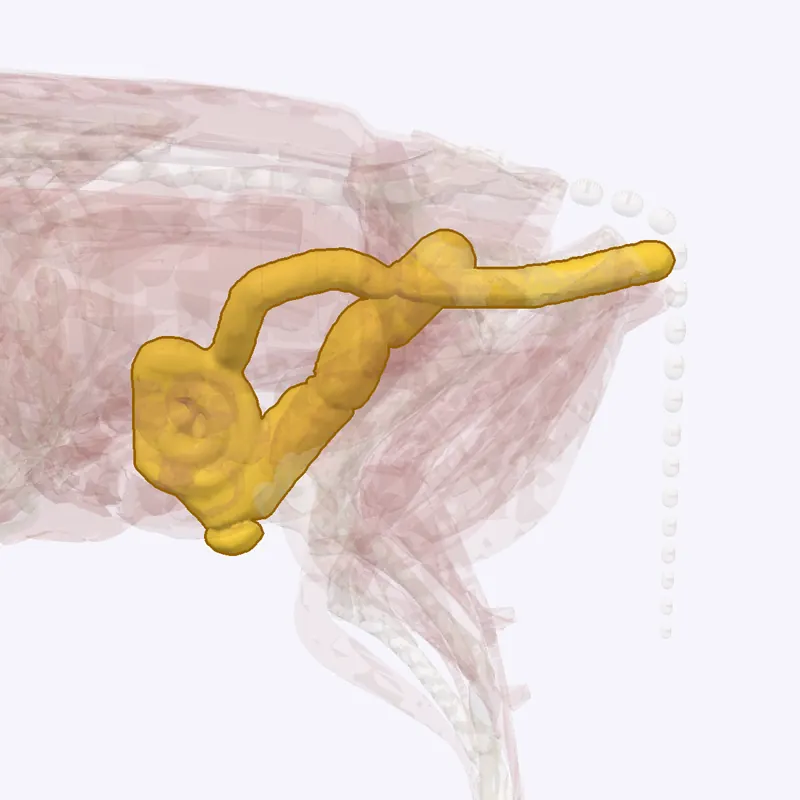
Caecum, colon and rectum. In cattle the ascending colon coils into a flat disc, the spiral colon, set in the mesentery to the right of the rumen; the caecum lies free in the right flank.
Key points
- Unlike that of the horse, it has no taeniae or sacculations.
- The spiral loop of the ascending colon forms a flat disc between the mesentery and the rumen.
- Caecal dilatation causes a ping in the right paralumbar fossa.
- Calf atresia coli is more common in Holsteins.
- Rough handling during palpation can cause rectal tears.
Overview
The bovine large intestine (intestinum crassum) is only slightly wider than the small intestine. Unlike that of the horse, it has no taeniae or sacculations.
Microbial fermentation of what escaped the rumen continues here, and water and electrolytes are absorbed.
It lies in the right half of the abdomen, together with the small intestine.
Parts
- Caecum (caecum). The blind continuation of the ascending colon beyond the ileal orifice. Its free apex points towards the pelvic inlet in the dorsal part of the right flank.
- Ascending colon. It begins with the proximal loop (ansa proximalis), continues as the spiral loop (ansa spiralis) and ends with the distal loop (ansa distalis).
- Spiral loop. It forms a flat disc in the sagittal plane, on the left face of the mesentery, so that it lies between the mesentery and the rumen. Its centripetal turns (gyri centripetales) converge on a central flexure. The centrifugal turns (gyri centrifugales) run back out to the periphery, interleaved with them.
- Transverse colon. It passes from right to left, cranial to the root of the mesentery.
- Descending colon. It runs caudally, near the midline and the roof of the abdomen, to the rectum.
- Rectum. It lies in the pelvic cavity. Through its wall the genital organs, bladder, left kidney and other structures of the caudal abdomen are palpated.
Clinical relevance
- Caecal dilatation and volvulus occur in adult dairy cows, often after calving and on concentrate-rich diets. They cause a ping on percussion of the right paralumbar fossa. Per rectum, the dilated caecum is felt as a cylinder whose apex points towards the pelvis. Volvulus requires surgery.
- Rectal palpation is the basis of the reproductive examination. Rough handling can cause rectal tears.
- Atresia coli is a congenital anomaly of calves, more common in Holsteins. It presents with no faeces and progressive abdominal distension. It has been linked to transrectal palpation of the amniotic vesicle in the first weeks of pregnancy.
- Winter dysentery is an epidemic disease of adult cows associated with bovine coronavirus. It causes diarrhoea, sometimes haemorrhagic, and a drop in milk yield.
Diseases
- Neonatal calf diarrhoeaDiarrhoea of calves in their first month of life caused by rotavirus, coronavirus, Cryptosporidium parvum and…
- Paratuberculosis (Johne's disease)Chronic granulomatous enteritis caused by Mycobacterium avium subsp. paratuberculosis. Calves are infected in…
Related structures
See it in 3D on your iPhone
Peel the layers, spin the model, quiz yourself on it and stand it on your desk in AR. AnatomyCompass is coming to iPhone, iPad and Mac: get one email when it’s out.
More of the Cow: Splanchnology (organs)
Text adapted from Vet Atlas (CC BY-SA 4.0). 3D model: Vet Atlas procedural organs (CC BY-SA 4.0). Sources and licences. This veterinary text has not yet been reviewed by a veterinarian.