 AnatomyCompass
Esophagus
Oesophagus · Cow · Splanchnology (organs) · Digestive system
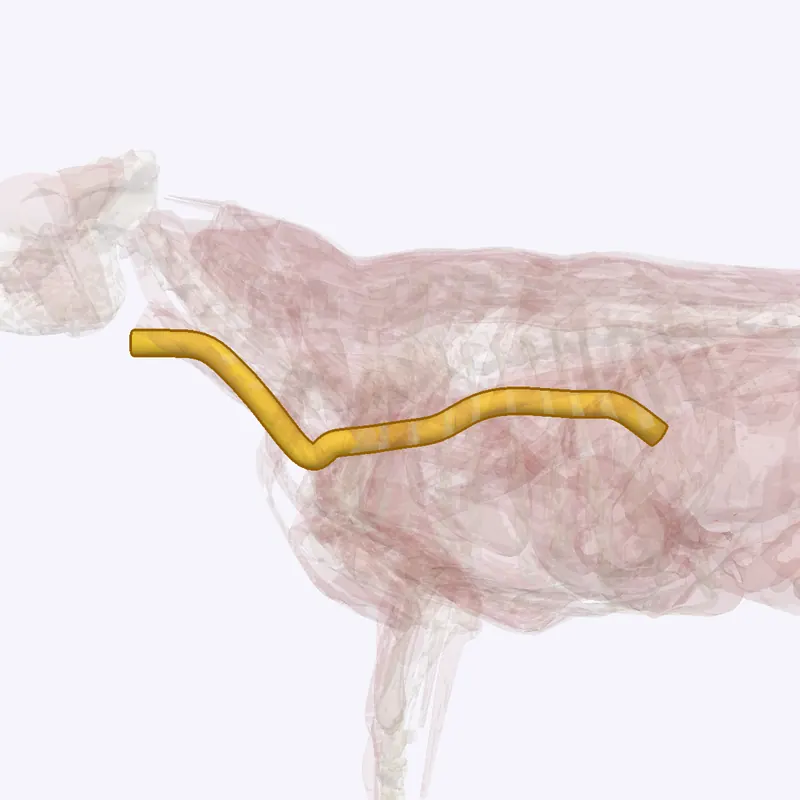
Muscular tube that carries food from the pharynx to the stomach. In cattle it opens at the cardia, between the reticulum and the ruminal atrium, and also returns the bolus for rumination and releases gas during eructation.
Key points
- In the neck it runs left of the trachea, in the left jugular groove.
- In ruminants its muscular coat is striated along its whole length.
- Choke from fruits or tubers causes free-gas bloat.
- The position of the orogastric tube is checked in the left jugular groove.
Overview
The esophagus (oesophagus) begins dorsal to the cricoid cartilage of the larynx.
In the neck it first runs dorsal to the trachea and then on its left, so the passage of a bolus can be seen in the left jugular groove.
In the thorax it runs through the mediastinum, dorsal to the trachea and the heart base. It crosses the diaphragm through the esophageal hiatus and opens soon after at the cardia, at the junction of the reticulum and the ruminal atrium.
Structure
- Muscular coat. In ruminants it is striated muscle along its whole length, which allows rapid transport in both directions.
- Mucosa. Stratified squamous epithelium with longitudinal folds that flatten when it distends.
- Reticular groove. Begins at the cardia and continues the line of the esophagus to the reticulo-omasal orifice.
Function in the ruminant
- Rumination. The esophagus returns boluses from the reticulorumen to the mouth to be chewed and mixed with saliva again, and then swallows them again.
- Eructation. Fermentation gases are expelled through the esophagus. Part of the gas passes into the lungs before leaving.
Clinical relevance
Esophageal obstruction
Whole fruits and tubers, such as potatoes, apples or beets, usually lodge at three points:
- the cervical part
- the thoracic inlet
- over the heart base
Choke causes drooling, attempts to swallow and free-gas bloat, because the animal cannot eructate.
Tubing
The orogastric tube is used to give fluids and drugs, relieve bloat and collect rumen fluid.
Its position is checked by palpating it in the left jugular groove, or by blowing and listening over the rumen.
Other lesions
- Compression. Enlarged mediastinal lymph nodes or abscesses can compress the esophagus and cause chronic bloat.
- Bovine viral diarrhoea, or mucosal disease. Causes erosions and ulcers in the esophageal mucosa, as well as in the mouth and the rest of the digestive tract.
Diseases
- Ruminal tympanyDistension of the reticulorumen by fermentation gas that the animal cannot eructate. It can be frothy or…
- Bovine viral diarrhoeaPestivirus infection that causes immunosuppression, reproductive losses, congenital malformations and…
Related structures
See it in 3D on your iPhone
Peel the layers, spin the model, quiz yourself on it and stand it on your desk in AR. AnatomyCompass is coming to iPhone, iPad and Mac: get one email when it’s out.
More of the Cow: Splanchnology (organs)
Text adapted from Vet Atlas (CC BY-SA 4.0). 3D model: Vet Atlas procedural organs (CC BY-SA 4.0). Sources and licences. This veterinary text has not yet been reviewed by a veterinarian.