 AnatomyCompass
Spinal nerve roots
Radices nervi spinalis · Back · Nerve
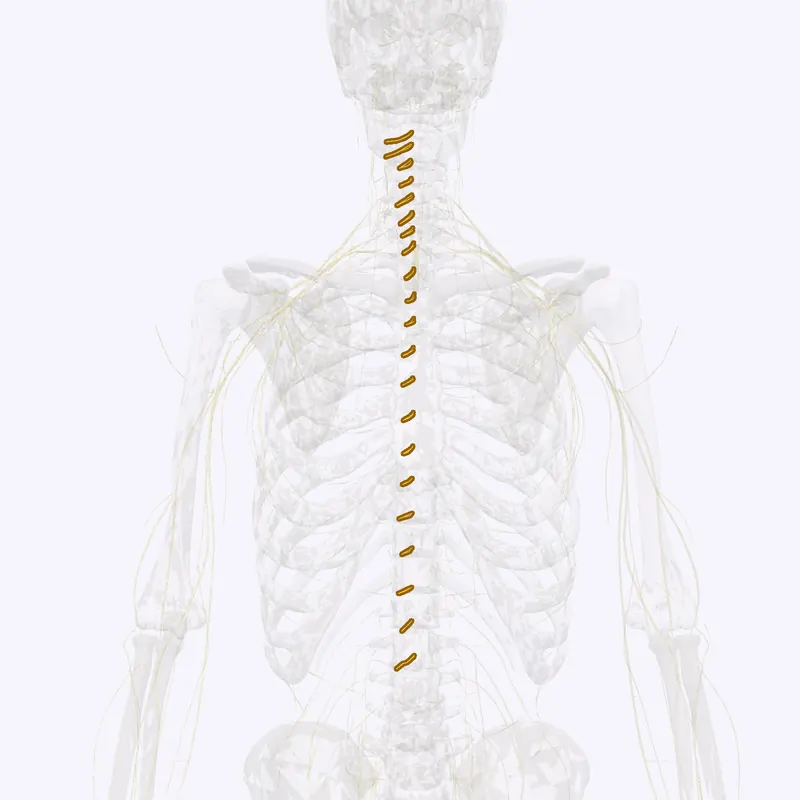
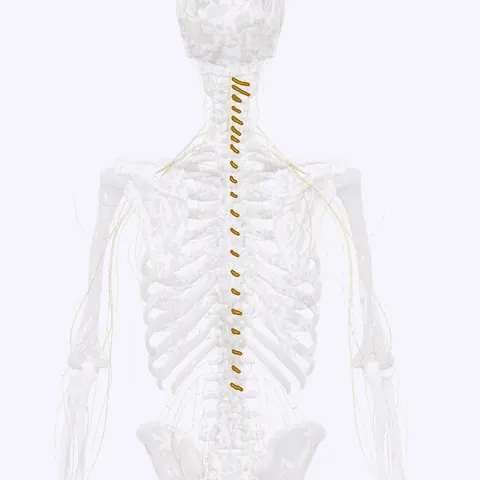
The anterior (motor) and posterior (sensory) roots that join each segment of the spinal cord to its spinal nerve.
Quick facts
- Latin name
- Radices nervi spinalis
- Type
- Nerve
- Body area
- Back
Spinal nerve roots: roots
31 pairs of segments: 8 cervical, 12 thoracic, 5 lumbar, 5 sacral, 1 coccygeal.
Spinal nerve roots: course
Rootlets leave the cord in front (anterior root) and behind (posterior root); the two roots cross the subarachnoid space, the posterior root swells into the spinal ganglion, and they join in or near the intervertebral foramen to form the spinal nerve.
Spinal nerve roots: motor
Anterior root: motor fibres to skeletal muscle and, at T1–L2 (and S2–S4), autonomic preganglionic fibres.
Spinal nerve roots: sensory
Posterior root: all sensory fibres from skin, muscles, joints and viscera.
Spinal nerve roots: injury sign
Radiculopathy: pain in a dermatome, weakness in a myotome and a lost reflex at that level.
3D views
Spinal nerve roots: clinical note
A disc herniation usually presses on the root that leaves one level below in the lumbar spine (an L4/L5 disc on the L5 root).
Questions about the spinal nerve roots
What is the spinal nerve roots?
The anterior (motor) and posterior (sensory) roots that join each segment of the spinal cord to its spinal nerve.
See the spinal nerve roots in 3D
Peel the layers, spin the model, quiz yourself on it and stand it on your desk in AR. AnatomyCompass is coming to iPhone, iPad and Mac: get one email when it’s out.
Other nerves: back
Spotted something wrong? Tell us and we’ll fix it. This page is a study reference, not medical advice.