 AnatomyCompass
Cauda equina
Cauda equina · Back · Nerve
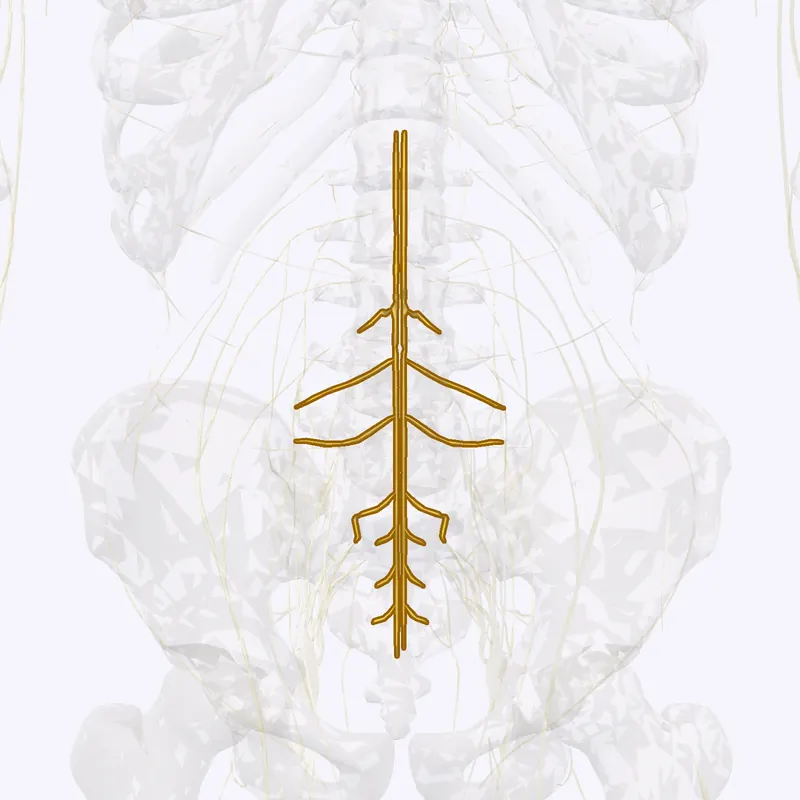
The bundle of lumbar, sacral and coccygeal nerve roots below the end of the spinal cord, like a horse's tail.
Quick facts
- Latin name
- Cauda equina
- Type
- Nerve
- Body area
- Back
Cauda equina: location
Lumbar cistern of the vertebral canal, from the conus medullaris (about L1/L2) to the sacrum, floating in cerebrospinal fluid.
Cauda equina: contents
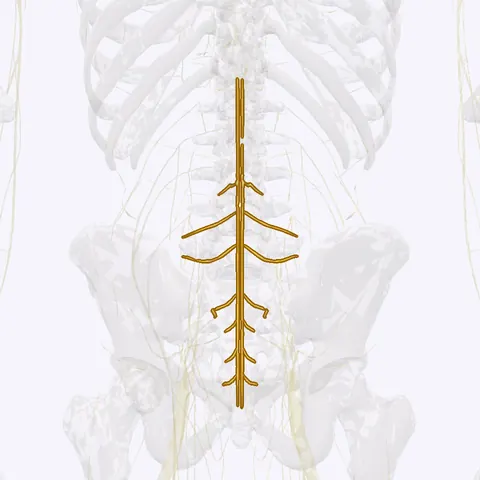
Anterior and posterior roots of L2–Co1 on their way to their foramina, around the filum terminale.
Cauda equina: function
Motor and sensory supply of the lower limbs, perineum, bladder, bowel and sexual organs.
Cauda equina: relations
Inside the dural sac, which ends at about S2; behind the lumbar discs.
3D views
Cauda equina: clinical note
Cauda equina syndrome (usually a large central disc): saddle numbness, bladder or bowel changes and leg weakness need an emergency MRI and surgery. Lumbar puncture is safe below L2 because the roots move aside from the needle.
Questions about the cauda equina
What is the cauda equina?
The bundle of lumbar, sacral and coccygeal nerve roots below the end of the spinal cord, like a horse's tail.
Where is the cauda equina?
Lumbar cistern of the vertebral canal, from the conus medullaris (about L1/L2) to the sacrum, floating in cerebrospinal fluid.
What does the cauda equina do?
Motor and sensory supply of the lower limbs, perineum, bladder, bowel and sexual organs.
See the cauda equina in 3D
Peel the layers, spin the model, quiz yourself on it and stand it on your desk in AR. AnatomyCompass is coming to iPhone, iPad and Mac: get one email when it’s out.
Other nerves: back
Spotted something wrong? Tell us and we’ll fix it. This page is a study reference, not medical advice.