Ribs
Costae · Trunk · Bone
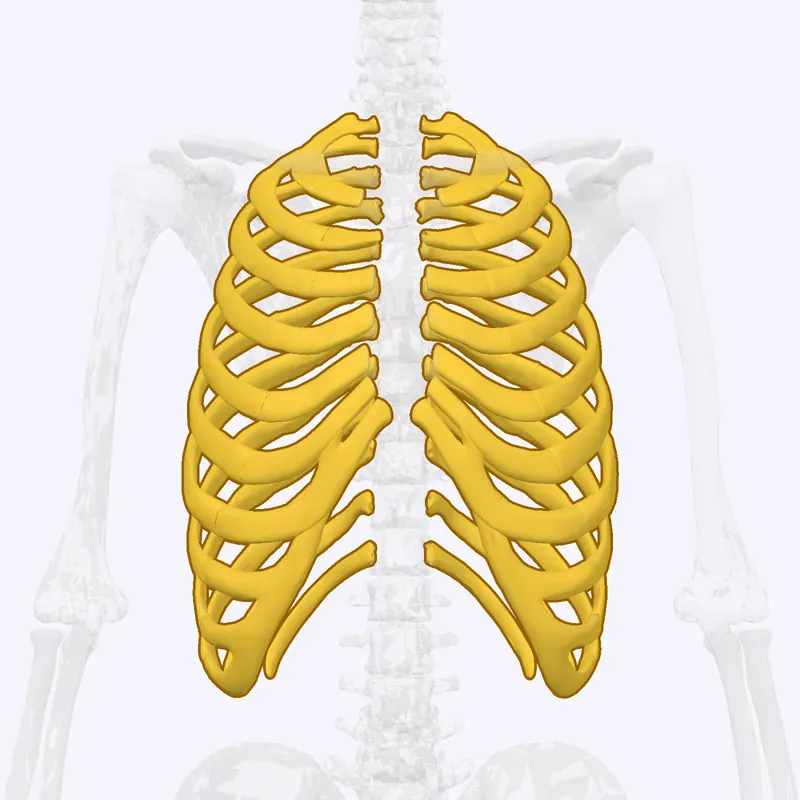
Twelve pairs of curved bones forming the rib cage. Ribs 1–7 join the sternum directly (true ribs), 8–10 through the cartilage above (false ribs), and 11–12 end free (floating ribs).
Quick facts
- Latin name
- Costae
- Also called
- ryobra, Roentgenizdat, music on ribs
- Type
- Bone
- Body area
- Trunk
Landmarks of the ribs
- Head
- Meets the bodies of its own vertebra and the one above.
- Tubercle
- Meets the transverse process of its own vertebra.
- Angle
- Sharpest bend at the back; iliocostalis attaches near it.
- Costal groove
- Under the lower border: intercostal vein, artery and nerve (in that order from above).
- Scalene tubercle (first rib)
- Scalenus anterior inserts; the subclavian vein passes in front and the artery behind.
- Costal cartilages
- Hyaline cartilage joining the ribs to the sternum; they let the cage spring when breathing.
Joints of the ribs
- Costovertebral and costotransverse joints
- Sternocostal joints
- Interchondral joints
3D views
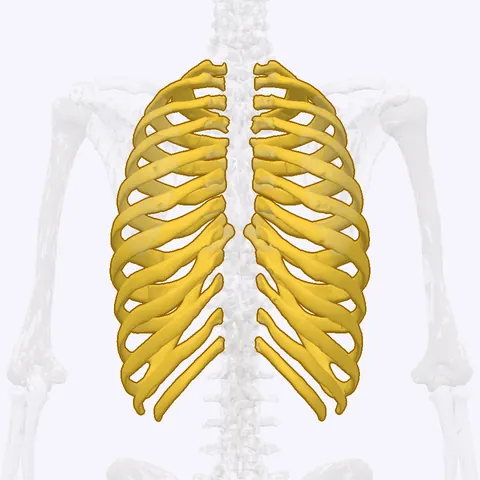
Muscles that attach to the ribs
From the origin and insertion on each muscle’s page.
- Latissimus dorsi
- Serratus posterior superior
- Serratus posterior inferior
- Iliocostalis
- Longissimus
- Quadratus lumborum
- Rectus abdominis
- External oblique
- Internal oblique
- Transversus abdominis
- Diaphragm
- External intercostals
- Internal intercostals
- Innermost intercostals
- Transversus thoracis
- Scalenus anterior
- Scalenus medius
- Scalenus posterior
Questions about the ribs
What is the ribs?
Twelve pairs of curved bones forming the rib cage. Ribs 1–7 join the sternum directly (true ribs), 8–10 through the cartilage above (false ribs), and 11–12 end free (floating ribs).
See the ribs in 3D
Peel the layers, spin the model, quiz yourself on it and stand it on your desk in AR. AnatomyCompass is coming to iPhone, iPad and Mac: get one email when it’s out.
Other bones: trunk
Spotted something wrong? Tell us and we’ll fix it. This page is a study reference, not medical advice.