 AnatomyCompass
Small intestine
Intestinum tenue · Horse · Splanchnology (organs) · Digestive system
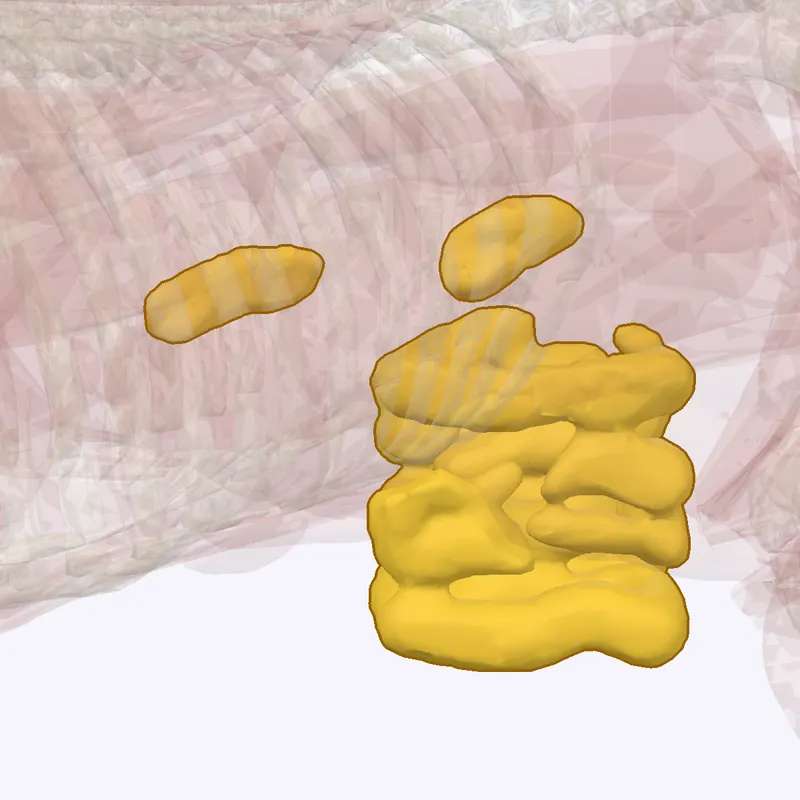
The segment between the pylorus and the caecum. In the horse the jejunum is long and hangs from a broad, mobile mesentery, mainly in the left dorsal quadrant of the abdomen, which explains its volvulus and entrapments; the ileum opens directly into the caecum.
Key points
- The bile duct and pancreatic duct open together on the major duodenal papilla.
- The root of the mesentery surrounds the cranial mesenteric artery.
- Strangulating lesions cause severe colic and nasogastric reflux, and need emergency surgery.
- In proximal duodenitis-jejunitis, pain usually eases once the stomach is decompressed.
- Anoplocephala perfoliata attaches at the ileocaecal junction and is associated with ileal colic.
Overview
The equine small intestine (intestinum tenue) is long and narrow compared with the large intestine.
It digests and absorbs sugars, starch, protein and fat before the ingesta reaches the caecum.
Apart from the duodenum, which is fixed, it hangs from a long mesentery whose root surrounds the cranial mesenteric artery. It moves freely among the loops of the colon.
Parts
- Duodenum. Begins with a dilatation, the duodenal ampulla, and makes an S-shaped curve next to the liver.
- The bile duct and the pancreatic duct open together on the major duodenal papilla. The accessory pancreatic duct opens opposite, on the minor papilla.
- The descending part runs caudally on the right and turns around the root of the mesentery caudally, at the caudal flexure, near the base of the caecum.
- The ascending part crosses to the left.
- Jejunum. The longest part. Its loops lie mainly in the left dorsal quadrant of the abdomen, mixed with the small colon.
- Ileum. Short, with a thick muscular wall. It opens into the lesser curvature of the base of the caecum at the ileal orifice, on a papilla. The ileocaecal fold joins it to the caecum.
Clinical relevance
Strangulating lesions
Because the jejunum is so mobile, these are common:
- volvulus
- entrapment in the epiploic foramen
- pedunculated lipomas strangling the bowel in older horses
- inguinal hernia in stallions
They cause severe colic, nasogastric reflux and distended loops on rectal palpation or ultrasound. They need emergency surgery.
Other conditions
- Proximal duodenitis-jejunitis. Inflammation of the first segment with large volumes of nasogastric reflux. Unlike obstruction, pain usually eases once the stomach is decompressed.
- Ileal impaction. Has been associated with very fibrous hay and with tapeworms.
- Tapeworms. Anoplocephala perfoliata attaches at the ileocaecal junction and is associated with ileal colic and intussusception.
- Ascarids. In foals, masses of Parascaris can obstruct the small intestine, sometimes after deworming with a fast-acting drug.
Diseases
- Colic (equine acute abdomen)Acute abdominal pain, usually of gastrointestinal origin. Most colics resolve with medical treatment, but…
- Equine metabolic syndromeA cluster of disturbances, centred on insulin dysregulation and often with obesity, that predisposes the…
Related structures
See it in 3D on your iPhone
Peel the layers, spin the model, quiz yourself on it and stand it on your desk in AR. AnatomyCompass is coming to iPhone, iPad and Mac: get one email when it’s out.
More of the Horse: Splanchnology (organs)
Text adapted from Vet Atlas (CC BY-SA 4.0). 3D model: Vet Atlas procedural organs (CC BY-SA 4.0). Sources and licences. This veterinary text has not yet been reviewed by a veterinarian.