 AnatomyCompass
Pancreas
Pancreas · Horse · Splanchnology (organs) · Digestive system
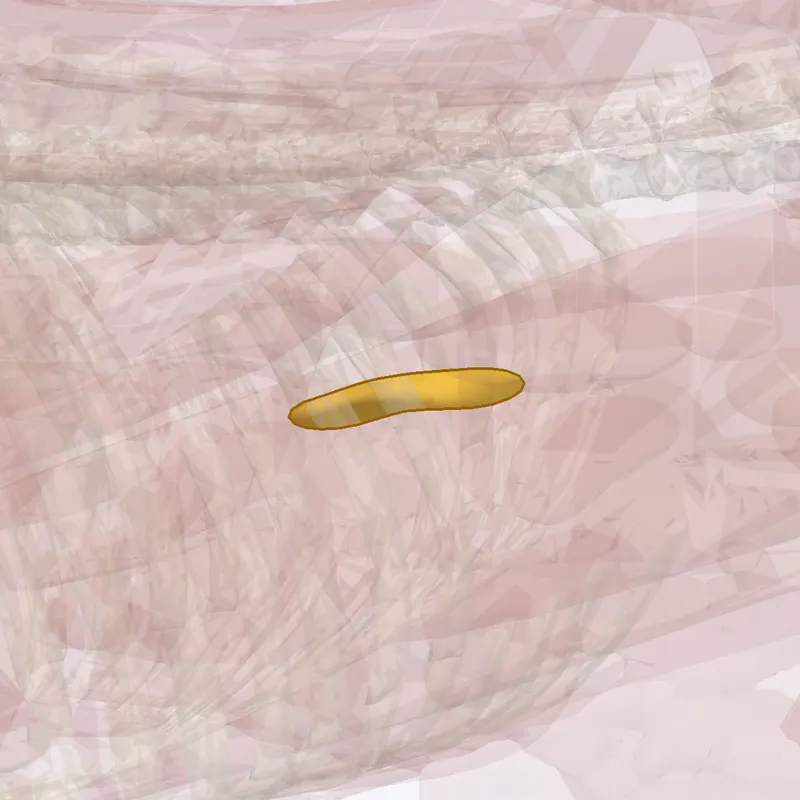
Mixed exocrine and endocrine gland, triangular in shape, lying on the roof of the abdomen on both sides of the median plane. In the horse the portal vein passes through it by a ring of pancreatic tissue, and its duct opens with the bile duct.
Key points
- Its exocrine secretion is continuous, abundant and rich in bicarbonate.
- The accessory pancreatic duct opens on the minor duodenal papilla.
- Acute pancreatitis is rare and hard to tell apart from proximal duodenitis-jejunitis.
- Insulin dysregulation in equine metabolic syndrome depends mainly on peripheral tissues.
- Its deep dorsal position means it cannot be palpated and is barely seen on ultrasound.
Overview
The pancreas produces:
- pancreatic juice, which drains into the duodenum
- insulin and glucagon, in the islets of Langerhans
In the horse the exocrine secretion is continuous and abundant, rich in bicarbonate and relatively poor in enzymes. This matches an almost constant food intake and the role of the large intestine in fibre digestion.
Topography and parts
- Position. On the roof of the abdomen, ventral to the last thoracic and first lumbar vertebrae. It lies between the liver, stomach, duodenum, base of the caecum, right dorsal colon and right kidney.
- Body. The middle part, next to the curve of the duodenum. The portal vein passes through it via the pancreatic ring (anulus pancreatis), an arrangement typical of the horse.
- Left lobe. Extends towards the spleen, the stomach and the left kidney.
- Right lobe. Follows the descending duodenum and rests on the base of the caecum and the right kidney.
- Ducts. The pancreatic duct opens with the bile duct on the major duodenal papilla. The accessory pancreatic duct opens opposite, on the minor duodenal papilla.
Clinical relevance
- Acute pancreatitis. Pancreatic disease is uncommon and acute pancreatitis is rare in horses. It causes colic, nasogastric reflux and shock. Without surgery or necropsy it is hard to tell apart from proximal duodenitis-jejunitis.
- Neoplasia. Pancreatic adenocarcinoma is rare. It presents with weight loss and sometimes ascites.
- Diabetes mellitus. Also rare. The insulin dysregulation of equine metabolic syndrome, linked to laminitis, depends mainly on peripheral tissues rather than on pancreatic failure.
- Examination. Its deep dorsal position prevents palpation, and it is barely visible on transabdominal ultrasound.
Diseases
- Equine metabolic syndromeA cluster of disturbances, centred on insulin dysregulation and often with obesity, that predisposes the…
Related structures
See it in 3D on your iPhone
Peel the layers, spin the model, quiz yourself on it and stand it on your desk in AR. AnatomyCompass is coming to iPhone, iPad and Mac: get one email when it’s out.
More of the Horse: Splanchnology (organs)
Text adapted from Vet Atlas (CC BY-SA 4.0). 3D model: Vet Atlas procedural organs (CC BY-SA 4.0). Sources and licences. This veterinary text has not yet been reviewed by a veterinarian.