 AnatomyCompass
Heart
Cor · Horse · Splanchnology (organs) · Cardiovascular system
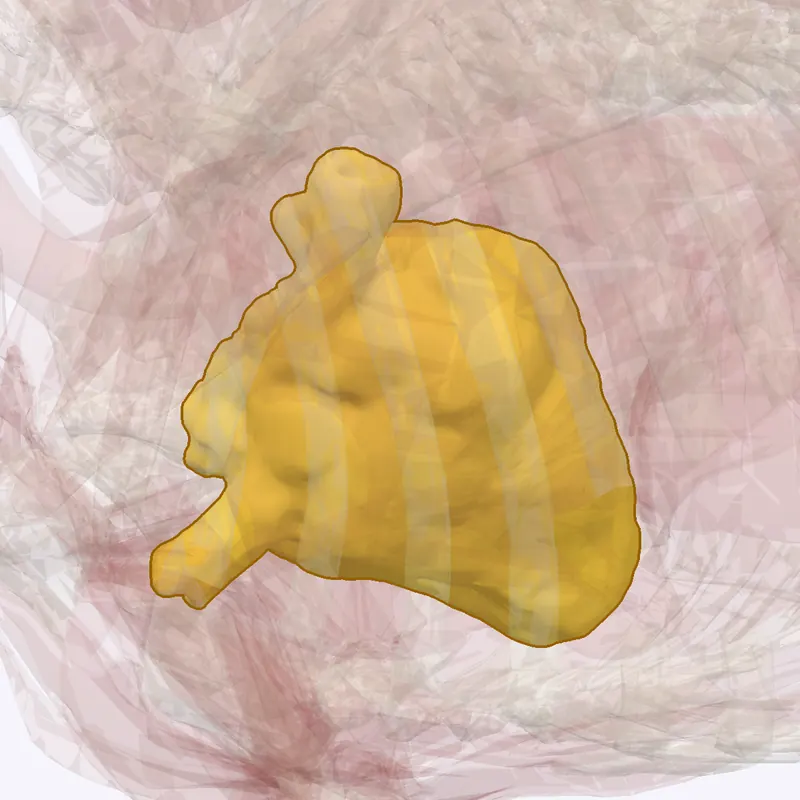
Four-chambered muscular organ in the middle mediastinum, roughly between the 3rd and 6th ribs and mostly on the left. In the horse it is large, especially in racehorses, and its resting rate is slow because of high vagal tone.
Key points
- The mitral area is auscultated at the left 5th intercostal space.
- The resting heart rate of the adult is around 28–44 bpm.
- Second-degree atrioventricular block at rest is physiological and disappears with exercise.
- Atrial fibrillation is the most common clinically important arrhythmia in the horse.
- Ionophores in cattle or poultry feed cause myocardial necrosis in horses.
Overview
The equine heart (cor) is conical, with a blunt apex formed by the left ventricle. Wrapped in the pericardium, it fills the middle mediastinum, roughly between the 3rd and 6th ribs, mostly left of the median plane.
- The base, where the great vessels leave, lies halfway up the thorax.
- The apex points ventrally, close to the sternum and the diaphragm.
The cardiac notch of the left lung leaves an area where the heart touches the thoracic wall, under the thoracic limb.
Parts
- Right atrium and ventricle. They receive blood from the venae cavae and the coronary sinus and pump it into the pulmonary trunk.
- Left atrium and ventricle. The left atrium receives the pulmonary veins. The thick-walled left ventricle forms the apex and ejects blood into the aorta.
- Valves. Tricuspid, mitral, pulmonary and aortic.
- Fibrous skeleton. The horse has cardiac cartilages (cartilagines cordis) in the aortic ring, which may ossify in old animals. It lacks the constant cardiac bones of cattle.
- Coronary arteries. The circulation is balanced. The left coronary artery gives the paraconal interventricular branch and the right one the subsinuosal branch.
Clinical relevance
- Auscultation. The mitral area is at the left 5th intercostal space, the aortic at the 4th and the pulmonary at the 3rd, under the triceps. The tricuspid is heard on the right, at the 3rd or 4th space. The resting heart rate of the adult is around 28–44 bpm.
- Physiological arrhythmias. Second-degree atrioventricular block and sinus arrhythmia are common at rest because of high vagal tone. They disappear with exercise or excitement.
- Atrial fibrillation. The most common clinically important arrhythmia in the horse. It may go unnoticed at rest but reduces performance at high-intensity exercise. It is treated with quinidine or transvenous electrical cardioversion.
- Valvular regurgitation. Murmurs from aortic and mitral regurgitation are common in older horses. Echocardiography grades their severity.
- Toxic cardiomyopathy. Ionophores such as monensin are found in cattle or poultry feed. They are highly toxic to horses and cause myocardial necrosis.
Diseases
- Exercise-induced pulmonary haemorrhageBleeding from the pulmonary capillaries during intense exercise, very common in racehorses. Blood at the…
Related structures
See it in 3D on your iPhone
Peel the layers, spin the model, quiz yourself on it and stand it on your desk in AR. AnatomyCompass is coming to iPhone, iPad and Mac: get one email when it’s out.
More of the Horse: Splanchnology (organs)
Text adapted from Vet Atlas (CC BY-SA 4.0). 3D model: "Heart (horse) Plastinated" by the Veterinary Faculty, University of Sarajevo (UNSA-VF on Sketchfab) (CC BY 4.0). Sources and licences. This veterinary text has not yet been reviewed by a veterinarian.