 AnatomyCompass
Brachialis
M. brachialis · Dog · Muscular system · Thoracic limb
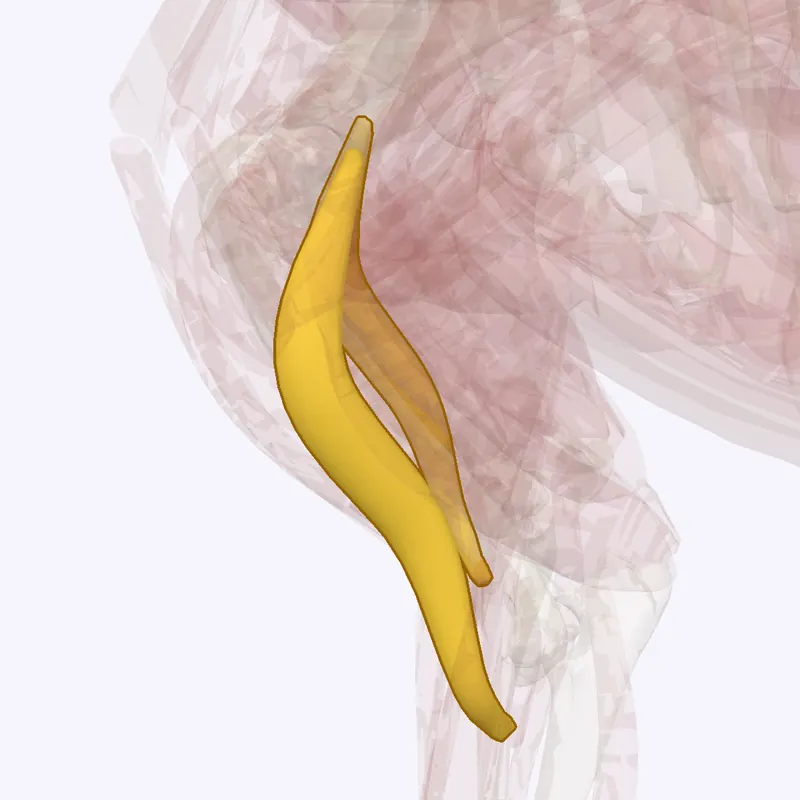
Elbow flexor that spirals along the brachial groove of the humerus.
Key points
- It arises on the caudolateral surface of the proximal humerus, distal to the head.
- It inserts on the ulnar and radial tuberosities.
- It is supplied by the musculocutaneous nerve.
- The radial nerve crosses its lateral surface and can be injured in humeral shaft fractures.
Overview
It arises on the caudal surface of the proximal humerus. It spirals down the brachial groove (sulcus musculi brachialis) to the cranial side of the elbow.
Origin
Caudolateral surface of the proximal humerus, distal to the head.
Insertion
Ulnar and radial tuberosities, on the medial side of the proximal forearm.
Action
Flexes the elbow.
Innervation
Musculocutaneous nerve (n. musculocutaneus).
Clinical relevance
In the distal half of the arm the radial nerve crosses its lateral surface. The nerve can therefore be injured in fractures of the humeral shaft.
Related structures
See it in 3D on your iPhone
Peel the layers, spin the model, quiz yourself on it and stand it on your desk in AR. AnatomyCompass is coming to iPhone, iPad and Mac: get one email when it’s out.
More of the Dog: Muscular system
Text adapted from Vet Atlas (CC BY-SA 4.0). 3D model: Vet Atlas procedural musculature (CC BY-SA 4.0). Sources and licences. This veterinary text has not yet been reviewed by a veterinarian.