 AnatomyCompass
Humerus
Humerus · Dog · Skeletal system · Thoracic limb
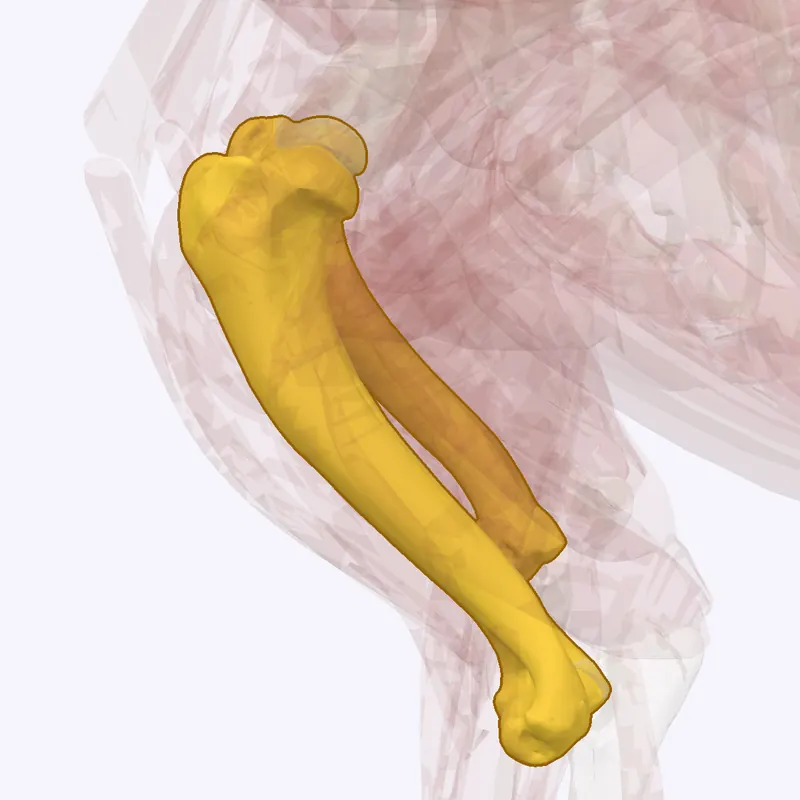
Long bone of the arm. Articulates proximally with the scapula (shoulder) and distally with the radius and ulna (elbow).
Key points
- The greater tubercle is palpable and forms the point of the shoulder.
- In the dog the supratrochlear foramen connects the olecranon and radial fossae.
- The proximal humerus is, with the distal radius, the most common site of osteosarcoma in large breeds.
- Incomplete ossification of the humeral condyle predisposes Spaniels to fractures.
- The humeral head is the classic site of shoulder osteochondrosis.
Overview
The humerus is the bone of the arm. It is a strong bone that carries the insertions of most muscles moving the shoulder and elbow.
Its shaft is slightly twisted in an S shape. The head faces caudally at the proximal end and the trochlea faces cranially at the distal end.
Proximal end
- Head (caput humeri). Convex articular surface, larger than the glenoid cavity, facing caudally.
- Greater tubercle (tuberculum majus). Lateral projection where the supraspinatus and infraspinatus insert. It is palpable and forms the "point of the shoulder".
- Lesser tubercle (tuberculum minus). Medial projection where the subscapularis inserts.
- Intertubercular groove. It lies between both tubercles and carries the tendon of the biceps brachii.
Shaft and distal end
- Deltoid tuberosity. Prominent lateral ridge where the deltoideus inserts.
- Humeral condyle. It is made of the trochlea, medial, which articulates with the ulna and radius, and the capitulum, lateral, which articulates with the radius.
- Olecranon and radial fossae. The olecranon fossa is caudal and the radial fossa cranial. In the dog they are connected by the supratrochlear foramen.
- Medial and lateral epicondyles. The medial one gives origin to the carpal and digital flexors; the lateral one, to the extensors.
Clinical relevance
- The proximal humerus is, together with the distal radius, the most common site of osteosarcoma in large breeds. The rule is "away from the elbow, toward the knee".
- Humeral condylar fractures are typical in chondrodystrophic puppies.
- Incomplete ossification of the humeral condyle (IOHC) predisposes Spaniels to fractures.
- The humeral head is the classic site of shoulder osteochondrosis.
Diseases
- OsteosarcomaThe most common malignant bone tumour of the dog. It affects the metaphysis of long bones in large and giant…
- Elbow dysplasiaGroup of inherited developmental disorders of the elbow joint in young dogs of medium and large breeds.…
- Shoulder osteochondrosisDevelopmental disorder of endochondral ossification in the caudal part of the humeral head. A cartilage flap…
- PanosteitisSelf-limiting disease of the medullary cavity of the long bones in young dogs of large breeds. It causes…
- Bicipital tenosynovitisInflammation of the tendon of origin of the biceps brachii and its synovial sheath in the intertubercular…
Related structures
See it in 3D on your iPhone
Peel the layers, spin the model, quiz yourself on it and stand it on your desk in AR. AnatomyCompass is coming to iPhone, iPad and Mac: get one email when it’s out.
More of the Dog: Skeletal system
Text adapted from Vet Atlas (CC BY-SA 4.0). 3D model: 3D Dog Bone Project, Massey University (School of Veterinary Science and Institute of Natural and Mathematical Sciences), nzfauna on Sketchfab (CC BY-SA 4.0). Sources and licences. This veterinary text has not yet been reviewed by a veterinarian.