 AnatomyCompass
Shoulder osteochondrosis
Congenital · Dog
Developmental disorder of endochondral ossification in the caudal part of the humeral head. A cartilage flap forms (osteochondritis dissecans) and causes thoracic limb lameness in young dogs of large breeds.
Key points
- Signs usually appear between 4 and 8 months, and it is more common in males.
- It may be bilateral even when lameness is seen in only one limb.
- A detached flap can migrate as a joint mouse into the bicipital tendon sheath.
- It is treated by removing the flap and curetting its bed, by arthroscopy or arthrotomy.
- The prognosis after surgery is good, much better than for OCD of the elbow, stifle or hock.
What it is
Osteochondrosis is a failure of endochondral ossification in the growing articular-epiphyseal cartilage.
The cartilage stays abnormally thick. Its deep layers are poorly nourished and become necrotic, and a fissure separates a flap of cartilage from the subchondral bone.
Once a flap forms and the joint becomes inflamed, the condition is called osteochondritis dissecans (OCD). The flap may stay attached, or detach and become a "joint mouse" that can migrate into the bicipital tendon sheath.
The cause is multifactorial:
- genetics
- rapid growth
- excess energy and calcium in the diet
- local mechanical stress
Who it affects
Young dogs of large and giant breeds. Signs usually appear between 4 and 8 months of age.
It is more common in males and may be bilateral, even when lameness is seen in only one limb.
The shoulder is one of the joints most often affected. Osteochondrosis also occurs in the elbow, stifle and tarsus.
Anatomy involved
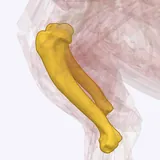
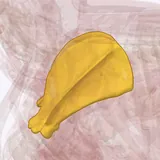
The lesion sits on the caudal or caudocentral part of the humeral head (caput humeri), which articulates with the glenoid cavity of the scapula (cavitas glenoidalis).
Free fragments may attach to the joint capsule, be resorbed, or migrate into the sheath of the tendon of origin of the biceps brachii.
Clinical signs
Thoracic limb lameness of gradual onset, mild to moderate. It improves with rest and worsens after exercise.
Pain and reduced range of motion of the shoulder are the key findings.
Diagnosis
- Mediolateral radiographs of both shoulders. They show flattening or a concave defect of the caudal humeral head, with sclerosis of the subchondral bone; sometimes a mineralised flap or free body. Screen the opposite shoulder.
- Arthrography, CT or arthroscopy, to show a cartilage flap that is not mineralised.
Treatment
Some dogs improve with rest and controlled exercise.
When lameness persists or a flap is present, the treatment of choice is removal of the flap and curettage of its bed, by arthroscopy or arthrotomy. Fibrocartilage then fills the defect.
Joint mice in the bicipital sheath should be removed.
Prognosis after surgery is good, much better than for OCD in the elbow, stifle or hock.
Avoiding overfeeding and excess calcium in growing large-breed puppies reduces the risk.
Structures affected
References
- Fossum TW. Small Animal Surgery, 5th ed. Elsevier (2018)
- Piermattei DL, Flo GL, DeCamp CE. Brinker, Piermattei and Flo's Handbook of Small Animal Orthopedics and Fracture Repair, 4th ed. Saunders (2006)
- Thrall DE. Textbook of Veterinary Diagnostic Radiology, 7th ed. Elsevier (2018)
- Merck Veterinary Manual: Osteochondrosis in Dogs
- American College of Veterinary Surgeons: Osteochondrosis of the Shoulder
- Merck Veterinary Manual: Muscular Trauma in Dogs and Cats
- Allan G, Davies S. Radiographic signs of joint disease in dogs and cats. In: Thrall DE, Textbook of Veterinary Diagnostic Radiology, 7th ed. Elsevier (2018)
See it in 3D on your iPhone
Peel the layers, spin the model, quiz yourself on it and stand it on your desk in AR. AnatomyCompass is coming to iPhone, iPad and Mac: get one email when it’s out.
Text adapted from Vet Atlas (CC BY-SA 4.0). Sources and licences. This veterinary text has not yet been reviewed by a veterinarian.