 AnatomyCompass
Adductor
M. adductor · Cat · Muscular system · Pelvic limb
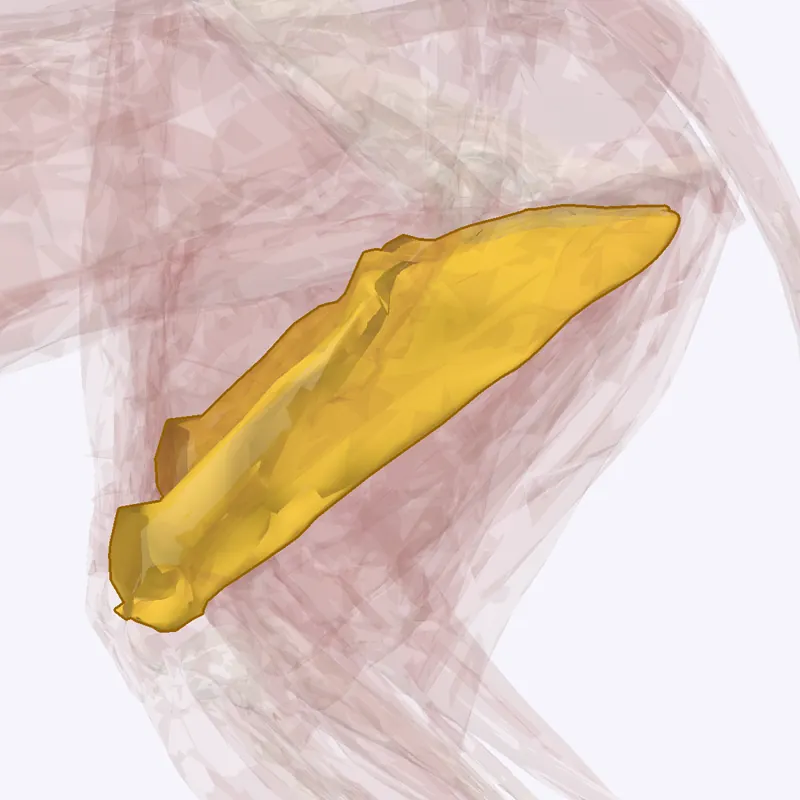
Large muscle of the medial thigh, deep to the gracilis.
Key points
- It arises from the pelvic symphysis and the ventral surface of the pubis and ischium.
- It inserts along the caudal surface of the femur.
- It adducts the limb and extends the hip.
- It is supplied by the obturator nerve.
Overview
It has a large part (m. adductor magnus et brevis) and a small cranial part (m. adductor longus). It lies deep to the gracilis, between the pectineus cranially and the semimembranosus caudally.
Origin
Pelvic symphysis, through the symphyseal tendon, and the ventral surface of the pubis and ischium.
Insertion
Caudal surface of the femur, along most of its length.
Action
Adducts the limb and extends the hip.
Innervation
Obturator nerve (n. obturatorius).
Clinical relevance
With the pectineus and gracilis it depends on the obturator nerve, which can be injured in pelvic fractures. The limb then tends to slide outward on slippery floors.
Related structures
See it in 3D on your iPhone
Peel the layers, spin the model, quiz yourself on it and stand it on your desk in AR. AnatomyCompass is coming to iPhone, iPad and Mac: get one email when it’s out.
More of the Cat: Muscular system
Text adapted from Vet Atlas (CC BY-SA 4.0). 3D model: "Feline Ecorche Dec" by westerly (Sketchfab) (CC BY 4.0). Sources and licences. This veterinary text has not yet been reviewed by a veterinarian.