Trachea
Trachea · Thorax · Organ
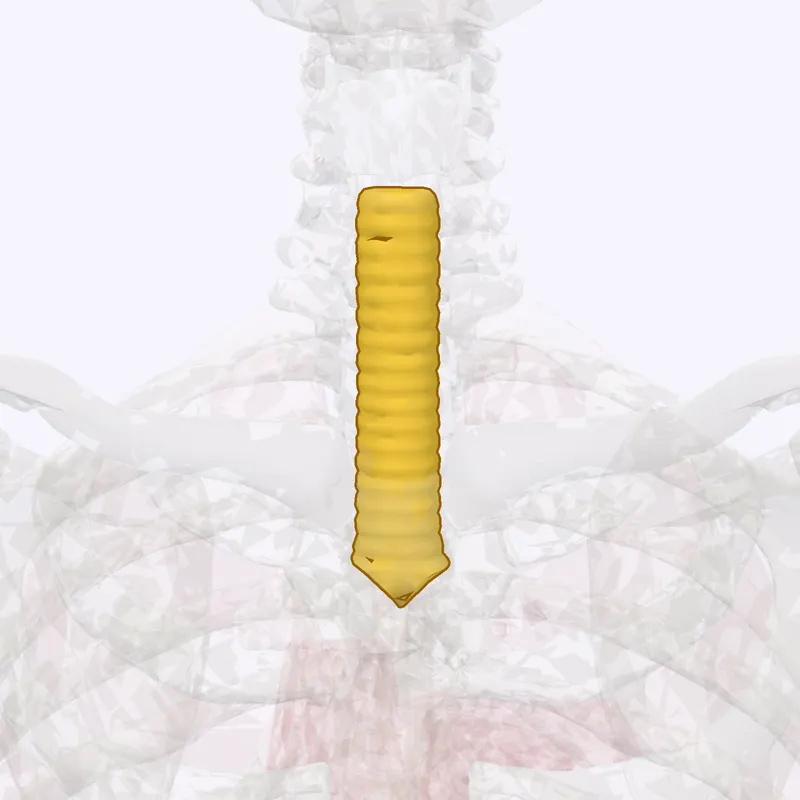
The windpipe: a tube of 16–20 C-shaped cartilage rings running from the cricoid cartilage to its division into the main bronchi.
Quick facts
- Latin name
- Trachea
- Type
- Organ
- Body area
- Thorax
Trachea: location
From C6 in the neck to the sternal angle (T4/T5), where it bifurcates at the carina.
Trachea: function
Conducts air; ciliated lining moves mucus up towards the larynx.
Trachea: blood supply
Inferior thyroid and bronchial arteries.
Trachea: nerve supply
Vagus and recurrent laryngeal nerves; sympathetic trunk.
Trachea: relations
Oesophagus behind; thyroid isthmus in front of rings 2–4; arch of aorta and brachiocephalic trunk in front in the chest.
3D views
Trachea: clinical note
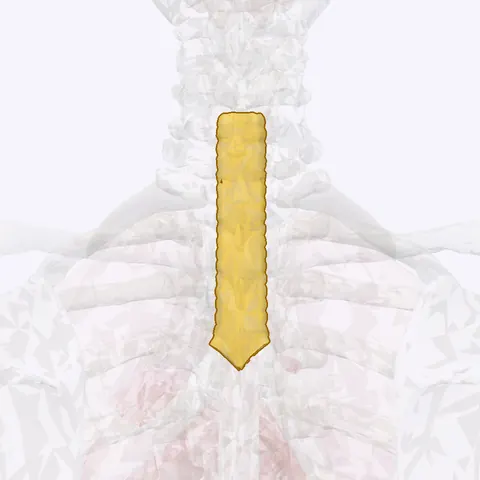
Tracheostomy goes through rings 2–4; a widened carina on bronchoscopy suggests enlarged lymph nodes beneath it.
Questions about the trachea
What is the trachea?
The windpipe: a tube of 16–20 C-shaped cartilage rings running from the cricoid cartilage to its division into the main bronchi.
What does the trachea do?
Conducts air; ciliated lining moves mucus up towards the larynx.
Where is the trachea?
From C6 in the neck to the sternal angle (T4/T5), where it bifurcates at the carina.
What is the blood supply of the trachea?
Inferior thyroid and bronchial arteries.
See the trachea in 3D
Peel the layers, spin the model, quiz yourself on it and stand it on your desk in AR. AnatomyCompass is coming to iPhone, iPad and Mac: get one email when it’s out.
Other organs: thorax
Spotted something wrong? Tell us and we’ll fix it. This page is a study reference, not medical advice.