Facial nerve
Nervus facialis · Head and neck · Nerve
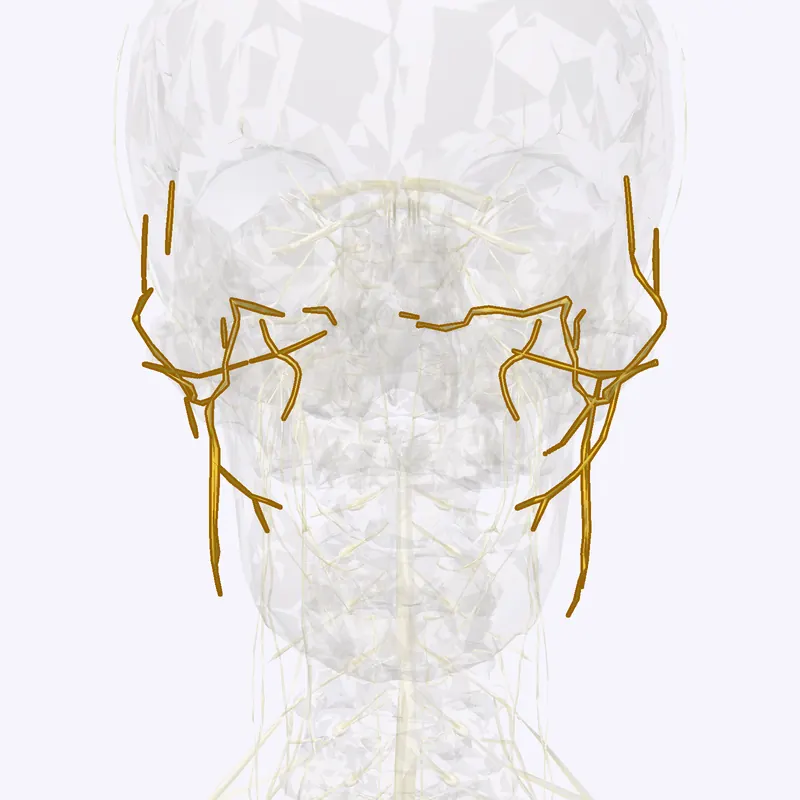
Moves the muscles of facial expression; also taste, tears and saliva.
Quick facts
- Latin name
- Nervus facialis
- Also called
- cranial nerve VII
- Type
- Nerve
- Body area
- Head and neck
Facial nerve: roots
Motor nucleus in the pons; nervus intermedius (taste and parasympathetic).
Facial nerve: course
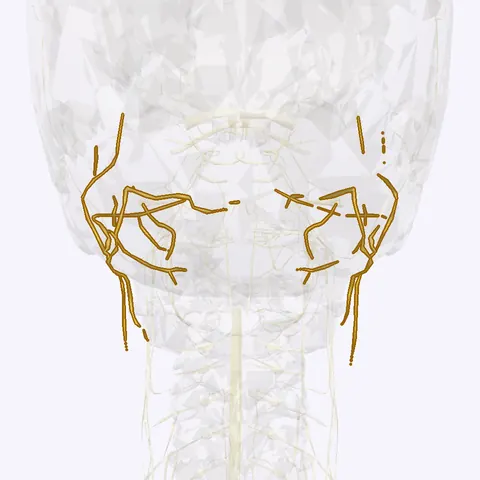
Through the internal acoustic meatus and the facial canal of the temporal bone (geniculate ganglion), out of the stylomastoid foramen, into the parotid gland, where it divides into five branches.
Facial nerve: motor
Muscles of facial expression (temporal, zygomatic, buccal, marginal mandibular, cervical branches), stapedius, posterior digastric, stylohyoid.
Facial nerve: sensory
Taste from the front two-thirds of the tongue (chorda tympani); a small area of the ear.
Facial nerve: injury sign
Weakness of one whole side of the face including the forehead (lower motor neuron, e.g. Bell's palsy); a stroke spares the forehead.
3D views
Facial nerve: clinical note
Bell's palsy is the commonest cause; the nerve is at risk in parotid surgery.
Muscles supplied by the facial nerve
- PlatysmaCervical branch of the facial nerve (CN VII)
- DigastricAnterior belly: nerve to mylohyoid (CN V3). Posterior belly: facial nerve (CN VII)
- OccipitofrontalisFacial nerve (CN VII): temporal branch (frontal belly), posterior auricular branch…
- Orbicularis oculiFacial nerve (CN VII): temporal and zygomatic branches
- Orbicularis orisFacial nerve (CN VII): buccal and marginal mandibular branches
- Zygomaticus majorFacial nerve (CN VII): zygomatic and buccal branches
- BuccinatorBuccal branch of the facial nerve (CN VII)
Questions about the facial nerve
What is the facial nerve?
Moves the muscles of facial expression; also taste, tears and saliva.
See the facial nerve in 3D
Peel the layers, spin the model, quiz yourself on it and stand it on your desk in AR. AnatomyCompass is coming to iPhone, iPad and Mac: get one email when it’s out.
Other nerves: head and neck
Spotted something wrong? Tell us and we’ll fix it. This page is a study reference, not medical advice.