Mandible
Mandibula · Head and neck · Bone
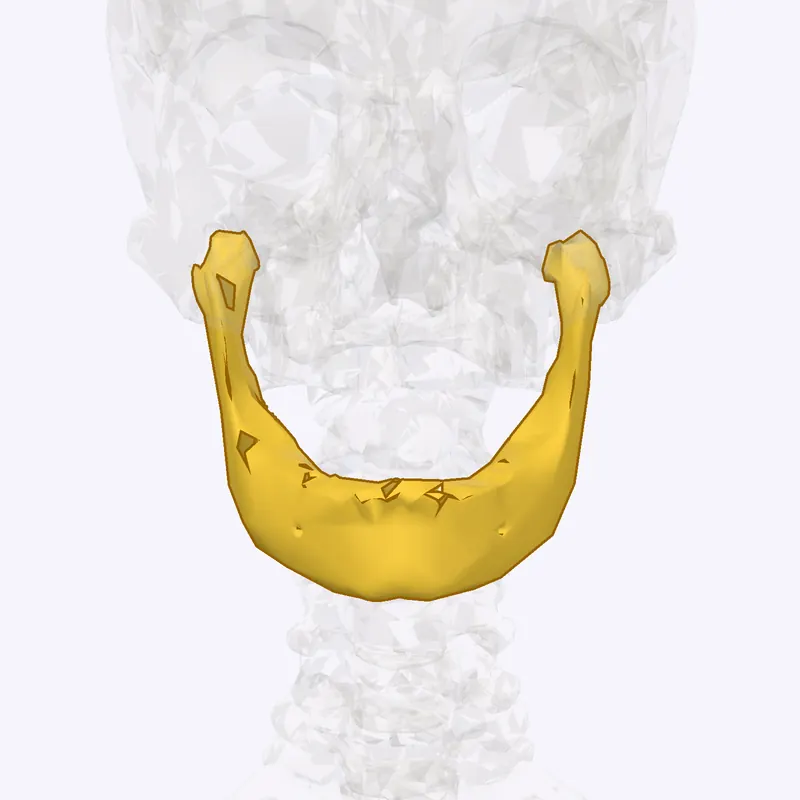
The lower jaw: the only movable skull bone, and the largest and strongest bone of the face.
Quick facts
- Latin name
- Mandibula
- Also called
- human mandible, lower jaws, jawbone
- Type
- Bone
- Body area
- Head and neck
Landmarks of the mandible
- Condyle (head)
- Sits in the mandibular fossa at the jaw joint; lateral pterygoid inserts on its neck.
- Coronoid process
- Front upward plate: temporalis inserts.
- Ramus
- Vertical part: masseter outside, medial pterygoid inside.
- Angle
- Corner where ramus meets body.
- Mental foramen
- Below the premolars: mental nerve to the lower lip and chin.
- Mylohyoid line
- Inner ridge: mylohyoid arises.
- Digastric fossa
- Inner surface near the midline: anterior belly of digastric.
Joints of the mandible
- Temporomandibular joints
- Lower teeth
3D views
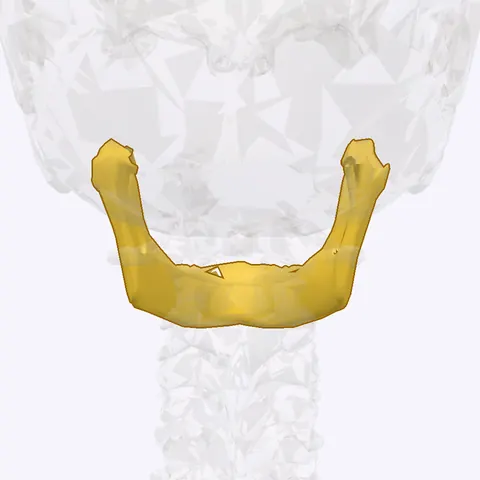
Muscles that attach to the mandible
From the origin and insertion on each muscle’s page.
Questions about the mandible
What is the mandible?
The lower jaw: the only movable skull bone, and the largest and strongest bone of the face.
See the mandible in 3D
Peel the layers, spin the model, quiz yourself on it and stand it on your desk in AR. AnatomyCompass is coming to iPhone, iPad and Mac: get one email when it’s out.
Other bones: head and neck
Spotted something wrong? Tell us and we’ll fix it. This page is a study reference, not medical advice.