Carpal bones
Ossa carpi · Upper limb · Bone
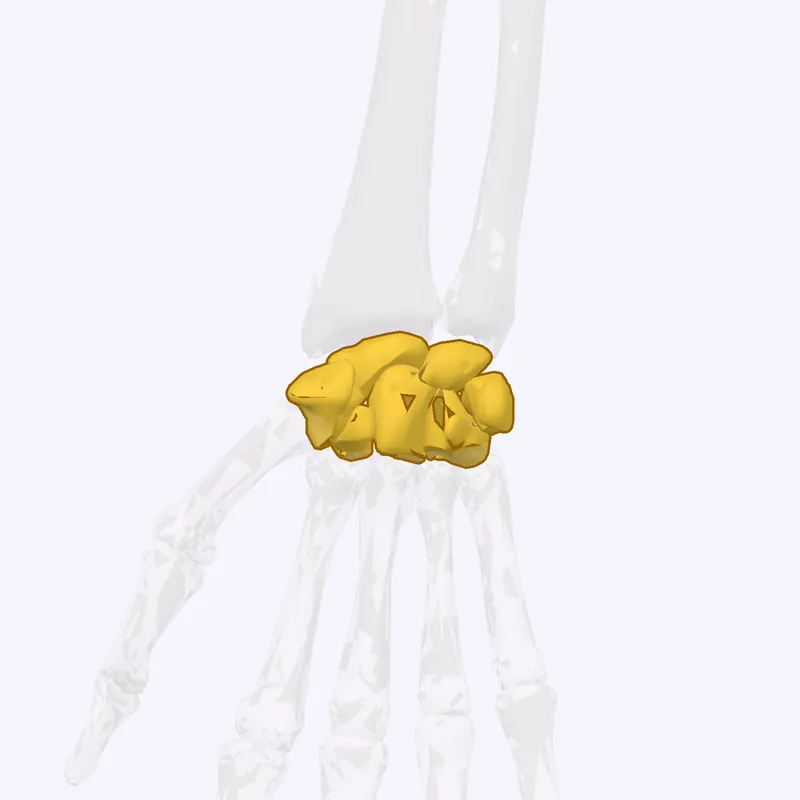
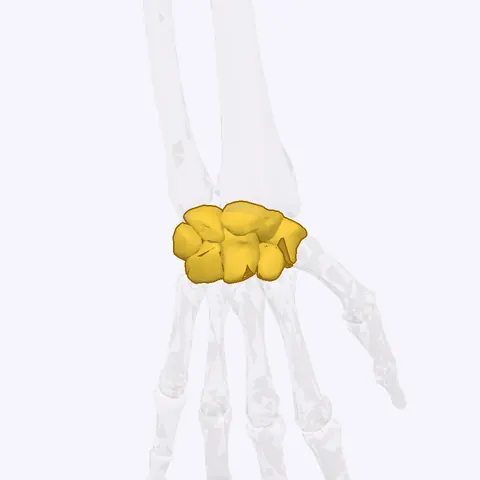
Eight small wrist bones in two rows: scaphoid, lunate, triquetral and pisiform (proximal), trapezium, trapezoid, capitate and hamate (distal).
Quick facts
- Latin name
- Ossa carpi
- Type
- Bone
- Body area
- Upper limb
Landmarks of the carpal bones
- Scaphoid
- In the floor of the anatomical snuffbox; the most often fractured carpal, with a risk of avascular necrosis.
- Lunate
- Most often dislocated carpal; can press on the median nerve.
- Pisiform
- Pea-shaped sesamoid in flexor carpi ulnaris, felt at the base of the hypothenar eminence.
- Hook of the hamate
- Attachment of the flexor retinaculum; lateral wall of Guyon's canal.
- Trapezium
- Saddle joint with the first metacarpal: the thumb's carpometacarpal joint.
- Capitate
- Largest carpal, at the centre of the wrist.
Joints of the carpal bones
- Radiocarpal (wrist) joint
- Midcarpal joint
- Carpometacarpal joints
3D views
Muscles that attach to the carpal bones
From the origin and insertion on each muscle’s page.
Questions about the carpal bones
What is the carpal bones?
Eight small wrist bones in two rows: scaphoid, lunate, triquetral and pisiform (proximal), trapezium, trapezoid, capitate and hamate (distal).
See the carpal bones in 3D
Peel the layers, spin the model, quiz yourself on it and stand it on your desk in AR. AnatomyCompass is coming to iPhone, iPad and Mac: get one email when it’s out.
Other bones: upper limb
Spotted something wrong? Tell us and we’ll fix it. This page is a study reference, not medical advice.