 AnatomyCompass
Subclavian artery
Arteria subclavia · Upper limb · Artery
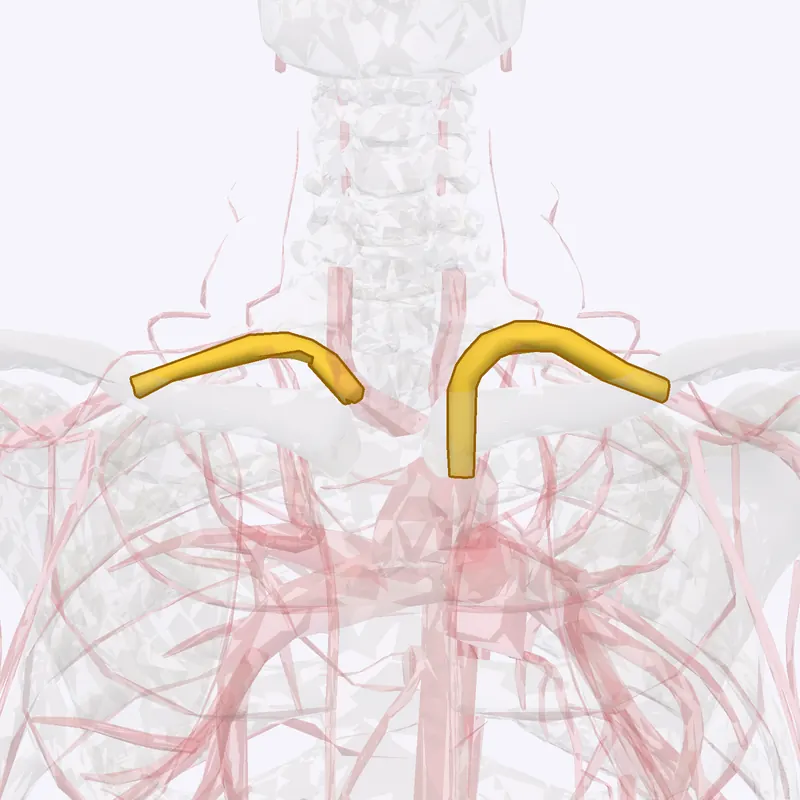
The main artery to the arm, arching over the first rib behind scalenus anterior.
Quick facts
- Latin name
- Arteria subclavia
- Type
- Artery
- Body area
- Upper limb
Subclavian artery: origin
Right: brachiocephalic trunk. Left: arch of aorta.
Subclavian artery: course
Arches over the pleura and first rib behind scalenus anterior (three parts); becomes the axillary artery at the outer border of the first rib.
Subclavian artery: branches
Vertebral, internal thoracic, thyrocervical trunk, costocervical trunk, dorsal scapular.
Subclavian artery: supplies
Upper limb, neck, brain (vertebral), chest wall and breast (internal thoracic).
3D views
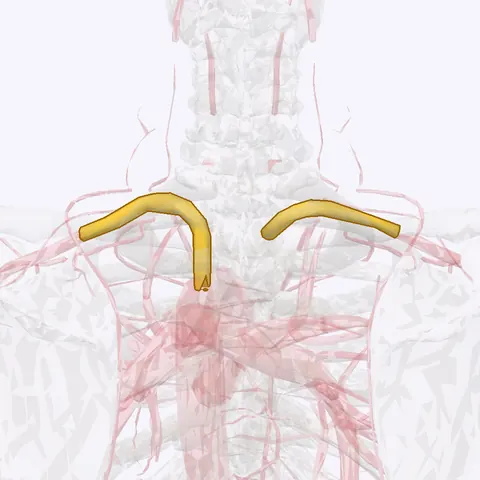
Watch the video guide
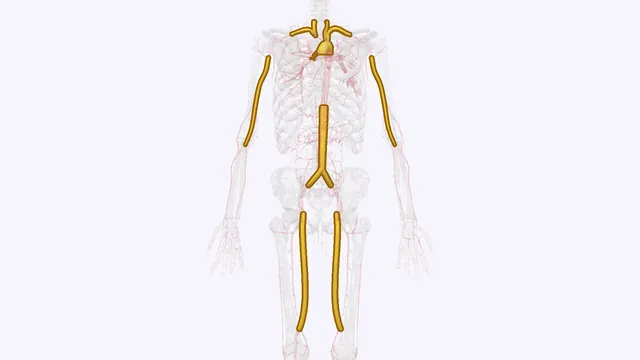
Subclavian artery: clinical note
Compression in the thoracic outlet; a blockage before the vertebral origin can 'steal' blood from the brain (subclavian steal).
Questions about the subclavian artery
What is the subclavian artery?
The main artery to the arm, arching over the first rib behind scalenus anterior.
What are the branches of the subclavian artery?
Vertebral, internal thoracic, thyrocervical trunk, costocervical trunk, dorsal scapular.
See the subclavian artery in 3D
Peel the layers, spin the model, quiz yourself on it and stand it on your desk in AR. AnatomyCompass is coming to iPhone, iPad and Mac: get one email when it’s out.
Other arteries: upper limb
- Axillary artery
- Thoraco-acromial artery
- Subscapular artery
- Circumflex humeral arteries
- Brachial artery
- Deep brachial artery
- Ulnar collateral arteries
- Radial artery
- Radial recurrent artery
- Ulnar artery
- Ulnar recurrent arteries
- Interosseous arteries
- Superficial palmar arch
- Deep palmar arch
- Dorsal carpal arch and metacarpal arteries
Spotted something wrong? Tell us and we’ll fix it. This page is a study reference, not medical advice.