 AnatomyCompass
Thyroid
Glandula thyroidea · Horse · Splanchnology (organs) · Endocrine and lymphatic organs
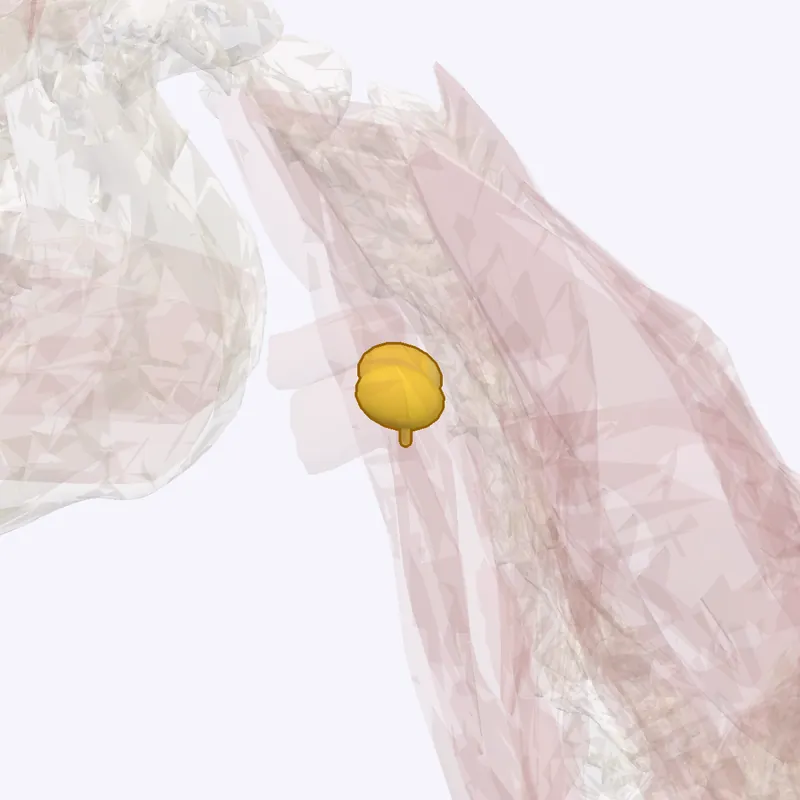
Endocrine gland lying on either side of the first tracheal rings, caudal to the larynx. In the horse its two lobes are oval and firm, the isthmus is a thin fibrous cord, and they are usually palpable in the throatlatch.
Key points
- Its hormone synthesis needs dietary iodine.
- The cranial parathyroid glands usually lie next to the thyroid.
- Thyroid adenoma is common in older horses and is usually unilateral and non-functional.
- Congenital hypothyroidism causes prognathism, incomplete carpal and tarsal ossification and ruptured extensor tendons.
- A low T4 is common in non-thyroidal illness and is not enough for a diagnosis.
Overview
The thyroid gland (glandula thyroidea) produces the thyroid hormones, thyroxine and triiodothyronine, and calcitonin. The thyroid hormones regulate metabolism, growth and fetal development.
Their synthesis needs dietary iodine.
Topography and shape
- Lobes. Two, oval, smooth and firm, one on each side of the first tracheal rings, caudal to the larynx.
- Isthmus. In the horse it is a narrow band of connective tissue, sometimes almost absent, crossing the ventral surface of the trachea. Unlike in cattle, it has no glandular tissue.
- Relations. The lobes are covered by the neck muscles and the skin of the throatlatch. They lie close to the common carotid artery, the vagosympathetic trunk and the jugular vein. The oesophagus lies dorsal to the trachea.
- Parathyroids. The cranial parathyroid glands usually lie next to the thyroid.
Clinical relevance
- Palpation. In the horse the lobes can usually be felt in the throatlatch, especially in lean animals. This makes enlargement easy to detect.
- Thyroid adenoma. Common in older horses. It is usually unilateral and non-functional, and is found as a lump in the throatlatch.
- Congenital hypothyroidism and dysmaturity. Foals show mandibular prognathism, incomplete ossification of the carpal and tarsal bones, ruptured extensor tendons and weakness. It has been associated with diets of the pregnant mare high in nitrates or low in iodine.
- Goitre. Both too little and too much iodine in the mare's diet, for example from seaweed supplements, can cause goitre in the foal.
- Adult hypothyroidism. The evidence that it exists as a clinical disease is weak. Low T4 concentrations are common in non-thyroidal illness or after phenylbutazone and are not enough for a diagnosis.
Related structures
See it in 3D on your iPhone
Peel the layers, spin the model, quiz yourself on it and stand it on your desk in AR. AnatomyCompass is coming to iPhone, iPad and Mac: get one email when it’s out.
More of the Horse: Splanchnology (organs)
Text adapted from Vet Atlas (CC BY-SA 4.0). 3D model: Vet Atlas procedural organs (CC BY-SA 4.0). Sources and licences. This veterinary text has not yet been reviewed by a veterinarian.