 AnatomyCompass
Claws
Unguicula · Dog · Integumentary system · Thoracic limb
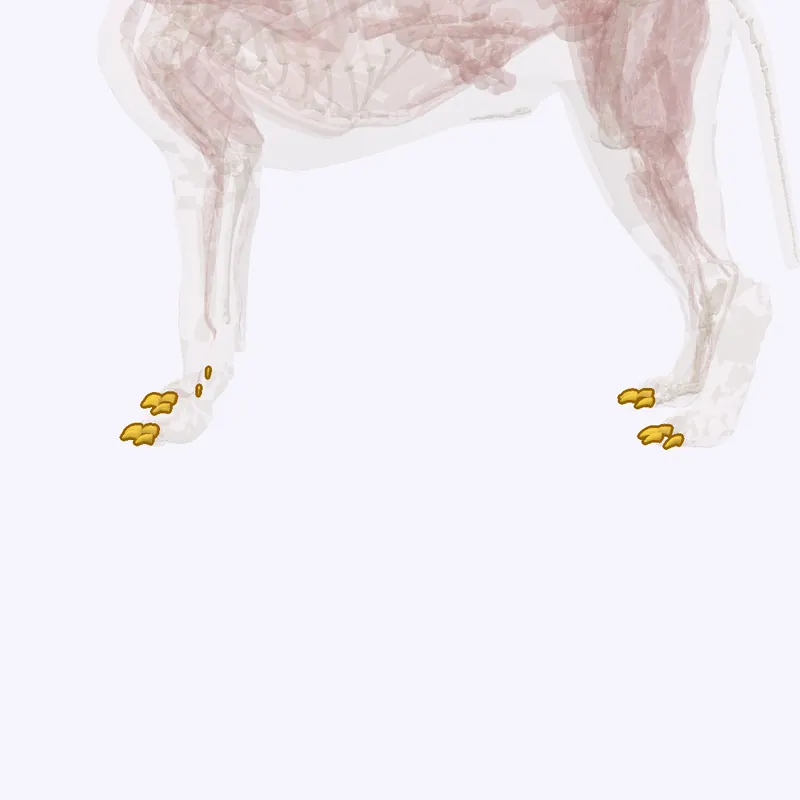
Horny capsules covering the tip of each digit over the ungual process of the distal phalanx. Five on the thoracic limb, including the dewclaw, and usually four on the pelvic limb.
Key points
- The dewclaw is digit I of the thoracic limb and does not bear weight.
- The quick is the living, vascular and innervated claw dermis; in unpigmented claws it shows pink.
- Trimming must stay distal to the quick; pigmented claws are trimmed in small steps.
- Frequent trims let the quick recede gradually.
- An unworn dewclaw can grow round until it pierces the pad.
Overview
The claw of the dog (unguicula) is a modified skin structure. It is a capsule of hard keratin that wraps the ungual process (processus unguicularis) of the distal phalanx.
At its base, the ungual crest (crista unguicularis) of the phalanx forms a bony shelf that covers the proximal edge of the claw.
Number of claws
- Thoracic limb. Five clawed digits. Digit I is the dewclaw: it sits on the medial side, above the ground, and does not bear weight.
- Pelvic limb. Usually four digits. Digit I is absent or vestigial, although some breeds have hind dewclaws, sometimes double.
Structure
- Wall. Forms the dorsal and side surfaces of the claw. It is curved and laterally compressed.
- Sole (solea unguiculae). Palmar or plantar surface of softer keratin, between the edges of the wall.
- Claw dermis. Highly vascular, innervated connective tissue between the phalanx and the keratin. It is the living part of the claw, known as the quick. In unpigmented claws it shows as a pink zone.
- Growth. The claw grows continuously from its base, under the fold of skin around it, and is worn down by use.
Clinical relevance
Overgrowth
In dogs with little exercise or on soft surfaces the claw does not wear. It curls and alters how the digit bears weight.
The dewclaw never touches the ground and can grow round until it pierces the pad.
Nail trimming
- The cut must stay distal to the quick.
- In white claws the quick can be seen. Pigmented claws are trimmed in small steps.
- The quick lengthens as the claw grows, so frequent trims let it recede gradually.
- Cutting into the quick causes pain and bleeding. It is controlled with pressure or a styptic powder.
Other disorders
- claw fractures and avulsions, common in the dewclaw
- paronychia, infection of the claw fold
- symmetric lupoid onychodystrophy
- tumours of the nail bed, such as squamous cell carcinoma and digital melanoma
Diseases
- Symmetric lupoid onychodystrophyImmune-mediated disease of the claw-forming tissue that makes the claws slough one after another on all four…
- Canine leishmaniosisChronic systemic disease caused by the protozoan Leishmania infantum, transmitted by sand flies. It is a…
Related structures
See it in 3D on your iPhone
Peel the layers, spin the model, quiz yourself on it and stand it on your desk in AR. AnatomyCompass is coming to iPhone, iPad and Mac: get one email when it’s out.
Text adapted from Vet Atlas (CC BY-SA 4.0). 3D model: "Canine Model" by Lova Dahn (lovadahn on Sketchfab) (CC BY 4.0). Sources and licences. This veterinary text has not yet been reviewed by a veterinarian.