 AnatomyCompass
Bones of the digits of the hind paw
Ossa digitorum pedis · Dog · Skeletal system · Pelvic limb
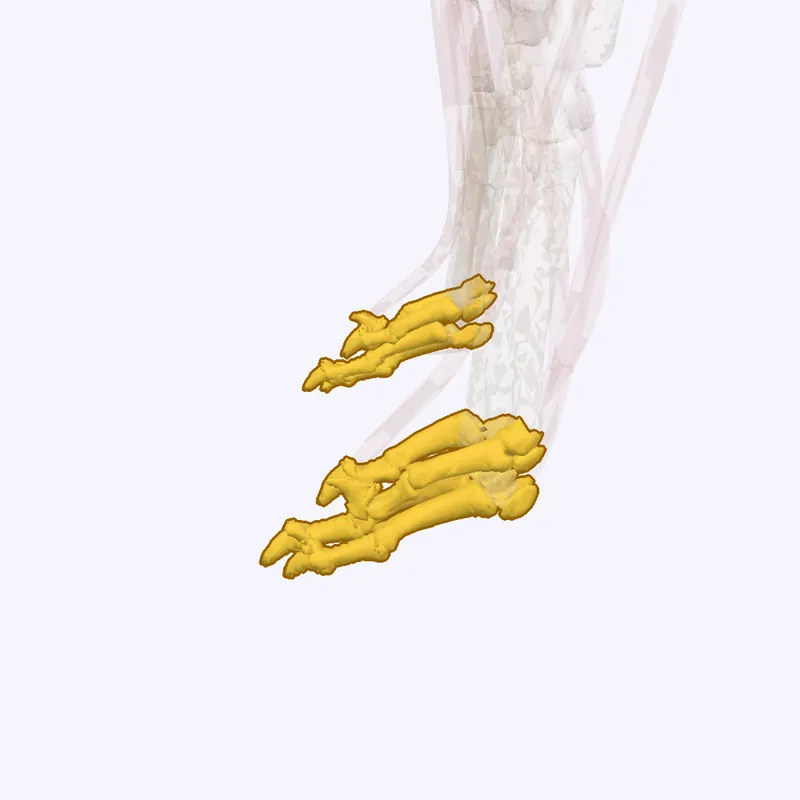
Phalanges and sesamoid bones of the digits of the pelvic limb. Digits II to V have three phalanges each; the distal phalanx carries the claw.
Key points
- Digit I, the dewclaw, is often absent on the hind paw; when present it usually has two phalanges.
- Digits III and IV are the longest and take most of the load.
- The deep digital flexor inserts on the flexor tubercle of the distal phalanx.
- The claw is not retractile because its elastic dorsal ligaments are less developed than in the cat.
- A broken claw that does not heal may be a subungual tumour, with lysis of the distal phalanx.
Overview
The hind paw of the dog normally has four functional digits, II to V. Each has three phalanges: proximal, middle and distal.
Digits III and IV are the longest and take most of the load.
Digit I, the dewclaw, is often absent on the pelvic limb. When present it usually has only two phalanges and may be attached to the rest of the paw by skin alone.
The arrangement is the same as in the forepaw. The NAV terms for the hind paw use pedis instead of manus.
Proximal phalanx (*phalanx proximalis*)
The longest.
- Its base has a concave articular surface that receives the head of the metatarsal.
- Its distal head carries a trochlea for the middle phalanx.
The collateral ligaments and the proximal sesamoids attach at the metatarsophalangeal joint.
Middle phalanx (*phalanx media*)
Shorter than the proximal one, of similar shape.
The tendon of the superficial digital flexor inserts on its base. Before that, the tendon splits into two branches to let the deep flexor pass.
Distal phalanx (*phalanx distalis*)
Housed inside the claw.
- Ungual process (processus unguicularis). Curved, conical projection over which the claw (unguis) is moulded.
- Ungual crest (crista unguicularis). Bony rim around the base of the process. The claw fold of the skin attaches to it.
- Flexor tubercle (tuberculum flexorium). On the plantar surface. It receives the deep digital flexor tendon.
- Extensor process. Dorsal. It receives the extensor tendon.
Sesamoid bones
- Proximal sesamoids, or plantar sesamoids. One pair for each of digits II to V, on the plantar side of the metatarsophalangeal joint, embedded in the tendons of the interosseous muscles. They form a groove for the flexor tendons.
- Dorsal sesamoids. Small, in the extensor tendon over the same joint. Often cartilaginous.
- Plantar sesamoid cartilage. At the distal interphalangeal joint; it is not a bone.
Joints and movement
The interphalangeal joints are hinges.
The distal one is held in slight hyperextension, with the claw raised, by elastic dorsal ligaments. This mechanism is far less developed than in the cat, so the dog's claw is not retractile.
Clinical relevance
- Digital fractures and luxations. Common in working dogs and greyhounds. Proximal interphalangeal luxation gives the "knocked-up toe".
- Sesamoid disease. Fragmentation or fracture of the proximal sesamoids, especially in Rottweilers and greyhounds. It is better documented in the forepaw than in the hind paw.
- Subungual tumours. Squamous cell carcinoma and melanoma. They present as a broken claw that does not heal or a swollen digit, and radiographs show lysis of the distal phalanx. Treatment is digit amputation.
- Hind dewclaws. Often removed in puppies because they tend to catch and tear.
Related structures
See it in 3D on your iPhone
Peel the layers, spin the model, quiz yourself on it and stand it on your desk in AR. AnatomyCompass is coming to iPhone, iPad and Mac: get one email when it’s out.
More of the Dog: Skeletal system
Text adapted from Vet Atlas (CC BY-SA 4.0). 3D model: Greyhound pelvic limb CT scan, John Hutchinson (Royal Veterinary College), figshare (CC BY 4.0). Sources and licences. This veterinary text has not yet been reviewed by a veterinarian.