 AnatomyCompass
Thoracic vertebrae
Vertebrae thoracicae · Cow · Skeletal system · Axial skeleton
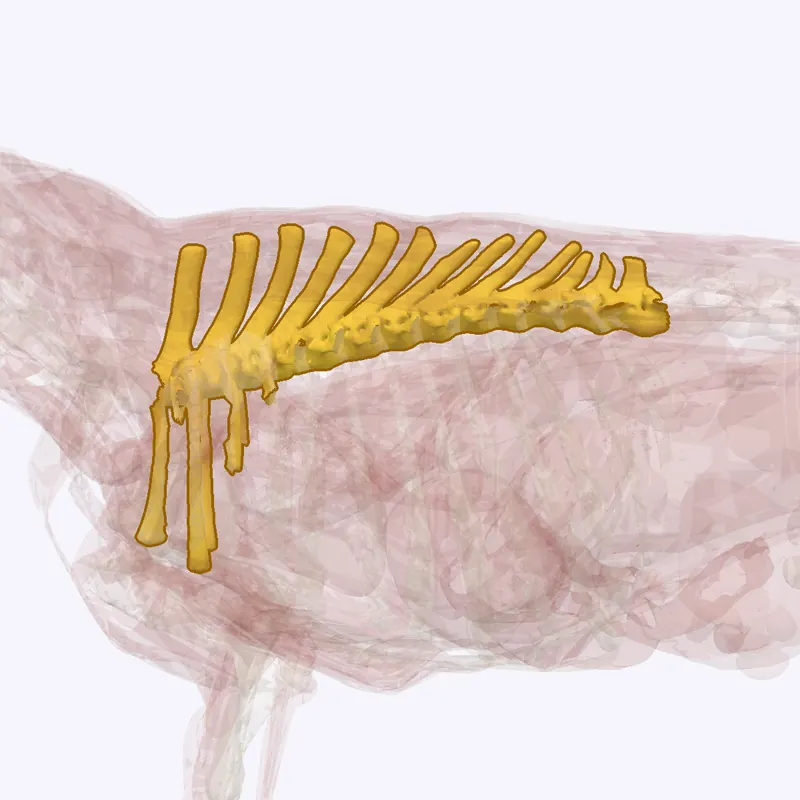
The thirteen vertebrae of the back, each articulating with a pair of ribs. The spinous processes of the first ones are the longest and form the withers.
Key points
- The bovine vertebral formula is C7, T13, L6, S5, Cd18–20.
- The head of each rib articulates with two consecutive vertebrae.
- The spinous processes of the first thoracic vertebrae form the bony base of the withers.
- In the withers pinch test, resistance or a grunt suggests cranial abdominal pain.
- An arched back is a non-specific sign of abdominal pain or lameness.
Overview
Cattle have thirteen thoracic vertebrae. The vertebral formula is C7, T13, L6, S5, Cd18–20. Together with the ribs and the sternum they form the rib cage.
Their bodies are short and their spinous processes long and plate-like. Those of the first thoracic vertebrae form the bony base of the withers (regio interscapularis), between the dorsal borders of the scapulae.
Key features
- Body (corpus vertebrae). Short, with cranial and caudal costal foveae. The head of each rib articulates with two consecutive vertebrae. The last thoracic vertebra has cranial foveae only.
- Transverse processes. Short, with a transverse costal fovea for the tubercle of the rib of the same number. In the last thoracic vertebrae they carry mamillary processes.
- Spinous processes. Long, broad and flattened, inclined caudally. The longest belong to the first thoracic vertebrae, and they shorten progressively towards the lumbar region. They give attachment to the supraspinous ligament and the epaxial muscles.
- Articular processes. Small, with almost horizontal surfaces. In the last thoracic vertebrae they take the lumbar form.
- Vertebral canal. Relatively narrow. It houses the thoracic spinal cord.
Clinical relevance
- Vertebral body abscesses. In calves, vertebral osteomyelitis secondary to infections such as omphalitis or pneumonia can compress the spinal cord. It causes pelvic limb paresis, ataxia and pain on palpation of the spine.
- Withers pinch test. When the skin over the withers is pinched, a normal cow dips its back. Resistance or a grunt suggests cranial abdominal pain, as in traumatic reticuloperitonitis.
- Back posture. An arched back, or kyphosis, is a non-specific sign of abdominal pain or lameness in cattle.
Related structures
See it in 3D on your iPhone
Peel the layers, spin the model, quiz yourself on it and stand it on your desk in AR. AnatomyCompass is coming to iPhone, iPad and Mac: get one email when it’s out.
More of the Cow: Skeletal system
Text adapted from Vet Atlas (CC BY-SA 4.0). 3D model: "Skelet jonge koe | skeleton young cow (800-1000)" by Archeologiemuseum Huis van Hilde (Sketchfab) (CC BY-SA 4.0). Sources and licences. This veterinary text has not yet been reviewed by a veterinarian.