 AnatomyCompass
Lumbar vertebrae
Vertebrae lumbales · Cow · Skeletal system · Axial skeleton
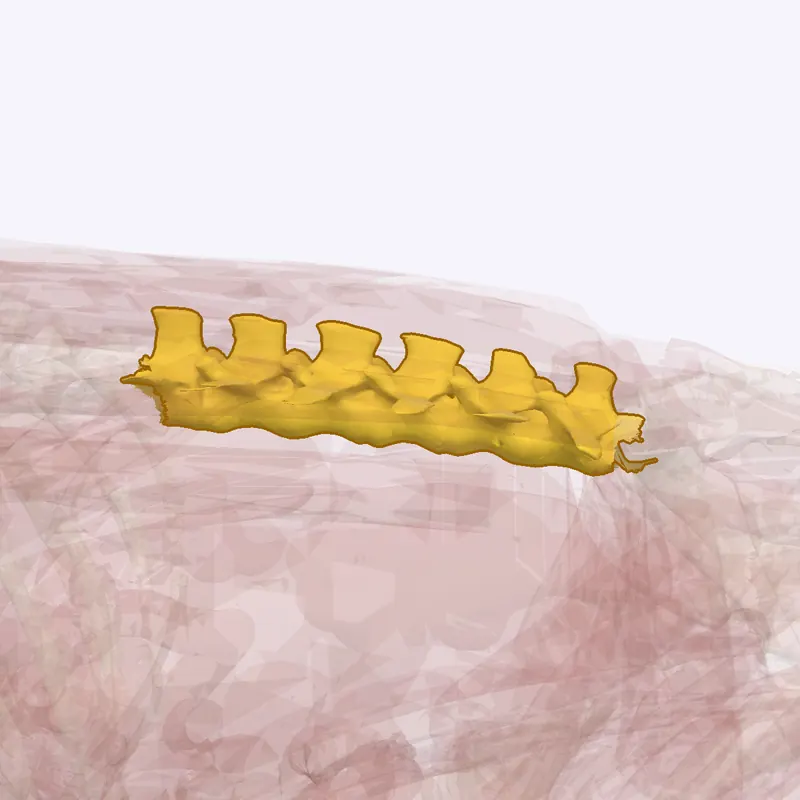
The six vertebrae of the lumbar region, between the thorax and the sacrum. Their very long, flat and horizontal transverse processes are palpable under the skin and are landmarks for body condition scoring and paravertebral anaesthesia.
Key points
- Cattle have six lumbar vertebrae.
- The tips of the transverse processes form the dorsal boundary of the paralumbar fossa.
- Paravertebral anaesthesia blocks T13, L1 and L2 for standing laparotomy.
- The lumbosacral space, caudal to the spinous process of L6, is used to collect cerebrospinal fluid.
- In old bulls, ankylosing spondylosis fuses vertebrae that can fracture during mounting.
Overview
Cattle have six lumbar vertebrae. They form the skeleton of the loin between the last rib and the sacrum. Their bodies are longer than those of the thoracic vertebrae.
They support the epaxial and sublumbar muscles and transmit the thrust of the pelvic limbs to the trunk.
Key features
- Transverse processes (processus transversi). Very long, plate-like and horizontal, longest in the middle of the series. Their tips are palpable under the skin and form the dorsal boundary of the paralumbar fossa, the flank, which is bounded cranially by the last rib. The sublumbar muscles attach to their ventral surface.
- Spinous processes. Broad and sturdy. Their dorsal border is palpable on the midline of the loin.
- Articular processes. The concave cranial ones embrace the convex caudal ones of the vertebra in front. This interlocking limits rotation and lateral bending. The cranial ones carry mamillary processes.
- Lumbosacral space. Between the arch of L6 and the sacrum. It is palpable as a midline depression caudal to the spinous process of L6.
Clinical relevance
Body condition
The tips of the transverse processes and the spinous processes are palpated or inspected to score body condition. They are prominent in a thin cow and covered with fat in a fat one.
Paravertebral anaesthesia
It anaesthetises the flank for standing laparotomy: caesarean section, abomasal surgery or rumenotomy. It blocks the T13, L1 and L2 nerves.
- Proximal technique. Blocks the nerves as they leave the intervertebral foramina. The landmark is the cranial border of the transverse processes of L1, L2 and L3.
- Distal technique. Blocks them at the tips of the transverse processes of L1, L2 and L4.
Lumbosacral space
Puncture site for collecting cerebrospinal fluid in the standing animal and for lumbosacral epidural anaesthesia.
Other diseases
- Vertebral body abscesses, in calves.
- Ankylosing spondylosis, in old bulls. The fused vertebrae can fracture, for example during mounting.
Related structures
See it in 3D on your iPhone
Peel the layers, spin the model, quiz yourself on it and stand it on your desk in AR. AnatomyCompass is coming to iPhone, iPad and Mac: get one email when it’s out.
More of the Cow: Skeletal system
Text adapted from Vet Atlas (CC BY-SA 4.0). 3D model: "Skelet jonge koe | skeleton young cow (800-1000)" by Archeologiemuseum Huis van Hilde (Sketchfab) (CC BY-SA 4.0). Sources and licences. This veterinary text has not yet been reviewed by a veterinarian.