 AnatomyCompass
Tail muscles
Mm. sacrocaudales · Cat · Muscular system · Trunk
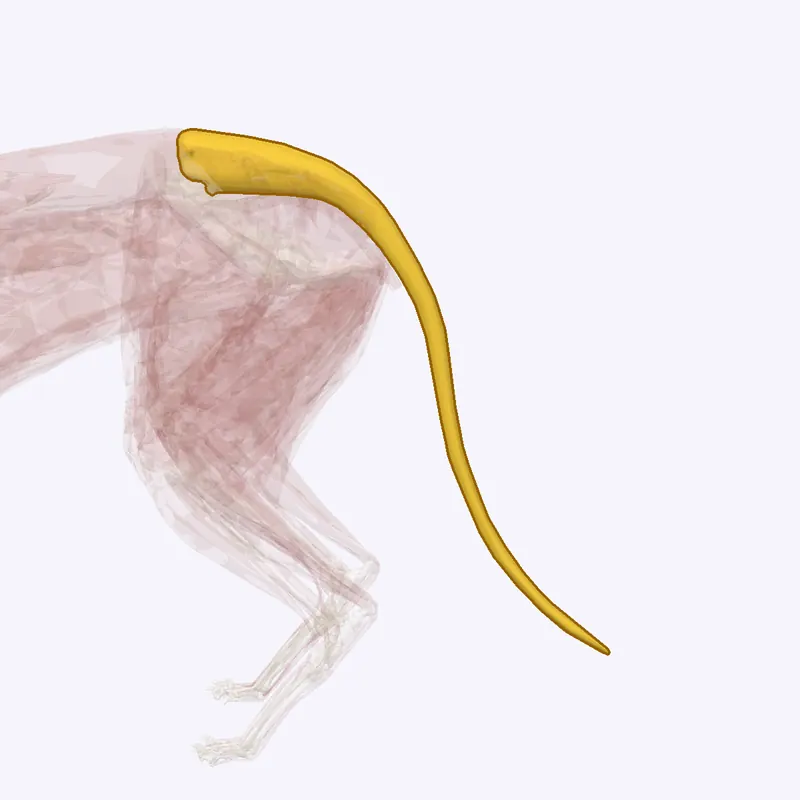
Long muscles along the caudal vertebrae that raise, lower and swing the tail.
Key points
- The dorsal sacrocaudal muscles continue the epaxial muscles into the tail and raise it.
- The ventral sacrocaudal muscles lower it.
- The intertransversarii between them swing it from side to side.
- A tail-pull injury can stretch the nerves of the cauda equina, with tail paralysis and incontinence.
Overview
Several long muscles run along the tail, each made of segments that end on the caudal vertebrae by long tendons:
- Dorsal sacrocaudal muscles (mm. sacrocaudales dorsales medialis et lateralis), the continuation of the epaxial muscles.
- Ventral sacrocaudal muscles (mm. sacrocaudales ventrales medialis et lateralis).
- Intertransversarii (mm. intertransversarii dorsales et ventrales caudae), between the transverse processes.
The tail is important to the cat for balance and as a signal of mood.
Origin and insertion
Sacrum and caudal vertebrae; each segment ends on a vertebra further along the tail.
Action
The dorsal muscles raise the tail, the ventral ones lower it, and those of one side bend it to that side.
Innervation
Dorsal and ventral branches of the caudal nerves.
Clinical relevance
When the tail is caught or pulled, the sacrocaudal region can be fractured or luxated and the nerves of the cauda equina stretched. The tail then hangs limp and is insensitive, and there may be urinary and faecal incontinence.
3D model
The model shows the tail muscles as one mass around the caudal vertebrae.
Related structures
See it in 3D on your iPhone
Peel the layers, spin the model, quiz yourself on it and stand it on your desk in AR. AnatomyCompass is coming to iPhone, iPad and Mac: get one email when it’s out.
More of the Cat: Muscular system
Text adapted from Vet Atlas (CC BY-SA 4.0). 3D model: "Feline Ecorche Dec" by westerly (Sketchfab) (CC BY 4.0). Sources and licences. This veterinary text has not yet been reviewed by a veterinarian.