 AnatomyCompass
Infraspinatus contracture
Traumatic · Dog
Fibrosis and shortening of the infraspinatus muscle after a strain, typically in active hunting and working dogs. The shoulder becomes fixed in external rotation and the limb swings outward when the dog walks.
Key points
- It starts with an acute strain of the muscle during strenuous exercise.
- The initial lameness is painful and improves over one to four weeks; the chronic one is painless.
- The infraspinatus inserts on the greater tubercle of the humerus and is supplied by the suprascapular nerve.
- Radiographs are usually normal; ultrasound or MRI shows the fibrotic muscle.
- Tenotomy of the tendon at its insertion releases the shoulder immediately.
What it is
Infraspinatus contracture is a fibrotic shortening of the infraspinatus muscle.
It is believed to start with an acute strain or partial tear of the muscle during strenuous exercise. The injured muscle fibres are replaced by fibrous tissue, which contracts over the following weeks. The muscle can no longer lengthen.
As a result, the shoulder stays in external rotation and abduction, and its range of motion is restricted.
Who it affects
Active dogs, especially hunting and working breeds. It can be unilateral or bilateral.
Anatomy involved
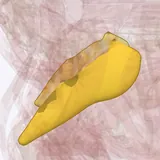
The infraspinatus (m. infraspinatus) fills the infraspinous fossa of the scapula, caudal to the spine. It inserts by a strong tendon on the lateral surface of the greater tubercle of the humerus.
It acts as a lateral collateral ligament of the shoulder and rotates the arm outward. It also flexes or extends the shoulder depending on the position of the joint.
It is innervated by the suprascapular nerve.
Clinical signs
Initial phase
Sudden lameness and pain over the shoulder after exercise, which improves over one to four weeks.
Chronic phase
Weeks later, a non-painful lameness with a typical posture appears:
- at rest, the elbow is held adducted and the paw turned outward, abducted and externally rotated
- when walking, the lower limb swings outward in an arc (circumduction) during the swing phase
- atrophy of the muscle over the scapula is visible
- full flexion of the shoulder is restricted
Diagnosis
- History, posture and gait are typical, and shoulder motion is restricted on manipulation. Flexing the shoulder and elbow makes the distal limb rotate outward.
- Ultrasound or MRI shows the fibrotic muscle.
- Radiographs are usually normal and serve to rule out other shoulder diseases.
Treatment
Tenotomy of the infraspinatus tendon at its insertion on the greater tubercle releases the shoulder. The range of motion and the gait usually improve immediately, on the operating table.
Removal of part of the fibrotic tendon is sometimes added.
Prognosis after surgery is excellent, and most dogs return to full function.
Structures affected
References
- Fossum TW. Small Animal Surgery, 5th ed. Elsevier (2018)
- Piermattei DL, Flo GL, DeCamp CE. Brinker, Piermattei and Flo's Handbook of Small Animal Orthopedics and Fracture Repair, 4th ed. Saunders (2006)
- Merck Veterinary Manual: Muscular Trauma in Dogs and Cats
- IMAIOS vet-Anatomy: Infraspinatus muscle
- Devor M, Sørby R. Fibrotic contracture of the canine infraspinatus muscle: pathophysiology and prevention by early surgical intervention. Vet Comp Orthop Traumatol 19:117-121 (2006)
- Franch J, Bertran J, Remolins G, et al. Simultaneous bilateral contracture of the infraspinatus muscle. Vet Comp Orthop Traumatol 22:249-252 (2009)
- Orellana-James NG, Ginja MM, Regueiro M, et al. Sub-acute and chronic MRI findings in bilateral canine fibrotic contracture of the infraspinatus muscle. J Small Anim Pract 54:428-431 (2013)
- Dillon EA, Anderson LJ, Jones BR. Infraspinatus muscle contracture in a working dog. N Z Vet J 37:32-34 (1989)
See it in 3D on your iPhone
Peel the layers, spin the model, quiz yourself on it and stand it on your desk in AR. AnatomyCompass is coming to iPhone, iPad and Mac: get one email when it’s out.
Text adapted from Vet Atlas (CC BY-SA 4.0). Sources and licences. This veterinary text has not yet been reviewed by a veterinarian.