 AnatomyCompass
Feline injection-site sarcoma
Neoplastic · Cat
Malignant soft-tissue sarcoma that develops where a vaccine or another product was injected, months or years earlier. It is highly infiltrative and recurs easily; it is prevented by vaccinating in the distal limbs or the tail.
Key points
- It is linked mainly to adjuvanted vaccines.
- Biopsy follows the 3-2-1 rule, before any surgery.
- The first surgery has the best chance of cure.
- Radical excision is recommended, with lateral margins of about 5 cm and two fascial planes.
- Vaccinate in the distal limbs or the tail, never in the interscapular region.
What it is
Feline injection-site sarcoma (FISS) is a malignant mesenchymal tumour that arises at an injection site.
It is linked mainly to adjuvanted vaccines, historically inactivated rabies and feline leukaemia vaccines. It also follows other products, such as long-acting antibiotics or corticosteroids.
Chronic local inflammation in certain predisposed cats is thought to drive a proliferation of fibroblasts and myofibroblasts that eventually becomes malignant.
Histologically it is usually a fibrosarcoma, although other sarcomas are seen. It is more aggressive than feline sarcomas unrelated to injections.
Behaviour
The tumour grows in a highly infiltrative way. It sends microscopic projections along fascial planes far beyond the palpable mass.
This is why surgery with narrow margins almost always leaves tumour behind and recurrence is the rule.
A proportion of cases metastasise, mainly to the lung and then to regional lymph nodes.
Who it affects
Adult cats, at a variable interval after the injection, from months to years.
It is uncommon relative to the number of vaccines given, but the risk justifies prevention measures.
Anatomy involved
It presents as a firm subcutaneous mass, attached to deeper planes.
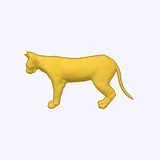
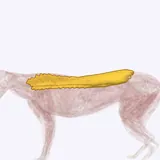
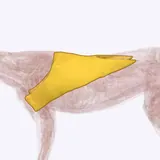
The classic site is the interscapular region, because vaccines used to be given there. The tumour can invade the underlying fascia and muscles, the spinous processes of the thoracic vertebrae and the scapula.
Other injection sites are the thoracic wall, the abdominal wall and the limbs.
Clinical signs
A firm mass, painless, subcutaneous or intramuscular, at an injection site that persists or grows and is often not freely movable.
Systemic signs appear only in advanced stages or with metastasis.
Diagnosis
3-2-1 rule
Biopsy any mass at an injection site that:
- persists more than 3 months after injection
- is larger than 2 cm
- is still growing 1 month after injection
Biopsy and imaging
- Incisional biopsy, core or wedge, before surgery. It is placed so that the tract can be removed later.
- Excising the mass without a prior diagnosis is not recommended, because it compromises curative surgery.
- Contrast-enhanced computed tomography to assess the true extent and plan surgery or radiotherapy.
- Thoracic radiographs or CT to look for metastases.
Treatment
The first surgery has the best chance of cure.
Radical excision is recommended, with lateral margins of about 5 cm and two fascial planes deep. It often includes resecting muscle, spinous processes, part of the scapula or of the thoracic or abdominal wall. On a limb, amputation.
Marginal excisions have very high recurrence rates.
- Radiotherapy before or after surgery improves local control.
- Chemotherapy, with doxorubicin among others, is used as an adjunct or for palliation, with limited benefit.
The prognosis improves greatly with early radical surgery. Recurrent tumours have a worse prognosis.
Prevention
- give only the vaccines the cat needs according to its risk, at appropriate intervals
- choose non-adjuvanted vaccines where available
- inject in the distal limbs, below the stifle or elbow, or in the tail
- never inject in the interscapular region
That way, a tumour could be removed completely.
Key studies
Frequency, risk and prevention
- Emdin et al. (2026). A systematic review and meta-analysis of 8 studies covering more than 14 million vaccinations and 411 sarcomas. The pooled incidence was 8.8 cases per 100,000 vaccinations (95% CI 0.8–100.6), about 1 in 10,000. Differences between studies were very large and the certainty of the evidence was very low.
- ABCD guidelines (Hartmann et al., 2015). They consider chronic inflammation the trigger and put the metastasis rate at 10–28%. The risk is higher with adjuvanted vaccines and lower with modified-live and recombinant vaccines, although no vaccine is risk-free. They recommend vaccinating as often as necessary but as rarely as possible, preferring non-adjuvanted vaccines, injecting where surgery could be curative and avoiding the interscapular region.
- Srivastav et al. (2012). A case-control study of 181 cats with sarcoma and two control groups. In the interscapular region, cases had more often received long-acting corticosteroids. In the pelvic limbs, cases were much less likely to have received recombinant rather than inactivated rabies vaccine (OR 0.1). No vaccine was risk-free.
- Shaw et al. (2009). 392 sarcomas at potential injection sites, before and after the 1996 recommendations of the North American Vaccine-Associated Feline Sarcoma Task Force. The interscapular proportion fell from 53.4% to 39.5% and tumours on the limbs increased, but so did tumours on the lateral abdominal wall, which are harder to remove, probably from injections aimed at the pelvic limb but given too high.
Surgery
- Phelps et al. (2011). 91 cats treated with radical excision with 5 cm margins alone. 14% had local recurrence and 20% metastasis; median survival was 901 days (1461 without recurrence and 499 with it). 10 cats had major complications, mostly wound dehiscence.
- Müller and Kessler (2018). 131 cats operated with lateral margins of at least 3 cm and two fascial planes deep (or full-thickness body wall). 38.1% recurred: 30.5% when tumour-bed biopsies contained no tumour and 76.2% when they did. Operating on a recurrence carried a worse prognosis than operating on a new tumour (further recurrence in 55.5% versus 33.3%). The two studies differ in margins and population, so their rates are not directly comparable.
Structures affected
References
- Hartmann K, Day MJ, Thiry E, et al. Feline injection-site sarcoma: ABCD guidelines on prevention and management. J Feline Med Surg 17:606-613 (2015)
- Phelps HA, Kuntz CA, Milner RJ, Powers BE, Bacon NJ. Radical excision with five-centimeter margins for treatment of feline injection-site sarcomas: 91 cases (1998-2002). J Am Vet Med Assoc 239:97-106 (2011)
- Stone AES, Brummet GO, Carozza EM, et al. 2020 AAHA/AAFP Feline Vaccination Guidelines. J Feline Med Surg 22:813-830 (2020)
- Vail DM, Thamm DH, Liptak JM. Withrow and MacEwen's Small Animal Clinical Oncology, 6th ed. Elsevier (2020)
- Emdin F, Naro SG, Hoang PM, et al. The incidence of vaccine-associated sarcomas in cats: a systematic review and meta-analysis. J Small Anim Pract (online ahead of print) (2026)
- Srivastav A, Kass PH, McGill LD, et al. Comparative vaccine-specific and other injectable-specific risks of injection-site sarcomas in cats. J Am Vet Med Assoc 241:595-602 (2012)
- Shaw SC, Kent MS, Gordon IK, et al. Temporal changes in characteristics of injection-site sarcomas in cats: 392 cases (1990-2006). J Am Vet Med Assoc 234:376-380 (2009)
- Müller N, Kessler M. Curative-intent radical en bloc resection using a minimum of a 3 cm margin in feline injection-site sarcomas: a retrospective analysis of 131 cases. J Feline Med Surg 20:509-519 (2018)
- Hartmann K, Egberink H, Möstl K, et al. Feline Injection-Site Sarcoma and Other Adverse Reactions to Vaccination in Cats. Viruses 15:1708 (2023)
- Zabielska-Koczywąs K, Wojtalewicz A, Lechowski R. Current knowledge on feline injection-site sarcoma treatment. Acta Vet Scand 59:47 (2017)
- Saba CF. Vaccine-associated feline sarcoma: current perspectives. Vet Med (Auckl) 8:13-20 (2017)
See it in 3D on your iPhone
Peel the layers, spin the model, quiz yourself on it and stand it on your desk in AR. AnatomyCompass is coming to iPhone, iPad and Mac: get one email when it’s out.
Text adapted from Vet Atlas (CC BY-SA 4.0). Sources and licences. This veterinary text has not yet been reviewed by a veterinarian.