 AnatomyCompass
Feline herpesvirus keratoconjunctivitis
Infectious · Cat
Ocular infection with feline herpesvirus type 1, which remains latent for life and reactivates with stress. It causes conjunctivitis and dendritic corneal ulcers, and in adult cats stromal keratitis, corneal sequestrum and eosinophilic keratitis.
Key points
- The virus stays latent in the trigeminal ganglion and the cat is a lifelong carrier.
- Dendritic ulcers are considered pathognomonic for herpesvirus.
- A positive PCR does not prove that the virus causes the signs.
- Never perform grid or punctate keratotomy in cats, because it predisposes to sequestrum.
- L-lysine is not effective, according to a systematic review.
What it is
Feline herpesvirus type 1 (FHV-1) is one of the main agents of the feline respiratory disease complex and the most important cause of corneal ulceration in the cat.
It spreads by direct contact with ocular, nasal and oral secretions.
After the initial infection the virus becomes latent in the trigeminal ganglion. Probably every cat that goes through primary infection remains a carrier for life.
Stress can reactivate it: moving to a new environment, giving birth and lactation, or corticosteroid treatment. The virus is then shed again in eye and nasal secretions, with new episodes of disease or without signs.
How lesions arise
- the virus's direct cytopathic effect on the epithelium, which causes conjunctivitis and dendritic ulcers
- the cat's immune response to viral antigen in the corneal stroma, which causes stromal keratitis
Associated eye diseases
Corneal sequestrum is a dark plaque of degenerated stroma, unique to the cat. It occurs in all breeds but may be more frequent in Persians and Siamese.
Eosinophilic, or proliferative, keratitis has been linked to FHV-1 in the cornea or blood, although some affected cats are FHV-1 negative.
Who it affects
Kittens and cats in shelters, catteries or colonies, where the virus circulates widely, have the primary infection, often with respiratory signs.
Carrier adults have reactivations with recurrent conjunctivitis or keratitis, or chronic immune-mediated stromal keratitis.
Vaccination reduces the severity of signs but does not prevent infection or latency.
Anatomy involved
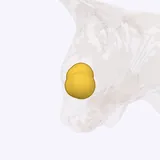
- The conjunctiva shows hyperaemia, chemosis and discharge. The conjunctivitis may start in one eye and become bilateral.
- The corneal epithelium develops dendritic ulcers, linear and branching, pathognomonic for herpesvirus. They can coalesce into geographic ulcers.
- The corneal stroma shows oedema, vascularisation, cellular infiltrates and scarring, and sequestrum in some cats.
- The latent virus resides in the trigeminal ganglion. Corneal hypoaesthesia has been found more often in FHV-1-exposed cats, suggesting damage to the corneal nerves.
Clinical signs
- ocular discomfort
- serous ocular discharge, which becomes purulent with secondary bacterial infection
- conjunctivitis with hyperaemia and chemosis
In kittens these come with sneezing, nasal discharge, salivation, fever, depression and anorexia. Disease is particularly severe in young kittens.
In adults there is keratitis with recurrent ulcers, vascularisation, corneal opacity or the dark spot of a sequestrum.
Diagnosis
- Fluorescein stain and rose bengal. Dendritic ulcers are considered pathognomonic.
- PCR of conjunctival, corneal or oropharyngeal samples, taken before fluorescein or topical anaesthetic is applied. It is the preferred test, but it also detects low-level shedding in carrier cats, so a positive result does not prove that the virus causes the signs. Quantitative PCR helps interpret it.
- Cytology of the conjunctiva or cornea, which shows eosinophils in eosinophilic keratitis.
- Slit-lamp examination and Schirmer tear test.
Treatment
Antivirals
- oral famciclovir in moderate to severe cases
- topical antivirals such as cidofovir, ganciclovir, idoxuridine or trifluridine, several times a day
Other measures
- topical antibiotics to prevent secondary bacterial infection of ulcers, and treatment for Chlamydia felis or Mycoplasma if suspected
- corneal sequestrum is treated by keratectomy and, if deep, a graft
- stress is reduced to limit reactivations
What not to do
- Grid or punctate keratotomy must not be performed in cats, because it predisposes to corneal sequestrum.
- Corticosteroids are avoided in acute disease and contraindicated while an ulcer is present. Glucocorticoids can also reactivate the latent virus.
- L-lysine was used for years, but a systematic review concluded that it is not effective.
The infection is lifelong and episodes may recur.
Key studies
Antivirals
- Fontenelle et al. (2008). Randomised controlled study in 12 cats experimentally infected with FHV-1. Topical 0.5% cidofovir twice daily for 10 days reduced clinical scores and ocular viral shedding compared with the vehicle alone.
- Thomasy et al. (2011). Randomised placebo-controlled study in 16 experimentally infected cats. Oral famciclovir (90 mg/kg three times daily for 21 days) lowered disease scores from day 4 to day 18, reduced viral shedding and conjunctival inflammation and preserved conjunctival goblet cells. It modelled primary infection, not recurrent disease.
- Ledbetter et al. (2022). Randomised placebo-controlled study in 16 experimentally infected cats. Topical 0.15% ganciclovir gel three times daily and oral famciclovir (90 mg/kg twice daily) reduced ocular disease scores and corneal inflammation to a similar degree; only ganciclovir significantly lowered viral load. The groups had 4 to 6 cats.
- Mironovich et al. (2023). Masked placebo-controlled study in 132 shelter cats positive for FHV-1, treated for 7 days with compounded topical cidofovir, oral famciclovir or topical ganciclovir. Only cidofovir reduced viral load, and no drug improved ocular scores more than placebo (65–75% of cats improved in every group). All corneal ulcers in the placebo group failed to heal, whereas 77% healed with an antiviral. The course was short and the compounded drugs may vary in quality.
- Vernau et al. (2024). Randomised, triple-masked, placebo-controlled trial in 373 kittens with ocular signs of infectious upper respiratory disease, all treated with doxycycline and half also with famciclovir. Fewer kittens developed corneal disease with famciclovir, kittens with mild disease reached clinical resolution 4–5 days sooner, and all 5 kittens withdrawn because they worsened were in the doxycycline-only group.
L-lysine
- Bol and Bunnik (2015). Systematic review of 7 studies on lysine and FHV-1 (2 in vitro, 5 in cats). Lysine had no effect on viral replication and did not prevent or treat infection; some studies found more infection or more severe disease in supplemented cats. The authors recommend stopping its use.
Structures affected
References
- Thiry E, Addie D, Belák S, et al. Feline herpesvirus infection. ABCD guidelines on prevention and management. J Feline Med Surg 11:547-555 (2009)
- Gould D. Feline herpesvirus-1: ocular manifestations, diagnosis and treatment options. J Feline Med Surg 13:333-346 (2011)
- Thomasy SM, Maggs DJ. A review of antiviral drugs and other compounds with activity against feline herpesvirus type 1. Vet Ophthalmol 19 Suppl 1:119-130 (2016)
- Bol S, Bunnik EM. Lysine supplementation is not effective for the prevention or treatment of feline herpesvirus 1 infection in cats: a systematic review. BMC Vet Res 11:284 (2015)
- Fontenelle JP, Powell CC, Veir JK, et al. Effect of topical ophthalmic application of cidofovir on experimentally induced primary ocular feline herpesvirus-1 infection in cats. Am J Vet Res 69:289-293 (2008)
- Thomasy SM, Lim CC, Reilly CM, et al. Evaluation of orally administered famciclovir in cats experimentally infected with feline herpesvirus type-1. Am J Vet Res 72:85-95 (2011)
- Ledbetter EC, Badanes ZI, Chan RX, et al. Comparative efficacy of topical ophthalmic ganciclovir and oral famciclovir in cats with experimental ocular feline herpesvirus-1 epithelial infection. J Ocul Pharmacol Ther 38:339-347 (2022)
- Mironovich MA, Yoon A, Marino ME, et al. Evaluation of compounded cidofovir, famciclovir, and ganciclovir for the treatment of feline herpesvirus ocular surface disease in shelter-housed cats. Vet Ophthalmol 26 Suppl 1:143-153 (2023)
- Vernau KM, Kim S, Thomasy SM, et al. Doxycycline with or without famciclovir for infectious ophthalmic and respiratory disease: a prospective, randomized, masked, placebo-controlled trial in 373 kittens. J Feline Med Surg 26:1098612X241278413 (2024)
- ABCD Europe: Guideline for Feline Herpesvirus infection
- Merck Veterinary Manual: The Conjunctiva in Animals
- Merck Veterinary Manual: The Cornea in Animals
- Merck Veterinary Manual: Physical Examination of the Eye in Animals
See it in 3D on your iPhone
Peel the layers, spin the model, quiz yourself on it and stand it on your desk in AR. AnatomyCompass is coming to iPhone, iPad and Mac: get one email when it’s out.
Text adapted from Vet Atlas (CC BY-SA 4.0). Sources and licences. This veterinary text has not yet been reviewed by a veterinarian.