 AnatomyCompass
Feline aortic thromboembolism
Degenerative · Cat
Sudden obstruction of the terminal aorta by a thrombus that almost always forms in the left atrium of a cat with cardiomyopathy. It causes acute, very painful paralysis of the pelvic limbs, with cold, pulseless extremities.
Key points
- The embolus lodges at the aortic trifurcation, the "saddle" thrombus.
- It is often the first sign of an undiagnosed cardiomyopathy.
- In the ischaemic limb glucose is lower and lactate higher.
- A hypothermic cat has a worse prognosis.
- Lifelong clopidogrel is maintained; in the FAT CAT trial it outperformed aspirin.
What it is
Arterial thromboembolism is the occlusion of an artery by a thrombus that formed elsewhere and travelled in the blood.
In the cat the great majority are cardiogenic. In the dilated left atrium of a cat with cardiomyopathy, above all hypertrophic cardiomyopathy, blood stagnates and a thrombus forms. Endothelial dysfunction and increased platelet activation probably contribute.
When it breaks free, the thrombus usually lodges at the aortic trifurcation, where the aorta divides into the iliac arteries. This is the "saddle" thrombus.
Less often the embolus obstructs another artery:
- a brachial artery, affecting a single thoracic limb, usually the right
- a renal, mesenteric or cerebral artery
A minority of cases are associated with neoplasia, especially of the lung.
Who it affects
Adult cats, more often males, with a cardiomyopathy that has often not been diagnosed. In many cats thromboembolism is the first sign of the heart disease.
The risk rises with:
- left atrial size
- atrial dysfunction
- spontaneous echo contrast or a thrombus on echocardiography
- previous episodes
Anatomy involved
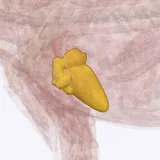
The thrombus forms in the left atrium and auricle.
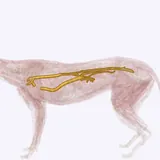
In the terminal abdominal aorta, the embolus lodges at the trifurcation and blocks flow to the external iliac arteries and, from them, to the femoral arteries, which lose their pulse.
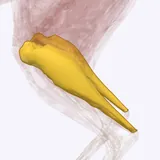
In the pelvic limbs, the gastrocnemius muscles become very firm and painful. The limb nerves are also affected, with lower motor neuron dysfunction, which explains the paralysis.
Clinical signs
Sudden paresis or paralysis of one or both pelvic limbs, with severe pain and vocalisation.
The signs are summed up as the "five Ps":
- paralysis
- pain
- pallor, with pale or cyanotic pads and nail beds
- pulselessness, with no femoral pulse
- poikilothermia, with cold limbs
The gastrocnemius muscles are firm. Tachypnoea is common, from pain, stress or concurrent heart failure.
Cats are often hypothermic, which worsens the prognosis.
Diagnosis
- Diagnosis is mainly clinical: absent femoral pulses, cold limbs and pain in a cat with acute paralysis.
- Glucose and lactate in blood from the affected limb are compared with a normal limb or the central circulation. In the ischaemic limb glucose is lower and lactate higher.
- Doppler or ultrasound of the terminal aorta confirms absent flow.
- Echocardiography assesses the underlying cardiomyopathy, atrial size and residual thrombi. Thoracic radiographs and NT-proBNP assess heart failure.
- On blood work, hyperglycaemia, azotaemia and increased muscle enzymes are common. Electrolytes, especially potassium, must be monitored.
Treatment
Analgesia with opioids is given from the start, with oxygen and treatment of heart failure if present.
Antithrombotic therapy is started with clopidogrel together with an anticoagulant: unfractionated or low-molecular-weight heparin, or a factor Xa inhibitor such as rivaroxaban.
Thrombolysis and surgical removal of the thrombus are little used because of reperfusion injury, in particular life-threatening hyperkalaemia.
Recovery needs nursing care. Motor function, when it returns, can take weeks or months, and distal necrosis may develop.
The prognosis is guarded, and many cats are euthanised at initial presentation. Survival is better when:
- a single limb is affected
- some motor function is preserved
- the cat is not hypothermic
Concurrent heart failure worsens it.
Recurrence is common, so lifelong clopidogrel prophylaxis is maintained. In the FAT CAT trial clopidogrel was superior to aspirin in preventing further episodes.
Key studies
Presentation and prognosis
- Smith et al. (2003). Retrospective study of 127 cats at a referral hospital. Hypothermia (66%) and absent motor function (66%) were common, and 93% of the cats examined had an enlarged left atrium. Of 87 cats treated, 45% survived to discharge. Rectal temperature, heart rate, phosphorus, motor function and the number of limbs affected differed between survivors and non-survivors, and a model based on rectal temperature predicted a 50% probability of survival at 37.2 °C. Median survival after discharge was 117 days, shorter in cats with heart failure (77 versus 223 days).
- Borgeat et al. (2014). Retrospective study of 250 cats in 3 general practices in the United Kingdom. 61.2% were euthanised at presentation. Hypothermia predicted death or euthanasia within 24 hours and, in cats that survived longer, so did not receiving aspirin, clopidogrel or both. Cats that survived 7 days had a median survival of 94 days, and 6 were alive a year later.
Diagnosis
- Klainbart et al. (2014). Prospective controlled study of 22 cats with thromboembolism, 10 cats paralysed for other reasons and 10 ambulatory cats (and dogs in parallel). The difference between systemic glucose and glucose in the affected limb identified thromboembolism well: a difference of 30 mg/dL had 100% sensitivity and 90% specificity in cats.
Treatment and prevention
- Guillaumin et al. (2022, BLASTT). Double-blind, randomised, placebo-controlled trial of tissue plasminogen activator in 40 cats with thromboembolism of 2 or more limbs, treated within 6 hours. Only 20 cats survived to 48 hours. Limb scores, survival to discharge (45% with thrombolysis, 30% with placebo) and complications such as acute kidney injury or reperfusion injury did not differ significantly. The high mortality left the trial with little statistical power.
- Hogan et al. (2015, FAT CAT). Double-blind randomised trial in 75 cats that had survived a cardiogenic thromboembolism. Clopidogrel reduced recurrence compared with aspirin (median time to recurrence 443 versus 192 days) and also the combined outcome of recurrence or cardiac death. Both drugs were well tolerated.
- Brainard et al. (2025, SUPERCAT). Double-masked randomised trial in 45 cats that had recovered from cardiogenic thromboembolism. Recurrence was similar with clopidogrel (7 of 19 cats, 37%) and rivaroxaban (10 of 26, 39%), as was the time to death. The number of cats is small for a comparison of this kind.
Structures affected
References
- Smith SA, Tobias AH, Jacob KA, et al. Arterial thromboembolism in cats: acute crisis in 127 cases (1992-2001) and long-term management with low-dose aspirin in 24 cases. J Vet Intern Med 17:73-83 (2003)
- Borgeat K, Wright J, Garrod O, et al. Arterial thromboembolism in 250 cats in general practice: 2004-2012. J Vet Intern Med 28:102-108 (2014)
- Hogan DF, Fox PR, Jacob K, et al. Secondary prevention of cardiogenic arterial thromboembolism in the cat: The double-blind, randomized, positive-controlled feline arterial thromboembolism; clopidogrel vs. aspirin trial (FAT CAT). J Vet Cardiol 17 Suppl 1:S306-S317 (2015)
- Luis Fuentes V, Abbott J, Chetboul V, et al. ACVIM consensus statement guidelines for the classification, diagnosis, and management of cardiomyopathies in cats. J Vet Intern Med 34:1062-1077 (2020)
- Klainbart S, Kelmer E, Vidmayer B, et al. Peripheral and central venous blood glucose concentrations in dogs and cats with acute arterial thromboembolism. J Vet Intern Med 28:1513-1519 (2014)
- Brainard BM, Coleman AE, Kurosawa A, et al. Therapy with clopidogrel or rivaroxaban has equivalent impacts on recurrence of thromboembolism and survival in cats following cardiogenic thromboembolism: the SUPERCAT study. J Am Vet Med Assoc 263:1-10 (2025)
- Guillaumin J, DeFrancesco TC, Scansen BA, et al. Bilateral lysis of aortic saddle thrombus with early tissue plasminogen activator (BLASTT): a prospective, randomized, placebo-controlled study in feline acute aortic thromboembolism. J Feline Med Surg 24:e535-e545 (2022)
- Merck Veterinary Manual: Arterial Thromboembolism in Dogs and Cats
- Arcuri G, Bresolin P, Guglielmini C. Treatment and Prevention of Cardiogenic Arterial Thromboembolism in the Cat: A Systematic Review. Animals (Basel) 15 (2025)
- Yeh NS, Shaverdian M, Li RHL. Evolving FATE: A New Lens on the Pathogenesis and Management of Feline Cardiogenic Arterial Thromboembolism. Animals (Basel) 15 (2025)
See it in 3D on your iPhone
Peel the layers, spin the model, quiz yourself on it and stand it on your desk in AR. AnatomyCompass is coming to iPhone, iPad and Mac: get one email when it’s out.
Text adapted from Vet Atlas (CC BY-SA 4.0). Sources and licences. This veterinary text has not yet been reviewed by a veterinarian.