 AnatomyCompass
Canine parvoviral enteritis
Infectious · Dog
Severe, highly contagious viral enteritis of puppies caused by canine parvovirus type 2. The virus destroys the intestinal crypts and the bone marrow, causing haemorrhagic diarrhoea, vomiting, leucopenia and sepsis.
Key points
- It mainly affects puppies of 6 weeks to 6 months, as maternal antibodies wane.
- The virus attacks the crypt epithelium, so the villi stop renewing.
- Leucopenia supports the diagnosis and has prognostic value.
- The faecal ELISA can be falsely negative early and positive after vaccination.
- There is no antiviral; with intensive support in hospital most puppies survive.
What it is
Canine parvovirus type 2 (CPV-2, with the variants 2a, 2b and 2c) is a small, non-enveloped DNA virus. It replicates only in rapidly dividing cells.
After oronasal infection it replicates in the lymphoid tissue of the oropharynx and spreads by viraemia. It infects the crypt epithelium of the small intestine, the bone marrow and lymphoid tissues.
Without crypts, the villi are not renewed and collapse. The result is:
- malabsorption
- fluid and protein loss
- breakdown of the mucosal barrier, so intestinal bacteria and endotoxins enter the blood while neutrophils are depleted
The virus is shed in large amounts in faeces. It survives in the environment for months and resists many common disinfectants.
Who it affects
Mainly unvaccinated or incompletely vaccinated puppies between about 6 weeks and 6 months of age, when maternal antibodies wane.
Rottweilers, Dobermanns, American pit bull terriers and German shepherds have been reported to be at higher risk.
Infection of neonates or in utero, now rare, caused myocarditis.
Anatomy involved
The small intestine has thickened, discoloured walls with watery, mucoid or haemorrhagic contents. Histology shows crypt necrosis and villous blunting and sloughing. Intussusception can complicate it.
In the bone marrow and lymphoid tissue, precursors and lymphocytes are destroyed. There is leucopenia and lymphoid depletion of Peyer's patches, lymph nodes and thymus.
Clinical signs
Onset is sudden, with lethargy, anorexia and fever. Profuse vomiting and diarrhoea follow, often haemorrhagic and foul-smelling.
Rapid dehydration, abdominal pain and hypoglycaemia come next. Severe cases develop septic shock with collapse and death.
Diagnosis
- The faecal antigen ELISA, a point-of-care test, is rapid and specific. It may be falsely negative early in the disease or once shedding has dropped, and briefly positive after vaccination with modified live vaccine.
- Faecal PCR is more sensitive.
- On the blood count, leucopenia (neutropenia and lymphopenia) supports the diagnosis and has prognostic value.
- Biochemistry shows hypoglycaemia, hypoalbuminaemia and hypokalaemia.
Treatment
There is no specific antiviral therapy. Treatment is supportive and intensive:
- intravenous fluids with potassium and glucose
- antiemetics, such as maropitant or ondansetron
- early enteral nutrition
- analgesia
- parenteral broad-spectrum antibiotics, to cover bacterial translocation and sepsis
- colloids or plasma for hypoalbuminaemia
With hospital treatment most puppies survive; without it, mortality is high.
Infected dogs are isolated. The environment is disinfected with products that inactivate parvovirus, such as diluted sodium hypochlorite or potassium peroxymonosulfate.
Vaccination, a core vaccine, is the main prevention. The puppy series is completed at 16 weeks or later.
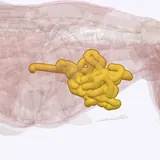
Structures affected
References
- Mylonakis ME, Kalli I, Rallis TS. Canine parvoviral enteritis: an update on the clinical diagnosis, treatment, and prevention. Vet Med (Auckl) 7:91-100 (2016)
- Sykes JE. Greene's Infectious Diseases of the Dog and Cat, 5th ed. Elsevier (2021)
- Merck Veterinary Manual: Canine Parvovirus Infection (Parvoviral Enteritis in Dogs)
See it in 3D on your iPhone
Peel the layers, spin the model, quiz yourself on it and stand it on your desk in AR. AnatomyCompass is coming to iPhone, iPad and Mac: get one email when it’s out.
Text adapted from Vet Atlas (CC BY-SA 4.0). Sources and licences. This veterinary text has not yet been reviewed by a veterinarian.