 AnatomyCompass
Feline alimentary lymphoma
Neoplastic · Cat
Lymphocyte neoplasia affecting the digestive tract and mesenteric lymph nodes. The most common form of lymphoma in the cat.
Key points
- Low-grade lymphoma is almost always of T lymphocytes and resembles inflammatory bowel disease.
- Telling it from enteropathy needs histology, immunophenotype and clonality together, and is sometimes impossible.
- Duodenal biopsies alone can miss lesions in the jejunum and ileum.
- Hypocobalaminaemia is common, and cobalamin is supplemented when it is low.
- Low-grade disease is treated with oral prednisolone and chlorambucil; many cats live for years.
What it is
Lymphoma is the most common tumour of the feline intestine. The alimentary form, or gastrointestinal form, is now the most frequent presentation of feline lymphoma.
Neoplastic lymphocytes infiltrate the wall of the stomach, the small intestine or, less often, the large intestine. They also involve the mesenteric lymph nodes and sometimes the liver.
Several forms with very different behaviour are recognised:
- Low-grade lymphoma, of small cells, is almost always of T lymphocytes. It diffusely infiltrates the small intestinal mucosa, especially in the jejunum and ileum. It progresses slowly and is hard to distinguish from chronic inflammatory bowel disease, from which it may arise in some cases.
- Intermediate- or high-grade lymphoma, of large cells, is of B or T lymphocytes. It forms transmural masses that can obstruct or perforate the intestine, and its course is more aggressive.
- Large granular lymphocyte lymphoma is an aggressive T- or NK-cell variant with an acute course that usually forms intestinal masses.
In the past many feline lymphomas were associated with feline leukaemia virus (FeLV). Today, with vaccination and control of the virus, most cats with alimentary lymphoma are FeLV-negative.
Exposure to tobacco smoke has been linked to lymphoma risk.
Who it affects
Middle-aged to older cats. Median age is 10 to 13 years depending on the form.
Low-grade lymphoma is very uncommon in cats under 8 years.
Anatomy involved
In low-grade lymphoma the wall of the small intestine is diffusely thickened, often with a thickened muscularis propria. In high-grade lymphoma, masses efface the wall layers.
The mesenteric lymph nodes are enlarged and sometimes form a palpable abdominal mass.
Other locations are the stomach, large intestine, liver, spleen and kidneys.
Clinical signs
Chronic weight loss, vomiting, diarrhoea and reduced or occasionally increased appetite.
In the low-grade form signs progress slowly and resemble those of an inflammatory enteropathy.
High-grade forms show anorexia, lethargy, a palpable abdominal mass and signs of obstruction or of peritonitis from perforation.
Diagnosis
- Abdominal palpation finds thickened bowel loops or masses and enlarged mesenteric lymph nodes.
- Blood work often shows hypocobalaminaemia, and there may be hypoalbuminaemia. T4 and kidney function are assessed in older cats.
- Abdominal ultrasound shows wall thickening, loss of layering in masses, muscularis thickening and enlarged lymph nodes. It also guides sampling.
- Aspiration cytology is usually enough for large cell lymphoma.
- Low-grade disease needs endoscopic or full-thickness surgical biopsies, with immunohistochemistry for the B or T immunophenotype and clonality testing (PARR).
According to the 2023 ACVIM consensus, distinguishing low-grade lymphoma from inflammatory enteropathy requires integrating histology, immunophenotype and clonality, and is sometimes not possible with certainty.
Duodenal biopsies alone may miss jejunal and ileal lesions.
Treatment
Low grade
Oral prednisolone and chlorambucil, with cobalamin supplementation when it is low. Most cats respond and many live for years with a good quality of life.
Intermediate or high grade
Multi-agent chemotherapy with COP- or CHOP-type protocols, combining cyclophosphamide, vincristine, doxorubicin and prednisolone. Surgery is needed for obstruction or perforation.
Response is more variable and survival is usually measured in months, although cats that achieve complete remission may live much longer.
Large granular lymphocytes
The prognosis is poor.
Key studies
Low-grade lymphoma versus inflammatory enteropathy
- ACVIM consensus (Marsilio et al., 2023). No single criterion or biomarker reliably separates lymphoplasmacytic enteritis from low-grade intestinal T-cell lymphoma. The diagnosis integrates all clinical and diagnostic data, with histopathology as the mainstay, and most recommendations rest on moderate or low-level evidence.
- Freiche et al. (2021). Prospective cohort of 44 cats, 22 with low-grade lymphoma and 22 with lymphoplasmacytic enteritis. A monomorphic lymphocyte population (22 of 22), deep mucosal infiltration (68%) and epithelial nests or plaques (50% versus 5%) pointed to lymphoma. Clonality testing found monoclonality in 86% of the lymphomas, but also in 70% of the cats with enteritis (40% monoclonal, 30% monoclonal on a polyclonal background). A clonal result does not prove lymphoma on its own.
- Evans et al. (2006). Prospective study of 22 cats sampled by endoscopy and then by full-thickness surgical biopsy. All 10 cats with lymphoma had it in the jejunum and ileum, and 9 in the duodenum. Endoscopic biopsies confirmed it in 3, were inconclusive in 3 and led to a wrong diagnosis of inflammatory bowel disease in 4.
- Scott et al. (2011). Retrospective study of 70 cats with endoscopic biopsies of both the duodenum and the ileum. Of the 18 with small cell lymphoma, 39% had it only in the duodenum and 44% only in the ileum, and agreement between the two sites was poor (kappa 0.23). A single pathologist reviewed the samples.
Treatment and outcome
- Kiselow et al. (2008). Retrospective series of 41 cats with low-grade lymphoma, confined to the gastrointestinal tract in 68%, treated with prednisone and chlorambucil. 56% achieved a complete response and 39% a partial response, and median survival was 704 days. 78% of the cats tested had low cobalamin.
- Bernardo Marques et al. (2024). Multicentre retrospective study of 57 cats with high-grade or large granular lymphocyte alimentary lymphoma treated with COP- or CHOP-based protocols. Complete response was 20%, overall response 42% and median survival 131 days. Diffuse infiltration of the gastrointestinal tract and involvement of a non-haematopoietic organ were negative prognostic factors.
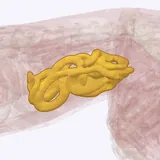
Structures affected
References
- Barrs VR, Beatty JA. Feline alimentary lymphoma: 1. Classification, risk factors, clinical signs and non-invasive diagnostics. J Feline Med Surg 14:182-190 (2012)
- Barrs VR, Beatty JA. Feline alimentary lymphoma: 2. Further diagnostics, therapy and prognosis. J Feline Med Surg 14:191-201 (2012)
- Marsilio S, Freiche V, Johnson E, et al. ACVIM consensus statement guidelines on diagnosing and distinguishing low-grade neoplastic from inflammatory lymphocytic chronic enteropathies in cats. J Vet Intern Med 37:794-816 (2023)
- Vail DM, Thamm DH, Liptak JM. Withrow and MacEwen's Small Animal Clinical Oncology, 6th ed. Elsevier (2020)
- Freiche V, Paulin MV, Cordonnier N, et al. Histopathologic, phenotypic, and molecular criteria to discriminate low-grade intestinal T-cell lymphoma in cats from lymphoplasmacytic enteritis. J Vet Intern Med 35:2673-2684 (2021)
- Evans SE, Bonczynski JJ, Broussard JD, et al. Comparison of endoscopic and full-thickness biopsy specimens for diagnosis of inflammatory bowel disease and alimentary tract lymphoma in cats. J Am Vet Med Assoc 229:1447-1450 (2006)
- Scott KD, Zoran DL, Mansell J, et al. Utility of endoscopic biopsies of the duodenum and ileum for diagnosis of inflammatory bowel disease and small cell lymphoma in cats. J Vet Intern Med 25:1253-1257 (2011)
- Kiselow MA, Rassnick KM, McDonough SP, et al. Outcome of cats with low-grade lymphocytic lymphoma: 41 cases (1995-2005). J Am Vet Med Assoc 232:405-410 (2008)
- Bernardo Marques G, Ponce F, Beaudu-Lange C, et al. Feline high-grade and large granular lymphocyte alimentary lymphomas treated with COP- or CHOP-based chemotherapy: a multi-centric retrospective study of 57 cases. Vet Comp Oncol 22:186-197 (2024)
- Merck Veterinary Manual: Gastrointestinal Neoplasia in Dogs and Cats
- Merck Veterinary Manual: Lymphoma in Dogs
See it in 3D on your iPhone
Peel the layers, spin the model, quiz yourself on it and stand it on your desk in AR. AnatomyCompass is coming to iPhone, iPad and Mac: get one email when it’s out.
Text adapted from Vet Atlas (CC BY-SA 4.0). Sources and licences. This veterinary text has not yet been reviewed by a veterinarian.