 AnatomyCompass
Sternocephalicus
M. sternocephalicus · Cow · Muscular system · Neck
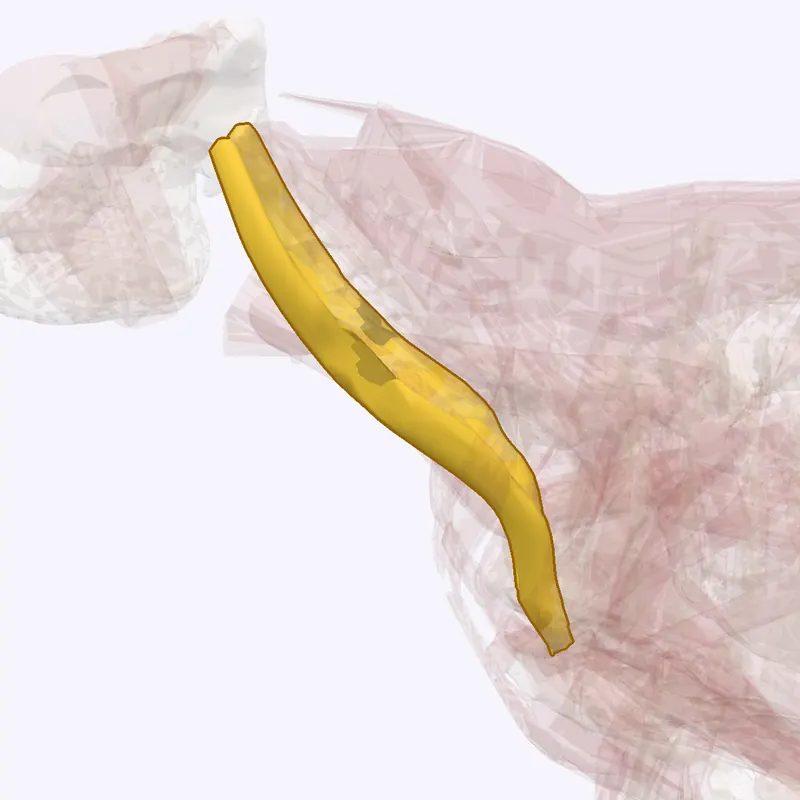
Long muscle of the ventrolateral neck, from the sternum to the head; in cattle it has two parts.
Key points
- The sternomandibularis ends on the mandible and the sternomastoideus on the mastoid process.
- It is supplied by the ventral branch of the accessory nerve.
- It forms the ventral border of the jugular groove.
- The external jugular vein in this groove is used to draw blood and give calcium for milk fever.
Overview
It arises on the manubrium of the sternum and runs along the ventrolateral neck to the head. In cattle it divides into two parts:
- Sternomandibularis (pars mandibularis). The more superficial. It ends on the mandible.
- Sternomastoideus (pars mastoidea). Deep. It ends in the region of the mastoid process.
Origin
Manubrium of the sternum.
Insertion
- Sternomandibularis: ventral border of the mandible, next to the rostral border of the masseter.
- Sternomastoideus: mastoid process of the temporal bone.
Action
Draws the head and neck ventrally or to the same side.
Innervation
Ventral branch of the accessory nerve (n. accessorius).
Clinical relevance
It forms the ventral border of the jugular groove.
In cattle, the external jugular vein, which runs in this groove, is used for drawing blood and for intravenous medication. One example is calcium for periparturient hypocalcaemia, or milk fever.
Related structures
See it in 3D on your iPhone
Peel the layers, spin the model, quiz yourself on it and stand it on your desk in AR. AnatomyCompass is coming to iPhone, iPad and Mac: get one email when it’s out.
Text adapted from Vet Atlas (CC BY-SA 4.0). 3D model: Vet Atlas procedural musculature (CC BY-SA 4.0). Sources and licences. This veterinary text has not yet been reviewed by a veterinarian.